


 русский
 Español
An EDM machine, also called an electrical discharge machining machine, uses controlled sparks to erode electrically conductive metal without direct contact between the tool and the workpiece. The workpiece is submerged in a diele...
READ MORE
What Is an EDM Machine? A Practical Guide to Electrical Discharge Machining
Content
- 1 How Does an EDM Machine Work? The Spark Erosion Principle
- 2 The Three Main Types of EDM Machines Actually Used in Production
- 3 What Is an EDM Machine Used For? Real Applications Across Industry
- 4 EDM vs Conventional CNC Machining: Which One Should Your Workshop Use?
- 5 What to Check Before Buying an EDM Machine
- 6 Cost Expectations and Operating Budget
- 7 Frequently Asked Questions About EDM Machines
- 7.1 What materials can an EDM machine process?
- 7.2 How accurate is an EDM machine?
- 7.3 What is the difference between wire EDM and die-sinking EDM?
- 7.4 How do you select the right electrode material?
- 7.5 Is EDM faster or slower than CNC milling?
- 7.6 Can EDM machines work without a CNC system?
- 7.7 How long does an EDM electrode last?
An EDM machine, also called an electrical discharge machining machine, uses controlled sparks to erode electrically conductive metal without direct contact between the tool and the workpiece. The workpiece is submerged in a dielectric fluid, and the tool acts as one electrode while the workpiece acts as the other. Thousands of high-frequency discharges per second melt and vaporize tiny amounts of material, creating the shape that you need.
If you have ever needed to cut a hardened die, drill a small hole in a turbine blade, or produce a complex cavity in tool steel, an EDM machine is very likely the correct answer. This guide explains what an EDM machine is, how spark erosion works, the main types available, where they are used in real production, and the specifications you should verify before making a purchase decision. The direct conclusion is simple: EDM is a non-contact machining process that removes material through electrical discharge in a liquid medium, and it remains the most practical choice for hard metals, deep cavities, and high-precision geometry.
How Does an EDM Machine Work? The Spark Erosion Principle
EDM is not a subtractive process in the way that milling or turning is. There is no physical tool breaking into the workpiece. Instead, a precisely controlled electrical field is built between an electrode and the workpiece. When the gap between them becomes small enough, the dielectric fluid breaks down, and a spark jumps across the gap. The spark generates localized heat that is higher than the melting point of the workpiece material. A tiny crater is formed on the workpiece surface, and the vaporized material is flushed away by the fluid.
The flushing action is critical. The dielectric fluid not only insulates the gap but also removes debris and cools the surfaces. A standard EDM cycle repeats this discharge process thousands of times per second. Each discharge removes a microscopic amount of material, giving the process exceptional dimensional control while affecting the workpiece structure far less than conventional cutting methods. There are four essential components of every EDM machine:
- Pulse generator: The power supply that creates a controlled sequence of voltage pulses. Its frequency, current amplitude, and pulse duration determine the material removal rate and surface finish.
- Electrode: The tool that shapes the cavity. It can be made from copper, graphite, brass, or other conductive material, depending on the application.
- Dielectric fluid: A non-conductive liquid, usually deionized water or hydrocarbon oil, that separates the electrode from the workpiece and flushes away particles.
- Servo control system: A closed-loop controller that maintains a constant spark gap by moving the electrode or workpiece in precise increments. If the gap is too wide, the spark cannot strike; if it is too narrow, a short circuit can occur.
In practice, the servo control is often overlooked by buyers, but it is one of the most important factors behind repeatable part quality. A good servo system reacts in fractions of a second to uneven surfaces, preventing overheating and electrode wear. If you want a more technical breakdown of the process, you can read our full electrical discharge machining knowledge guide, which covers the physics in more detail.
The Three Main Types of EDM Machines Actually Used in Production
When people ask what an EDM machine is, they are usually asking about one of three common categories. Each type solves a different problem, and knowing the distinction helps you decide whether you need one, two, or all three systems.
| Type | Tool / Electrode | Best For | Typical Surface Finish | Material Removal Rate |
|---|---|---|---|---|
| Die-Sinking EDM | Custom-shaped electrode made of graphite or copper | Complex cavities, injection molds, forging dies | Ra 0.1 µm achievable | Lower, but depends on pulse settings |
| Wire EDM | Spool of brass or coated wire | Cutting plates, punches, gears, and precise contours | Ra 0.2 µm achievable | Medium |
| Small-Hole / Drill EDM | Hollow rotating tube electrode | Cooling holes, start holes for wire EDM, aerospace parts | Ra 0.4 µm typical | Fast for deep, small holes |
The die-sinking category includes single-axis and 3-axis CNC versions. Manual machines are still used, but CNC-controlled models allow you to program electrode paths, automate changes, and hold much tighter tolerances. For general mold work, a 3-axis CNC die-sinking machine is the typical entry point because it handles side electrodes and complex positioning with minimal operator input. If your parts involve deep small holes or cooling channels, a small-hole EDM is a separate machine that performs a different job.
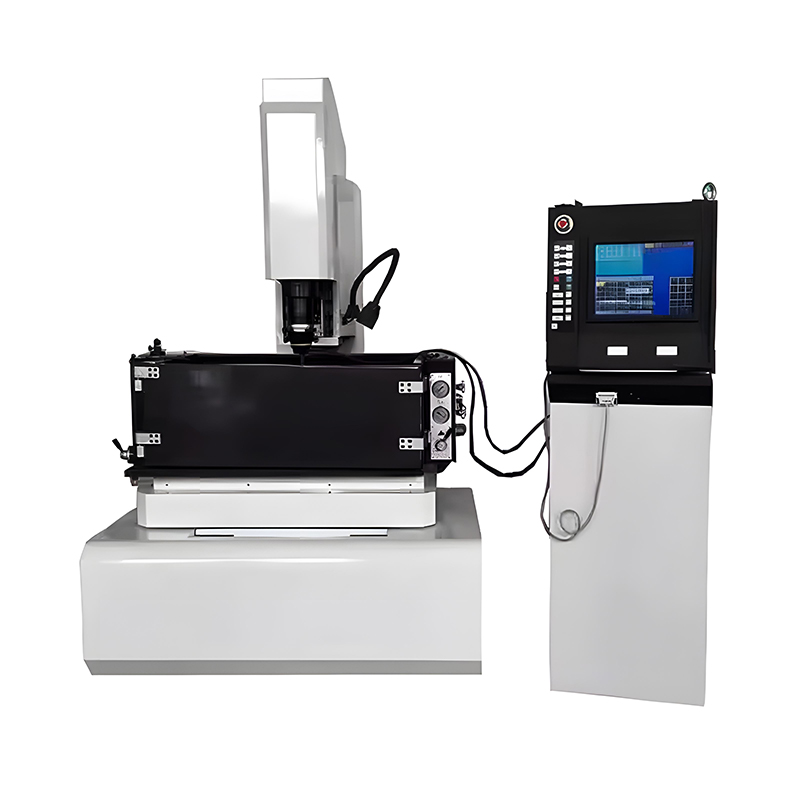 Compact CNC EDM Machine for Small Mold and Die ProductionThe CNC-430 is a compact, computer-controlled EDM system designed for small-scale mold and die work. Its adaptive control and intuitive interface simplify programming, while the modular design and coolant filtration support efficient, precise metal shaping in tight workshops.View Product →
What Is an EDM Machine Used For? Real Applications Across Industry
EDM machines are not general-purpose equipment. They are used where traditional cutting tools struggle or simply fail. The real value of EDM lies in bringing productivity to difficult materials and shapes.
Die and mold manufacturing is the largest application area. Deep ribs, sharp internal corners, and deep pockets are difficult to mill because standard end mills are limited by tool diameter and cutter deflection. Electrical discharge machining makes these shapes with an electrode that can be formed to match the mold geometry. A 3-axis EDM machine can produce an entire mold cavity in one setup, with no scallop marks and no cut forces varying the tool path. Graphite is a common electrode material because of its low wear rate and good conductive properties.
Aerospace and heavy manufacturing are also major users. In the aerospace sector, the need for cooling holes in turbine blades and other superalloy components creates a need for small-hole EDM. These holes are often drilled at an angle through materials that are harder than most conventional drills can handle. The xk430 high-speed CNC 5-axis EDM drilling machine is a good example of equipment designed for this kind of work, offering multi-axis positioning and the ability to process superhard alloys that other methods cannot touch.
 High-Speed 5-Axis CNC EDM Drill for Precision Hole MachiningThe XK-430 features five-axis CNC control for drilling complex holes at multiple angles without repositioning. Its high-speed EDM technology achieves clean, burr-free holes as small as 0.1mm in hardened steels and superalloys, with minimal heat-affected zones and automated electrode changes.View Product →
Wire EDM is widely used for cutting punches, dies, and precision plate components. If you need to cut an internal contour with a small corner radius, a wire EDM machine can achieve it with high repeatability and excellent surface quality. The workpiece remains stationary while the wire moves along a programmed path, making it ideal for parts that would deflect under a physical cutting force. You will also find EDM in the production of tooling for electronics, battery components, automotive parts, and even dental and medical equipment. In every case, the common thread is the same: hard or conductive material, precise shape, and relatively small features.
EDM vs Conventional CNC Machining: Which One Should Your Workshop Use?
EDM and conventional CNC machining are often presented as competing processes, but in a well-equipped shop they are complementary. The right choice depends on workpiece hardness, geometry complexity, and surface finish requirements. Use the following comparison to understand the boundaries.
| Factor | EDM | Conventional CNC |
|---|---|---|
| Hardened materials | Excellent, can machine any conductive hardened steel | Limited by tool life; machining hardened steel is slow and costly |
| Corner sharpness | Very sharp internal corners achievable | Round corners determined by cutter radius |
| Depth-to-width ratio | Can reach deep cavities and narrow slots | Limited by tool stiffness and vibration |
| Cut forces | Near zero, no tool force distortion | Significant cutting forces that may deflect the part |
| Surface finish | Ra 0.1–0.4 µm possible | Ra 0.4–1.6 µm common |
| Material removal speed | Slower for large volumes | Much faster for bulk material removal |
A common production strategy is to rough with a CNC machine where the material is not too hard, then heat-treat the part, and finish the hardened area with EDM. This hybrid approach minimizes cost while guaranteeing that the final cavity meets the required hardness. CNC vertical machining centers and CNC gantry milling machines cover the majority of standard material removal, while an EDM machine handles the specialized areas. If you are buying new equipment, it is worth considering both sides of the process together.
What to Check Before Buying an EDM Machine
Choosing an EDM machine is a capital decision, and a poorly configured machine can remain in your shop for years without paying for itself. Buyers often focus on the travel dimensions, but several specifications are more important for actual production success. Verify them before you compare quotes.
- Control axis count. A 3-axis CNC EDM machine gives you programmable X, Y, and Z movement, which is a baseline for cavity work. A 5-axis machine, or a machine with a rotary head, adds more flexibility for angular work and hole drilling. Check whether you actually need the extra axes, because they increase machine cost and programming complexity.
- Electrode holder and tooling system. Automatic tool changers and calibrated electrode holders reduce setup time and improve repeatability. For graphite electrodes, consider a dust extraction or flushing system on the machine itself.
- Pulse generator quality. The pulse generator controls the energy of each discharge. High-quality generators deliver better surface finishes and lower electrode wear, especially on difficult-to-machine steel. Ask for the current settings range and the smallest achievable pulse width.
- Dielectric fluid system. For wire EDM, the fluid is deionized water, while die-sinking uses hydrocarbon oil. In both cases, the fluid needs consistent filtration, temperature control, and flow. Poor fluid management is the most common cause of inconsistent surface finish.
- Table and workpiece capacity. Consider both the maximum workpiece weight and the distance between the tool head and the table. A deeper Z-axis travel allows you to machine deeper cavities without raising the table too far, but weight may also affect servo response.
- Machine rigidity. Even though EDM applies no actual cutting force, a rigid frame is important for maintaining the spark gap. Thermal deformation is the main challenge in EDM, and machines with a cooler or thermal compensation strategy hold better tolerances over an eight-hour shift.
If your work includes wire cutting of high-precision components, a moving-column or gantry-type wire EDM gives you better thermal stability for long workpieces. You can compare the options by reviewing the EDM machine range on our site. The d z653 moving-column wire cutting machine, for example, is built for applications that demand both rigidity and precision on medium-sized workpieces.
Moving-Column Wire EDM for Stable High-Precision CuttingThe DZ-653's moving-column design ensures thermal stability and low vibration, enabling sub-micron precision. Its efficient pulse power supply and automated wire threading reduce downtime, making it suitable for demanding applications in electronics, tooling, and energy sectors.View Product →Cost Expectations and Operating Budget
There is no universal price tag for an EDM machine. The actual investment depends on table size, axis configuration, control system accuracy, and the capacity of the power supply. Entry-level manual die-sinking machines cost significantly less than fully loaded CNC units, but they also produce lower productivity per operator hour.
When planning a budget, do not only look at the machine itself. The complete operating cost includes dielectric fluid, filters, electrode materials, wire costs, and electrical consumption. Graphite electrodes wear continuously, and wire for wire EDM is consumed at every cut. Some processes have a lower cost per part only when the machine is running continuously; for very low production volumes, EDM can be more expensive than a conventional mill.
However, the true financial benefit of EDM appears when parts are impossible to cut by other means. A single heat-treated die that would normally be rejected or require extensive post-processing can be completed accurately on an EDM machine with one setup. In many cases, the ability to finish a hardened component in-house eliminates outsourcing costs and shortens lead times substantially. One other important consideration is the need for a skilled operator. Modern CNC EDM machines are easier to program than older versions, but understanding electrode design, pulse parameters, and flushing is still essential. Planned maintenance, including pump seals, filters, and dielectric fluid replacement, should be scheduled and accounted for in your run rates.
Frequently Asked Questions About EDM Machines
What materials can an EDM machine process?
An EDM machine can process any electrically conductive material. Common workpieces are tool steel, hardened steel, stainless steel, tungsten carbide, titanium alloys, and other superalloys. It cannot process non-conductive materials, such as ceramics, plastics, or glass.
How accurate is an EDM machine?
Modern CNC EDM machines are capable of positioning accuracy in the range of ±0.005 mm. The final accuracy also depends on electrode quality and thermal stability. In production settings, dimensional repeatability of 0.01 mm is regularly achieved on machines with good temperature control.
What is the difference between wire EDM and die-sinking EDM?
Wire EDM uses a thin, continuously moving wire as the electrode to cut through a plate or block. Die-sinking EDM uses a shaped electrode that is plunged into the workpiece to create a mirror image cavity. Wire EDM is good for contour cutting, while die-sinking EDM is better for complex internal shapes.
How do you select the right electrode material?
Graphite is preferred for roughing due to its high wear resistance and machinability. Copper is often selected for finishing because it gives a finer surface finish and is more consistent. Brass wire is the standard for wire EDM, while composite wire or coated wire can increase cutting speed.
Is EDM faster or slower than CNC milling?
For bulk material removal, CNC milling is much faster. EDM becomes faster and more cost-effective when you need to machine internal corners, hard materials, or walls that would deflect in a milling operation. The best approach is to rough by milling whenever possible and use EDM for the features that require it.
Can EDM machines work without a CNC system?
Manual EDM machines still exist and are used in some workshops. However, a CNC system provides significantly better surface consistency, automated electrode paths, and the ability to handle multi-cavity or multi-electrode jobs with minimal operator intervention. For medium-volume production, CNC is almost always the better choice.
How long does an EDM electrode last?
Electrode life depends on the electrode material, current intensity, and workpiece material. Graphite electrodes generally have a lower wear rate than copper electrodes. A well-designed roughing electrode can complete many cavities before dressing is required. Under extreme conditions, wear can be severe, so always verify the wear ratio with your machine supplier.
An EDM machine is an investment in capability, not just a piece of equipment. It lets you do work that other processes cannot handle, and it rounds out a production floor that already includes CNC mills, gantry machines, and machining centers. The key is to match the machine type to your actual workpiece range. Start with a careful analysis of your current order mix, then choose a machine with the right axis count, power supply, and fluid handling system.
If your work involves hardened dies, deep cooling holes, or precision wire-cut components, an EDM machine deserves a place in your equipment plan. Take time to review specifications, visit a factory, and compare machines on real workpiece samples rather than catalog claims. That approach consistently produces the best long-term result for your shop.
PREV:No previous article
NEXT:What Are Cutting Tools Used For? Applications, Materials, and CNC Machining Insights
NEXT:What Are Cutting Tools Used For? Applications, Materials, and CNC Machining Insights
Interested in cooperation or have questions?
News
-
-
Cutting Tools Are Used to Convert Raw Material into Functional Parts Cutting tools are the hardened, wear-resistant elements that shear away unwanted material from a workpiece to create a finished component. They are applied in e...
READ MORE -
A CNC machine can cut, drill, mill, turn, burn, and shape almost any conductive or composite material with an accuracy that manual machines rarely match. The real question is not what a CNC machine can do in theory, but what a sp...
READ MORE -
Nantong Sunway Ships Two Custom CNC Machines for Aero-Engine Turbine Blade Micro-Hole Drilling Nantong Sunway Science and Technology Development Co., Ltd. has completed production and shipped two custom-engineered CNC drilling cen...
READ MORE
Related Products

-
Factory Address
Zhaxi Township Industrial Park, Nantong City, Jiangsu Province, China (west of Huaneng Power Plant)
-
Phone
+86-13615235768
+86-15950816906
-
Fax
+86-513-85632766
-
Email
pan.director@sunwayer.com
Stay Connected
lf you can't find the answer you're looking for, chat with our friendly team.
Stay Connected
Copyright © Nantong Sunway Science and Technology Development Co., Ltd. All Rights Reserved.
China CNC Equipment Manufacturers
Custom CNC Equipment Factory
