


 русский
 Español
Heat treatment is a controlled thermal process that changes the mechanical properties of metal by heating it to a specific temperature, holding it there, and then cooling it at a rate chosen to produce a desired internal structur...
READ MORE
What Are CNC Machines? A Complete Guide to CNC Equipment
Content
- 1 How CNC Machines Work: From Design File to Finished Part
- 2 Main Types of CNC Equipment Explained
- 3 CNC Equipment by Number of Axes — What the Difference Actually Means
- 4 Materials CNC Equipment Can Process
- 5 Key Specifications to Evaluate When Comparing CNC Equipment
- 6 CNC Equipment in Major Industries — Real-World Applications
- 7 CNC Equipment vs. Manual Machining — A Direct Comparison
- 8 The Role of Automation and Robotics in Modern CNC Equipment
- 9 CNC Equipment Pricing — What Does It Actually Cost?
- 10 Leading CNC Equipment Manufacturers
- 11 CNC Equipment Maintenance — What It Takes to Keep Machines Running
- 12 The Future of CNC Equipment — Where the Technology Is Heading
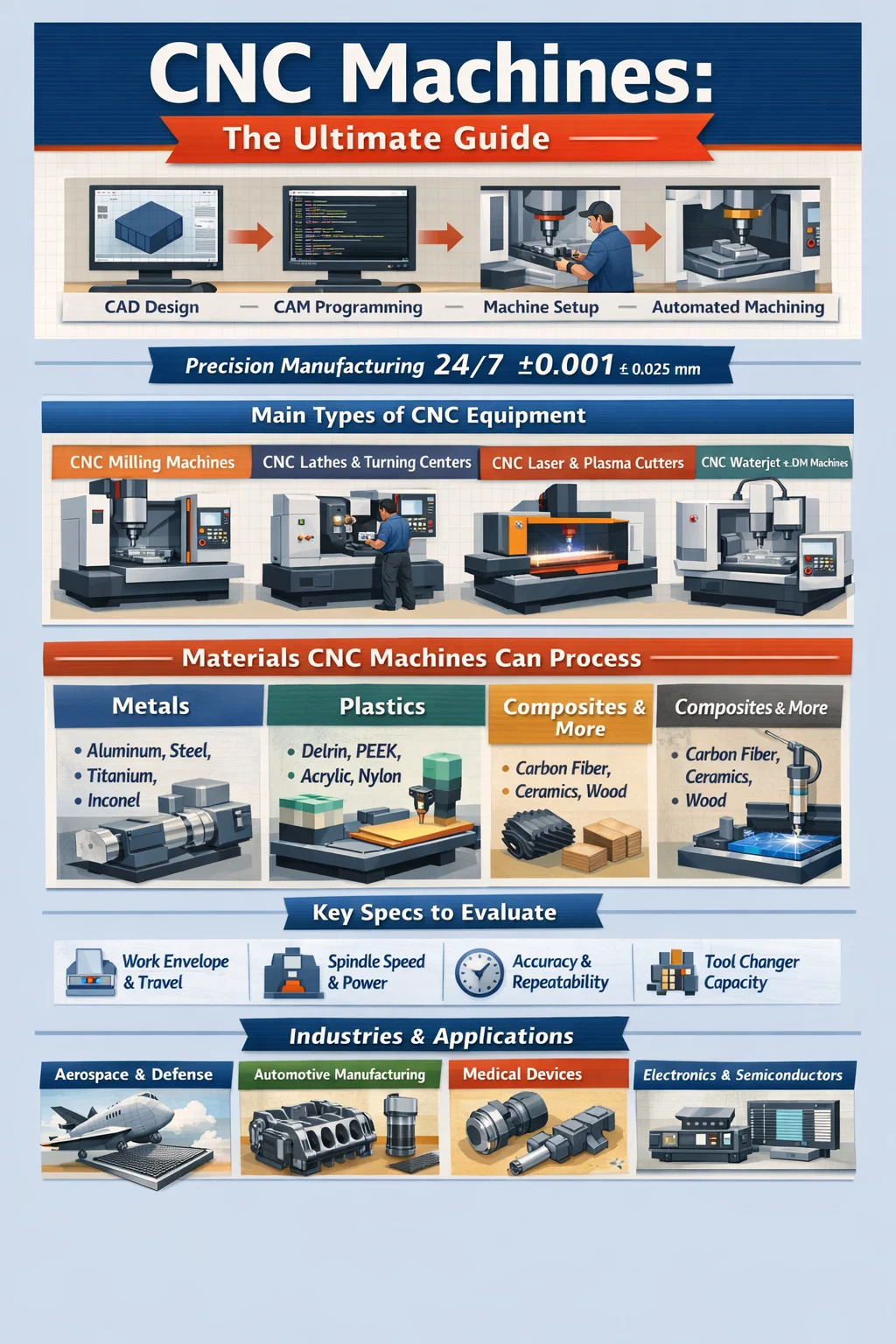
CNC machines — short for Computer Numerical Control machines — are automated manufacturing tools that use pre-programmed computer software to control the movement of cutting, drilling, milling, or shaping equipment. Instead of a human manually guiding a tool along a workpiece, the machine reads a coded program (typically G-code) and executes precise movements with consistency that no human hand can replicate. CNC equipment is the backbone of modern manufacturing, used in industries ranging from aerospace and automotive to medical device production and consumer electronics.
To put it simply: a CNC machine takes a digital design file, translates it into a sequence of motion commands, and then executes those commands to shape a raw material — metal, wood, plastic, foam, or composite — into a finished or semi-finished part. The entire process can run unattended, 24 hours a day, producing identical parts at tolerances as tight as ±0.001 inches (±0.025 mm).
This guide covers everything you need to know: how CNC machines work, the main categories of CNC equipment, what materials they handle, how to read their specs, and what to look for when selecting one for a specific application.
How CNC Machines Work: From Design File to Finished Part
The CNC machining process follows a clear chain of steps. Understanding this chain helps demystify why CNC equipment is so powerful and why it dominates precision manufacturing.
Step 1 — CAD Modeling
The process starts with a CAD (Computer-Aided Design) file. Engineers or designers use software like SolidWorks, Fusion 360, or AutoCAD to draw the part in three dimensions, specifying exact geometry, dimensions, tolerances, and surface finishes. This digital blueprint is the foundation for everything that follows.
Step 2 — CAM Programming
The CAD file is imported into CAM (Computer-Aided Manufacturing) software — tools like Mastercam, Siemens NX CAM, or the built-in CAM module in Fusion 360. The CAM software converts the geometry into toolpaths: the exact routes the cutting tool will travel, at what speed, feed rate, and depth of cut. The output of this stage is a G-code file — a text-based program full of coordinates, speeds, and commands.
Step 3 — Machine Setup
An operator loads the G-code onto the machine's controller, secures the raw material (called the workpiece or stock) in a vise, chuck, or fixture, mounts the appropriate cutting tools, and sets the work coordinate origin. This setup phase is the most human-intensive part of the CNC process.
Step 4 — Automated Machining
Once the program runs, the CNC controller interprets each line of G-code and sends precise electrical signals to servo motors or stepper motors on each axis. These motors drive the machine's linear or rotary motion with extraordinary accuracy. Modern CNC controllers can execute thousands of motion commands per second, coordinating multiple axes simultaneously to produce complex curved surfaces.
Step 5 — Inspection and Quality Control
After machining, finished parts are measured with calipers, micrometers, or coordinate measuring machines (CMMs) to verify they fall within specified tolerances. High-volume production often integrates in-process measurement directly into the CNC equipment workflow, automatically adjusting tool offsets when wear is detected.
Main Types of CNC Equipment Explained
"CNC machine" is an umbrella term. There are dozens of distinct types of CNC equipment, each designed for a specific class of operations and materials. Here are the most important categories.
CNC Milling Machines
CNC mills use rotating multi-point cutting tools to remove material from a stationary workpiece. The tool moves along X, Y, and Z axes — and on 4-axis and 5-axis machines, also rotates around one or two additional axes. This makes CNC milling one of the most versatile machining processes available.
- 3-axis mills — the standard configuration; the tool moves in X, Y, and Z while the part stays fixed. Suitable for prismatic parts and flat-surface work.
- 4-axis mills — add a rotary A-axis, allowing the part to be rotated and machined from multiple sides without re-fixturing.
- 5-axis mills — add two rotary axes (often A and C, or B and C), enabling complex sculptural surfaces, turbine blades, and medical implants to be machined in a single setup. A quality 5-axis machining center can maintain tolerances of ±0.002 mm on contoured surfaces.
CNC milling centers are found in aerospace, automotive, mold-making, and defense manufacturing. A typical vertical machining center (VMC) with a 40-taper spindle can spin at 10,000–15,000 RPM, while high-speed machining centers reach 40,000–60,000 RPM for aluminum and composites.
CNC Lathes and Turning Centers
Where mills rotate the tool, lathes rotate the workpiece. A CNC lathe clamps the stock in a spinning chuck, then moves a single-point cutting tool along the Z-axis (along the part's length) and X-axis (radially) to turn, face, bore, thread, and groove cylindrical parts.
Modern CNC turning centers often include a live tooling spindle — meaning they can also perform milling, drilling, and tapping operations on the same machine. This combination dramatically reduces setup time and improves concentricity between turned and milled features. Swiss-type CNC lathes, which guide the bar stock through a guide bushing and use multiple tools simultaneously, are the preferred CNC equipment for producing tiny, complex parts — like watchmaking components, dental screws, and hydraulic fittings — at high volume with diameters under 32 mm.
CNC Routers
CNC routers are structurally similar to CNC mills but are optimized for larger workpieces and softer materials: wood, MDF, foam, acrylic, soft plastics, and thin aluminum sheet. They use a gantry-style structure where the spindle bridges across a large cutting table — common table sizes range from 4×8 feet to 5×10 feet or larger.
Industries that rely heavily on CNC router equipment include furniture manufacturing, sign-making, cabinetry, boat building, and architectural millwork. A mid-range industrial CNC router with a 5-horsepower spindle can cut through 3/4-inch MDF at feed rates exceeding 800 inches per minute.
CNC Plasma Cutters
CNC plasma cutting equipment uses a jet of ionized gas (plasma) at temperatures exceeding 20,000°C to cut through electrically conductive metals — primarily steel, stainless steel, and aluminum. The CNC system controls the torch position, cutting speed, and height above the plate.
Plasma CNC equipment is valued for speed and cost-effectiveness when cutting medium to thick plate (typically 1/8 inch to 2 inches). It is widely used in structural steel fabrication, HVAC ductwork, trailer manufacturing, and general metalworking shops. While cut quality is not as fine as laser or waterjet, plasma cutting offers much lower operating costs per hour.
CNC Laser Cutters
CNC laser cutting equipment directs a high-powered laser beam — CO₂, fiber, or Nd:YAG — to melt, burn, or vaporize material along a programmed path. Laser CNC equipment excels at cutting thin to medium sheet metal (sheet steel up to ~25 mm with fiber lasers), as well as engraving, marking, and cutting non-metals like wood, acrylic, and leather.
Fiber laser CNC equipment has largely replaced CO₂ lasers for metal cutting over the past decade because fiber lasers cut reflective metals (copper, brass, aluminum) without risk of back-reflection, operate at higher electrical efficiency (wall-plug efficiency ~30–40% vs. ~10–15% for CO₂), and cut thin stainless steel at speeds 3–4× faster. A modern 6 kW fiber laser CNC machine can cut 1 mm stainless at over 30 meters per minute.
CNC Waterjet Cutters
Waterjet CNC equipment cuts materials using an ultra-high-pressure stream of water (up to 94,000 PSI / 6,500 bar), often combined with an abrasive garnet grit. Because the process generates no heat, it produces no heat-affected zone (HAZ), making it the preferred CNC cutting equipment for materials sensitive to thermal distortion — titanium, hardened tool steel, carbon fiber composites, glass, ceramics, and stone.
Waterjet CNC equipment can cut virtually any material and any thickness (steel plate up to 300 mm or more), but it is slower and has higher consumable costs compared to laser or plasma. It is the go-to choice for aerospace structural parts, stone countertops, bullet-proof glass panels, and artistic stone inlay work.
CNC EDM (Electrical Discharge Machining)
EDM CNC equipment removes material through controlled electrical sparks between the tool (electrode) and the workpiece, both submerged in a dielectric fluid. It can machine any electrically conductive material regardless of hardness, making it indispensable for hardened tool steel dies and molds that would destroy conventional cutting tools.
There are two main forms: sinker EDM (ram EDM), where a shaped copper or graphite electrode burns its inverse shape into the workpiece, used for mold cavities and deep pockets; and wire EDM, where a continuously fed brass wire cuts 2D contours through a part with positional accuracy of ±0.001 mm — used for punch and die sets, extrusion dies, and complex profile cutting of hardened steel.
CNC Grinding Machines
CNC grinding equipment uses abrasive wheels to achieve the finest surface finishes and tightest tolerances in manufacturing. Surface grinders produce flat reference faces to within 0.001 mm. Cylindrical grinders finish shafts and bores. Centerless grinders process high volumes of cylindrical parts without requiring centers. Tool and cutter grinders sharpen or profile cutting tools with precision. CNC grinding equipment is essential in bearing manufacturing, precision spindle production, and any application where a surface roughness of Ra 0.2 μm or better is specified.
CNC Equipment by Number of Axes — What the Difference Actually Means
One of the most important specifications when evaluating CNC equipment is the number of axes it operates on. This directly determines the geometric complexity of parts you can produce and how many setups a job requires.
| Axes | Motion Description | Typical Applications | Relative Cost |
|---|---|---|---|
| 2-axis | X + Z (turning) | Simple turned parts, facing, boring | Lowest |
| 3-axis | X + Y + Z | Prismatic parts, pockets, slots, flat surfaces | Moderate |
| 4-axis | X + Y + Z + A (rotary) | Helical features, multi-face parts, cams | Medium-High |
| 5-axis | X + Y + Z + A + C (or B) | Turbine blades, impellers, medical implants, molds | High |
| Mill-Turn | Full turning + milling on one machine | Complex turned/milled combination parts | Very High |
Moving from 3-axis to 5-axis CNC equipment can reduce the number of setups required for a complex aerospace bracket from five separate operations to a single setup — eliminating fixture cost, operator time, and the cumulative positional error introduced each time a part is re-clamped.
Materials CNC Equipment Can Process
One of the defining strengths of CNC equipment is its breadth of material compatibility. The specific material capability depends on the type of CNC machine, its spindle power, rigidity, and the tooling used.
Metals
- Aluminum alloys (6061, 7075) — the most commonly machined metal; cuts at high speed with excellent surface finish. 7075-T6 is used extensively in aerospace structural parts.
- Steel and stainless steel — from mild 1018 steel for general structures to 17-4 PH stainless for medical and food processing components.
- Titanium (Ti-6Al-4V) — difficult to machine due to its low thermal conductivity; requires rigid CNC equipment, sharp tools, and high coolant pressure.
- Copper and brass — high thermal and electrical conductivity; commonly machined for electrical connectors and plumbing fittings.
- Inconel and superalloys — extreme heat and corrosion resistance for jet engine components; very demanding on CNC machine rigidity and tool life.
Plastics and Polymers
- Delrin (POM) — self-lubricating, dimensionally stable; ideal for gears, bushings, and structural brackets.
- PEEK — high-performance engineering plastic used in medical implants and semiconductor equipment.
- HDPE, UHMW, nylon, polycarbonate — machined for industrial components, jigs, and fixtures.
- Acrylic (PMMA) — frequently routed or laser-cut for signage, displays, and light guides.
Composites and Specialty Materials
- Carbon fiber reinforced polymer (CFRP) — CNC routed and waterjet cut for aerospace and sporting goods. Requires diamond-coated or carbide tools and excellent dust extraction.
- G10/FR4 fiberglass — CNC machined for PCB substrates and insulating structural components.
- Ceramics and stone — waterjet cut or diamond ground for technical ceramics and architectural applications.
- Wood and MDF — CNC routed for furniture, cabinetry, and decorative woodwork.
Key Specifications to Evaluate When Comparing CNC Equipment
When evaluating CNC equipment for purchase or when speccing out a job to send to a machine shop, these are the technical parameters that actually determine whether a machine can do what you need.
Work Envelope / Travel
The maximum distance the machine can travel in X, Y, and Z defines the largest part it can physically machine. A VMC with 20" × 16" × 20" travel cannot cut a part that is 30 inches long in a single setup.
Spindle Speed (RPM) and Power (kW/HP)
Spindle speed determines how fast the cutting tool rotates. Small-diameter end mills and carbide drills need high RPM (10,000–40,000) to operate at proper surface footage. Large face mills in steel need lower RPM (500–2,000) but high torque. Spindle power determines how much material you can remove per minute — a 40 HP (30 kW) spindle can take much deeper cuts in hardened steel than a 10 HP spindle.
Positioning Accuracy and Repeatability
Positioning accuracy is how close the machine gets to the commanded position from any starting point. Repeatability is how consistently it returns to the same position. For precision CNC equipment, look for repeatability values of ±0.002 mm or better. Entry-level CNC equipment might only achieve ±0.01 mm, which rules out tight-tolerance work.
Tool Changer Capacity
Automatic tool changers (ATCs) allow the machine to switch between different cutting tools automatically, without operator intervention. Carousel-type tool magazines on VMCs typically hold 20–30 tools, while larger machining centers can hold 60, 120, or even 400+ tools. More tool capacity means longer unattended runs and greater operational flexibility.
Feed Rate
Maximum feed rate (measured in mm/min or in/min) determines how fast the axes can move. High rapid traverse rates — 30,000–60,000 mm/min (1,200–2,400 in/min) on modern machining centers — reduce non-cutting air-move time, which can be a significant portion of total cycle time on parts with many features.
CNC Controller Brand and Capabilities
The CNC controller is the brain of the machine. Major controller brands include Fanuc (dominant worldwide, known for reliability), Siemens (strong in Europe, powerful conversational and 5-axis features), Heidenhain (preferred for precision die/mold work and 5-axis contouring), and Mitsubishi. Controller capability affects programming ease, network connectivity, real-time monitoring, and support for advanced features like look-ahead buffering, AI thermal compensation, and Industry 4.0 integration.
CNC Equipment in Major Industries — Real-World Applications
CNC equipment is not a niche tool — it is the production method underpinning entire industrial sectors. Here is how it is deployed across key industries.
Aerospace and Defense
Aerospace is arguably the most demanding environment for CNC equipment. Structural components for commercial aircraft — wing spars, bulkheads, nacelle frames — are machined from large aluminum billets, often removing more than 90% of the starting material. This requires high-speed 5-axis machining centers with large work envelopes, powerful spindles, and high-pressure through-spindle coolant.
Engine components — turbine blades, discs, casings — are machined from titanium and Inconel superalloys. A single turbine blade can require 8–12 hours of CNC machining time on a 5-axis machine. Tolerances are often specified in microns, and all operations must be documented and traceable under AS9100 quality standards.
Automotive Manufacturing
Automotive plants use massive transfer lines and dedicated CNC machining cells to produce engine blocks, cylinder heads, crankshafts, camshafts, and transmission housings at volumes exceeding tens of thousands of parts per day. Horizontal machining centers (HMCs) with pallet changers are the workhorse of automotive engine machining — while one pallet is being machined, the operator is loading the next, keeping the spindle cutting nearly 100% of the time.
Automotive tooling (the molds and dies that stamp, press, and cast car body panels and structural components) is produced on 5-axis CNC machining centers and wire EDM machines in tool and die shops.
Medical Device Manufacturing
CNC equipment is essential for producing orthopedic implants (knee and hip replacement components), spinal cages, dental implants, surgical instruments, and catheter components. The materials are challenging — titanium, cobalt-chrome, stainless 316L, PEEK — and tolerances are extremely tight, often ±0.01 mm or tighter on bearing surfaces.
Swiss CNC lathes are heavily used for producing tiny bone screws, dental abutments, and catheter tips at high volume. Medical CNC machining also requires documented process validation, material traceability, and compliance with ISO 13485 quality systems.
Electronics and Semiconductor Equipment
The semiconductor equipment industry — companies building the machines that manufacture computer chips — requires extremely precise CNC machined components. Wafer stages, vacuum chambers, lens housings, and positioning mechanisms are machined to sub-micron form tolerances from aluminum, stainless steel, and ceramics. PCB drilling machines themselves are specialized CNC equipment, using spindles that rotate at 200,000–300,000 RPM to drill holes as small as 0.1 mm in fiberglass circuit boards.
Oil and Gas
Downhole drilling tools, valves, flanges, and wellhead components are machined on large CNC lathes and milling machines from high-strength alloy steels and exotic corrosion-resistant alloys. The parts are often large, heavy, and require deep-hole drilling — a specialized CNC operation using gun drills and BTA drills to produce precise long bores.
CNC Equipment vs. Manual Machining — A Direct Comparison
Manual machining — using engine lathes, knee mills, and surface grinders operated directly by a skilled machinist — still has a role in prototype work, repair, and single-piece jobs. But the gap between manual and CNC capability has widened enormously over the past 30 years.
| Factor | Manual Machining | CNC Equipment |
|---|---|---|
| Dimensional Repeatability | ±0.05–0.1 mm (operator dependent) | ±0.001–0.005 mm |
| Setup Time | Low for simple parts | Moderate (program + fixturing) |
| Production Speed | Slow | Very fast for medium/high volumes |
| Part Complexity | Limited to simple geometries | Extremely complex, 3D surfaces |
| Unattended Operation | Not possible | Fully possible with automation |
| Upfront Investment | Low ($5,000–$30,000 for used equipment) | Moderate to high ($30,000–$500,000+) |
| Skill Required | High traditional machinist skill | CAM programming + machine operation |
The Role of Automation and Robotics in Modern CNC Equipment
A standalone CNC machine is already far more productive than manual machining. But the real productivity leap in modern manufacturing comes from surrounding CNC equipment with automation systems that eliminate the human bottleneck entirely during production runs.
Pallet Changers
A pallet changer allows an operator to set up the next part on an external pallet while the machine is cutting the current one. When the current cycle finishes, the machine automatically swaps pallets in seconds. This simple addition can increase spindle utilization from 50–60% to over 85%.
Robotic Part Loading
6-axis industrial robots — from brands like Fanuc, KUKA, ABB, and Yaskawa — are increasingly deployed to load and unload CNC machines. A robot can service one machine or multiple machines simultaneously, operating 24 hours without breaks. Collaborative robots (cobots) from brands like Universal Robots are making robotic automation accessible to small machine shops that previously could not justify the cost or complexity of traditional industrial robots.
Flexible Manufacturing Systems (FMS)
An FMS links multiple CNC machining centers, lathes, washing machines, and inspection stations via automated guided vehicles (AGVs) or rail-guided pallet systems. Parts move automatically from station to station, and a central computer schedules which part goes where based on machine availability and priority. Large automotive and aerospace FMS installations can machine dozens of different part numbers with virtually no human intervention during the run.
Bar Feeders for CNC Lathes
A bar feeder automatically loads bar stock into a CNC lathe, allowing the machine to produce hundreds of parts from a single bar without operator involvement. A 12-foot (3.6 m) bar of aluminum or steel can produce dozens to hundreds of small parts in a single unattended run.
CNC Equipment Pricing — What Does It Actually Cost?
CNC equipment spans an enormous price range, from entry-level hobby machines to multi-million dollar production systems. Here is a realistic breakdown of what different categories of CNC equipment cost new (USD, approximate as of 2024).
- Hobbyist/Desktop CNC routers and mills (e.g., Shapeoko, X-Carve, Langmuir Systems): $1,500–$5,000. Suitable for wood, soft plastic, and thin aluminum sheet. Not for precision metal work.
- Entry-level industrial CNC mills (VMCs) (e.g., Haas Mini Mill, Brother Speedio entry): $40,000–$80,000. Capable of real production work in aluminum and mild steel.
- Mid-range production VMCs (e.g., Haas VF-2, Mazak VCS-430A): $80,000–$180,000. Full production capability for most job shop work in steel and alloys.
- 5-axis machining centers (e.g., DMG Mori DMU 50, Mazak Variaxis i-500): $250,000–$600,000. Required for aerospace, mold, and complex medical work.
- Large gantry-style machining centers for aerospace structural parts: $1,000,000–$5,000,000+.
- CNC plasma cutters (industrial table): $15,000–$80,000 depending on table size and plasma source power.
- Fiber laser CNC cutting systems: $100,000–$600,000+ depending on wattage (1 kW to 30 kW) and automation level.
- CNC waterjet systems: $80,000–$350,000 for industrial abrasive waterjet tables.
- Wire EDM machines: $80,000–$250,000 for precision production-grade systems.
Used CNC equipment can be purchased at 30–60% of new prices, though older controllers and worn mechanics introduce risk. Many shops acquire used machines to get started, then reinvest in new CNC equipment as capacity demands grow.
Leading CNC Equipment Manufacturers
The global CNC equipment market is dominated by a relatively small number of major manufacturers, along with a large number of regional players. Understanding who makes what helps when evaluating purchase decisions or understanding a machine shop's capabilities.
- Haas Automation (USA) — the largest machine tool manufacturer in the Western world by unit volume. Known for value-priced, reliable VMCs, HMCs, and lathes. The dominant choice for North American job shops.
- DMG Mori (Germany/Japan) — formed by the merger of Germany's Deckel Maho Gildemeister and Japan's Mori Seiki. A full-line manufacturer covering everything from entry VMCs to ultraprecision 5-axis centers and mill-turns.
- Mazak (Japan/USA) — a major player in turning centers, 5-axis mills, and multi-tasking mill-turns. Has a large US manufacturing plant in Florence, Kentucky.
- Okuma (Japan) — known for building their own controllers (OSP) and for high-quality turning and grinding centers. Strong in thermal stability technology.
- Makino (Japan/USA) — specializes in high-speed machining centers and EDM equipment for aerospace, automotive tooling, and precision die/mold work.
- Trumpf (Germany) — the global leader in laser CNC equipment, including sheet metal laser cutting, punching, and bending systems.
- Bystronic (Switzerland) — major manufacturer of laser and waterjet CNC cutting equipment for sheet metal fabrication.
- Fanuc (Japan) — primarily a CNC controller and robot manufacturer, but also produces highly automated drilling and tapping centers (Robodrill) used heavily in consumer electronics manufacturing.
CNC Equipment Maintenance — What It Takes to Keep Machines Running
CNC equipment is a significant capital investment, and like any precision machinery, it requires systematic maintenance to sustain accuracy, reliability, and longevity. Neglected CNC machines lose accuracy, produce scrap, and eventually fail in costly ways.
Daily Maintenance
- Check and clean the chip conveyor and chip pan.
- Inspect coolant level and concentration (typically 8–12% concentration for water-soluble coolants).
- Check air pressure to the machine (typically 80–100 PSI required for tool changers and workholding).
- Wipe down exposed way surfaces and apply way oil if not on an automatic lubrication system.
- Visually inspect tool holders and tooling for damage or runout.
Monthly and Periodic Maintenance
- Verify axis backlash and adjust or compensate in the controller if needed.
- Check spindle runout with a test indicator (should be ≤0.001 mm TIR for precision work).
- Inspect and replace coolant (full tank change typically every 6–12 months).
- Check servo drive and spindle drive for error codes and alarm history.
- Inspect the automatic lubrication system for blockages and oil level.
Spindle bearings are typically the most expensive single maintenance item on a CNC machining center. A spindle rebuild on a high-speed machining center can cost $5,000–$20,000. Running the spindle at low speed through a warm-up cycle before aggressive cutting — especially after weekends or cold starts — significantly extends bearing life.
The Future of CNC Equipment — Where the Technology Is Heading
CNC equipment is not static. Several converging technology trends are reshaping what CNC machines can do and how they are managed.
Hybrid Additive-Subtractive CNC Machines
Hybrid CNC machines combine metal additive manufacturing (directed energy deposition using laser cladding or wire arc) with conventional CNC milling on a single machine. This allows material to be added where needed, then immediately finish-machined to final dimensions. Companies like DMG Mori (LASERTEC series), Mazak (INTEGREX i-400 AM), and Matsuura offer hybrid systems. These machines open up repair of worn aerospace components and fabrication of bimetallic parts that were previously impossible to manufacture conventionally.
AI-Assisted CNC Machining
Machine tool builders are embedding AI into their CNC controllers to monitor cutting forces, vibration, and spindle load in real time, then automatically adjust feed rates and spindle speed to prevent tool breakage, chatter, and overloading. Fanuc's Intelligent Machine Functions, Mazak's Smooth Technology, and Siemens' SINUMERIK ONE with built-in AI capabilities represent this direction. AI-driven adaptive control can extend tool life by 20–50% and reduce scrapped parts caused by unexpected tool wear.
Industry 4.0 and Connected CNC Equipment
Modern CNC equipment is increasingly networked into factory-wide data systems through MTConnect (an open communication protocol for machine tools) or OPC-UA. This allows real-time tracking of machine utilization, cycle time, alarm history, and energy consumption. Production managers can view an entire shop floor's CNC equipment performance on a dashboard and identify bottlenecks, underutilized machines, and recurring quality issues. Integration with ERP systems allows automatic job scheduling based on machine availability and tooling inventory.
Lights-Out Manufacturing
The combination of high-capacity tool magazines, robotic part loading, automated inspection, and networked monitoring is enabling more shops to run CNC equipment "lights-out" — unmanned through night shifts and weekends. Japanese machine tool makers Fanuc and Makino have been operating their own lights-out factories since the 1990s. As automation costs fall, this model is spreading to mid-size job shops. A lights-out second shift on a CNC machining center can effectively double its productive output with minimal additional labor cost.
PREV:What Software for CNC Router: Best CNC Equipment Programs Guide
NEXT:What Is a Vertical Milling Machine Also Known As? VMC Guide
NEXT:What Is a Vertical Milling Machine Also Known As? VMC Guide
Interested in cooperation or have questions?
News
-
-
An EDM machine, also called an electrical discharge machining machine, uses controlled sparks to erode electrically conductive metal without direct contact between the tool and the workpiece. The workpiece is submerged in a diele...
READ MORE -
Cutting Tools Are Used to Convert Raw Material into Functional Parts Cutting tools are the hardened, wear-resistant elements that shear away unwanted material from a workpiece to create a finished component. They are applied in e...
READ MORE -
A CNC machine can cut, drill, mill, turn, burn, and shape almost any conductive or composite material with an accuracy that manual machines rarely match. The real question is not what a CNC machine can do in theory, but what a sp...
READ MORE
Related Products

-
Factory Address
Zhaxi Township Industrial Park, Nantong City, Jiangsu Province, China (west of Huaneng Power Plant)
-
Phone
+86-13615235768
+86-15950816906
-
Fax
+86-513-85632766
-
Email
pan.director@sunwayer.com
Stay Connected
lf you can't find the answer you're looking for, chat with our friendly team.
Stay Connected
Copyright © Nantong Sunway Science and Technology Development Co., Ltd. All Rights Reserved.
China CNC Equipment Manufacturers
Custom CNC Equipment Factory
