


 русский
 Español
Heat treatment is a controlled thermal process that changes the mechanical properties of metal by heating it to a specific temperature, holding it there, and then cooling it at a rate chosen to produce a desired internal structur...
READ MORE
What Is Heat Treatment? A Practical Guide for CNC Machining & Mold Makers
Content
- 1 What Is Heat Treatment? A Direct Answer
- 2 The Three Stages of Every Heat Treatment Cycle
- 3 The Four Core Heat Treatment Processes You Need to Know
- 4 How Heat Treatment Changes Steel at the Microstructural Level
- 5 Why Heat Treatment Matters for CNC Machining and Mold Making
- 6 Hardness vs. Machinability: Practical Trade-offs
- 7 Machining Heat-Treated Steels: What Changes on the Shop Floor
- 8 EDM and Heat-Treated Steel: A Natural Combination
- 9 Common Heat Treatment Mistakes in Part and Mold Manufacturing
- 10 Frequently Asked Questions About Heat Treatment
- 10.1 What is the difference between annealing and normalizing?
- 10.2 Why is quenching always followed by tempering?
- 10.3 Can you machine steel after heat treatment?
- 10.4 Does heat treatment cause distortion?
- 10.5 What is the difference between heat treatment and surface hardening?
- 10.6 What hardness should mold steel have for machining?
- 11 Key Takeaways for Your Next Heat-Treated Machining Job
Heat treatment is a controlled thermal process that changes the mechanical properties of metal by heating it to a specific temperature, holding it there, and then cooling it at a rate chosen to produce a desired internal structure. It does not change the shape of the part, but it changes hardness, toughness, ductility, and internal stress. In CNC machining and mold making, heat treatment determines whether a cavity can be milled at 30 HRC first and hardened to 56 HRC after, or whether a pre-hardened block should never see a roughing cutter at all.
If you operate machining centers, EDM machines, or wire cutters, the heat treatment state of your raw material directly affects tool life, dimensional stability, and final part performance. Before selecting a process or a machine, it is useful to understand what happens inside the steel.
What Is Heat Treatment? A Direct Answer
Heat treatment groups several metallurgical processes that use temperature to deliberately modify a metal's microstructure. For steel, that means transforming the arrangement of iron and carbon atoms. The most common processes are annealing, normalizing, quenching, and tempering. Each one uses the same three-step principle but applies a different cooling strategy, and each one leaves the steel with a different set of mechanical properties.
In manufacturing, heat treatment is rarely an afterthought. For example, a mold base made of pre-hardened steel at 28-32 HRC is normally machined directly. A mold insert that needs wear resistance may be machined in the annealed condition at around 200 HBW, then hardened to 50-58 HRC after all milling is complete. The same steel in two conditions behaves like two different materials on the shop floor.
The practical definition, then, is this: heat treatment is the deliberate control of heating and cooling cycles to give a metal the hardness, strength, toughness, stress state, or machinability that a specific manufacturing application requires.
The Three Stages of Every Heat Treatment Cycle
Every heat treatment process, no matter how complex the recipe, follows three stages. Getting any one of them wrong can offset the benefits of the other two.
- Heating to target temperature. For carbon and tool steels, the austenitizing range is normally 800-950 degrees C, depending on the carbon content. Below that range, the microstructure does not fully transform, and the final result will be inconsistent.
- Soaking at that temperature. The part is held long enough for its thickest section to reach the same temperature as the surface. A large mold insert can require several hours of soaking, while a thin workpiece may need only a few minutes.
- Cooling at a controlled rate. Cooling rate is the main lever that selects the final structure. Slow cooling in the furnace produces soft pearlite. Cooling in still air produces finer pearlite. Fast cooling in oil or water produces hard, brittle martensite.
The same steel can be made soft enough for aggressive milling or hard enough to cut glass, depending on how these three stages are executed.
The Four Core Heat Treatment Processes You Need to Know
Although heat treatment includes many specialized variations, these four processes are the foundation of nearly every workpiece you will machine, grind, or wire cut.
| Process | Temperature Range | Cooling Method | Result | Typical Use |
|---|---|---|---|---|
| Annealing | 800-900 degrees C | Furnace cooling | Soft, ductile, stress-relieved | Before machining |
| Normalizing | 850-950 degrees C | Still air | Uniform fine grain | Refining structure |
| Quenching | 800-900 degrees C | Oil or water | Hard, brittle martensite | Hardness after machining |
| Tempering | 150-650 degrees C | Air cooling after reheating | Balanced hardness and toughness | Final mechanical properties |
Quenching almost always followed by tempering in production because untempered martensite is too brittle for most tooling and structural applications.
How Heat Treatment Changes Steel at the Microstructural Level
The reason heat treatment has such a strong effect is that steel exists in different microstructural phases depending on temperature and cooling rate.
When steel is heated into the austenite range, the iron atoms rearrange into a face-centered cubic lattice that can dissolve more carbon. What happens during cooling decides where that carbon goes.
- Pearlite forms when austenite cools slowly. It consists of alternating layers of ferrite and cementite, and it is soft, tough, and easily machined.
- Bainite forms at intermediate cooling rates. It offers a good mix of strength and toughness without the extreme hardness of martensite.
- Martensite forms during very rapid cooling. Carbon is trapped in a distorted body-centered tetragonal lattice, producing the hardest, most wear-resistant, and most brittle structure available in steel.
This is why machinability cannot be judged by hardness alone. A fully annealed steel at 15 HRC cuts smoothly, but the same steel at 55 HRC in a martensitic condition will destroy standard carbide tooling in minutes.
Why Heat Treatment Matters for CNC Machining and Mold Making
For shops that produce molds, dies, and precision components, heat treatment is not just a metallurgy topic. It changes the entire production plan.
Some production parts, such as mold bases, are made from pre-hardened steel at 28-32 HRC and only need finishing. Other parts, such as forming punches and cavity inserts, are machined while soft, then heat treated to 50-60 HRC. Any feature that cannot be machined after hardening must be done before the heat treatment. Features that are added after hardening require EDM, grinding, or hard milling.
Heat treatment also affects dimensional accuracy. Phase transformations during quenching can cause small but predictable size changes. A cavity machined to a nominal dimension in the annealed state can grow or shrink by a few hundredths of a millimetre through the hardening cycle. Shops that ignore this must build compensation into the pre-heat-treatment program.
Residual stress relief is another reason. Welded frames, heavy roughing operations, and uneven stock removal create internal stress. A stress-relief annealing at 550-650 degrees C before finish machining prevents the part from moving later.
Hardness vs. Machinability: Practical Trade-offs
Choosing when to heat treat a workpiece means balancing final hardness against how the material will respond to cutting. The following table shows the general relationship used in most tool rooms.
| Material Condition | Hardness Range | Relative Machinability | Standard Approach |
|---|---|---|---|
| Annealed | 10-20 HRC | Excellent | Rough and semi-finish milling before hardening |
| Pre-hardened | 28-38 HRC | Good with carbide tooling | Mold base machining, direct finishing of pockets and cores |
| Hardened | 48-60 HRC | Poor for conventional milling | EDM sinking, wire EDM, grinding, or hard milling with specialized tools |
The trade-off is visible in every mold shop. Machining soft steel is faster, but the hardened part may show better wear resistance and dimensional stability in service. The correct choice depends on component function, expected service life, and whether the geometry can be produced after hardening.
Machining Heat-Treated Steels: What Changes on the Shop Floor
When a part must be machined after heat treatment, cutting conditions change dramatically compared with machining annealed stock.
Feeds, Speeds, and Tooling
Hardened steel above 48 HRC requires coated carbide or CBN inserts, lower cutting speeds, smaller depths of cut, and a very rigid machine tool. A light cut on a rigid spindle removes material more consistently than a heavy cut on a lightweight frame. Deflection and vibration cause edge breakage and poor surface finish.
Machine Rigidity Is Not Optional
Shops that machine hardened tool steel typically use heavy-duty vertical machining centers with hardened guideways, wide columns, and short tool setups. A hard-rail machining center with high static rigidity is a common choice because it dampens vibration and holds position under interrupted cutting conditions.
For example, a VMC855 hard-rail high-speed vertical machining center is built for exactly this type of work: a rigid bed, heavy-duty spindle, and hard guideways that absorb the shock loads generated when cutting pre-hardened or fully hardened steel. It is the kind of machine a tool room selects when conventional light-duty machining centers lose accuracy or stall in hardened material.
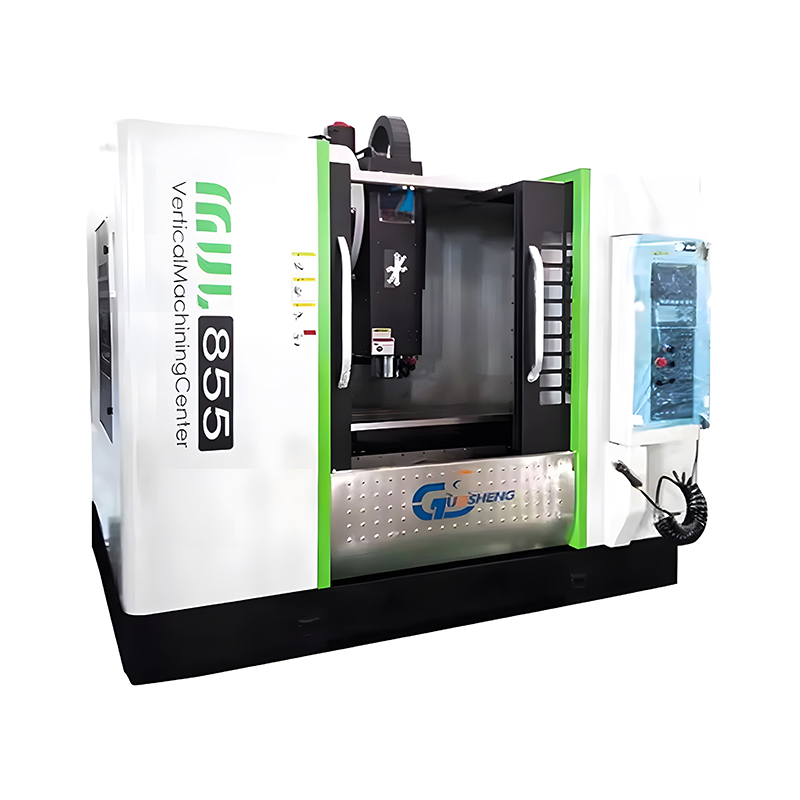 VMC-855 Hard Rail Vertical Machining Center for Heavy-Duty CuttingThis rigid, high-speed VMC handles pre-hardened and fully hardened steel with durable hard guideways and a heavy-duty spindle, ensuring the stability required for trochoidal tool paths and constant chip thickness.View Product →
Cutting Fluids and Tool Paths
Adequate coolant flow prevents thermal cracking of cutting edges. Trochoidal tool paths with constant chip thickness keep the load stable and reduce heat concentration. If the machine is not rigid enough to hold these parameters, the only economically sound solution is to switch to non-cutting processes such as EDM.
For a full overview of machining center options for this type of work, you can explore our vertical machining center range.
EDM and Heat-Treated Steel: A Natural Combination
Electrical discharge machining is the standard solution for adding features to hardened steel after heat treatment. Because EDM erodes material using electrical sparks, it does not depend on the workpiece being softer than the cutting tool.
Die-Sinking EDM for Cavities and Blind Pockets
After a mold insert is hardened to 52-56 HRC, the cavity detail can no longer be produced with standard end mills. A three-axis CNC die-sinking EDM machine uses a graphite or copper electrode to burn the exact cavity shape into the hardened steel. This is why EDM remains essential in mold shops: it finishes what conventional milling cannot reach after hardening.
A machine such as the CNCOX650 three-axis CNC EDM machine is designed for this workflow. It offers precise Z-axis control, good flushing, and stable spark generation across large cavity areas, which helps control the white layer and maintain dimensional accuracy on hardened mold components.
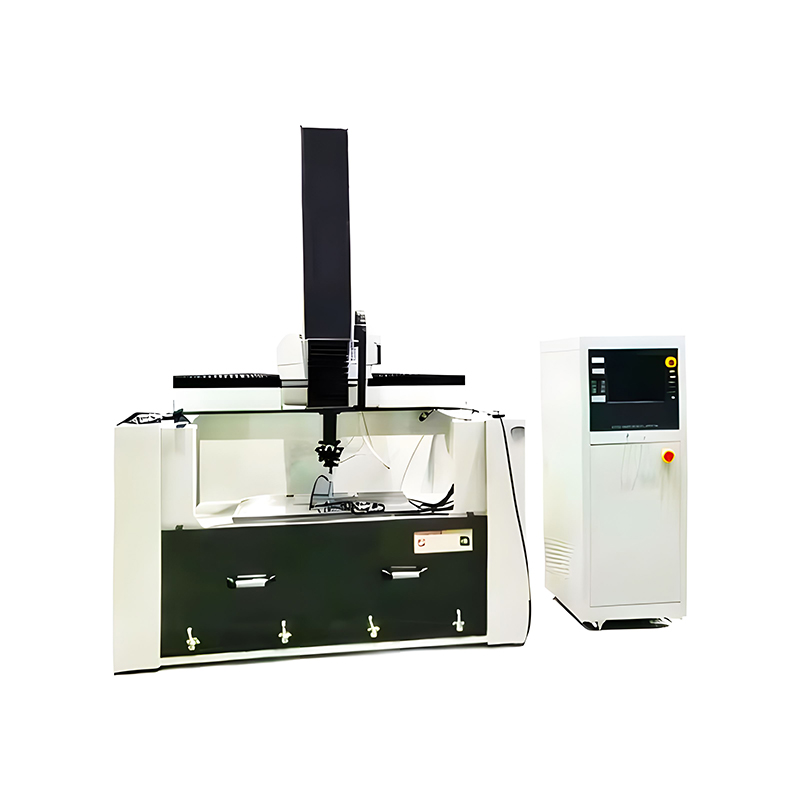 CNC-OX650 3-Axis CNC EDM Machine for Hardened MoldsDesigned for precision EDM on hardened mold components, this machine offers accurate Z-axis control, stable spark generation, and good flushing to control the white layer and maintain dimensional accuracy in large cavities.View Product →
Wire EDM for Through-Cuts and Precision Profiles
Wire EDM cuts through hardened steel with exceptional accuracy. Components such as punches, stripper plates, and precision forming tools are regularly heat treated first and then wire cut to final profile. The DZ653 high-precision moving-column wire-cutting machine is a good example of this class of equipment, offering the positioning stability needed for finishing hardened tooling at tolerances in the low micrometre range.
 DZ-653 High-Precision Moving-Column Wire Cutting MachineWith moving-column architecture and sub-micron precision, this wire EDM machine provides the positioning stability needed for finishing hardened tooling at tolerances in the low micrometre range.View Product →
If you are new to the technique, our guide on electrical discharge machining (EDM) explains the process and its typical applications in more detail.
Common Heat Treatment Mistakes in Part and Mold Manufacturing
Most heat treatment problems are not caused by the furnace itself. They come from poor planning around the interaction between heat treatment and machining.
- Machining before stress relief. Heavy roughing creates internal stress. Without a stress-relief cycle before finish machining, the workpiece can distort after precision cuts are completed.
- Ignoring distortion allowance. Hardening changes dimensions by small amounts. Leave extra stock on critical features, then finish with EDM or grinding after heat treatment.
- Uncontrolled quenching. Oil temperature, agitation, and part geometry all affect cooling uniformity. Inconsistent quenching produces soft spots, cracks, or excessive distortion.
- Skipping tempering. Untempered martensite is extremely brittle and can crack under impact or even during EDM. Always follow the recommended tempering cycle.
- Forgetting the EDM white layer. EDM leaves a recast layer on the surface. For highly stressed tooling, remove it with polishing or a second finishing pass to avoid premature failure.
- Not testing the first piece. Every heat treatment batch behaves slightly differently. A test coupon confirms hardness and microstructure before committing the production run.
Designing the process with heat treatment in mind from the start is cheaper than correcting a cracked insert or a distorted cavity after the fact.
Frequently Asked Questions About Heat Treatment
What is the difference between annealing and normalizing?
Annealing cools the steel slowly inside the furnace, producing maximum softness and relieving internal stress. Normalizing cools the steel in still air, which produces a finer pearlite structure and a more uniform grain size. Annealing is preferred when the main goal is maximum machinability or stress relief; normalizing is preferred when the goal is structure refinement before final hardening.
Why is quenching always followed by tempering?
Quenching creates martensite, which is extremely hard but also brittle. Tempering reheats the steel to a moderate temperature, allowing some of the internal stress to relax and converting part of the martensite into a tougher structure. The result is a material that keeps most of the hardness but has sufficient toughness for real service conditions.
Can you machine steel after heat treatment?
Yes, but the method depends on the hardness. Pre-hardened steel up to about 38 HRC can be milled with coated carbide tooling on a rigid machining center. Steel above 48 HRC is normally finished with EDM, wire EDM, or grinding. Hard milling of 50-60 HRC is possible with CBN tooling and a highly rigid machine, but it is more expensive and slower.
Does heat treatment cause distortion?
Yes. Thermal stress and phase transformation stress can cause small but measurable changes in size and shape. The amount depends on steel grade, part geometry, quenching speed, and furnace loading. Design the machining allowance so that this distortion can be removed by finishing operations after heat treatment.
What is the difference between heat treatment and surface hardening?
Heat treatment changes the properties of the entire cross-section of the workpiece. Surface hardening methods such as carburizing, nitriding, and induction hardening change only the outer layer while leaving the core softer and tougher. Surface hardening is used when wear resistance is needed only at the surface and the core must stay ductile.
What hardness should mold steel have for machining?
Most mold shops prefer pre-hardened steel in the 28-32 HRC range for large mold bases because it machines consistently and has adequate strength for service. Inserts that require wear resistance are machined in the annealed condition around 200 HBW and then hardened to 50-58 HRC with subsequent EDM finishing.
Key Takeaways for Your Next Heat-Treated Machining Job
Heat treatment is not a separate department in the factory. It is the starting point of every machining decision.
- Know the material condition before programming. Annealed, pre-hardened, and fully hardened steel are different machining problems.
- Plan distortion and stock allowances around the heat treatment cycle, not after it.
- Use rigid machine tools and appropriate tooling for pre-hardened and hardened materials.
- Switch to EDM or wire EDM for features that cannot be economically machined after hardening.
- Always include a test coupon when the heat treatment result is critical for production.
Selecting the right machine for the material condition is the fastest way to reduce tooling cost and scrap. Whether the job requires a heavy-duty machining center for pre-hardened steel or an EDM machine for hardened cavities, the correct equipment starts with understanding what heat treatment has done to the metal.
PREV:No previous article
NEXT:What Is an EDM Machine? A Practical Guide to Electrical Discharge Machining
NEXT:What Is an EDM Machine? A Practical Guide to Electrical Discharge Machining
Interested in cooperation or have questions?
News
-
-
An EDM machine, also called an electrical discharge machining machine, uses controlled sparks to erode electrically conductive metal without direct contact between the tool and the workpiece. The workpiece is submerged in a diele...
READ MORE -
Cutting Tools Are Used to Convert Raw Material into Functional Parts Cutting tools are the hardened, wear-resistant elements that shear away unwanted material from a workpiece to create a finished component. They are applied in e...
READ MORE -
A CNC machine can cut, drill, mill, turn, burn, and shape almost any conductive or composite material with an accuracy that manual machines rarely match. The real question is not what a CNC machine can do in theory, but what a sp...
READ MORE
Related Products

-
Factory Address
Zhaxi Township Industrial Park, Nantong City, Jiangsu Province, China (west of Huaneng Power Plant)
-
Phone
+86-13615235768
+86-15950816906
-
Fax
+86-513-85632766
-
Email
pan.director@sunwayer.com
Stay Connected
lf you can't find the answer you're looking for, chat with our friendly team.
Stay Connected
Copyright © Nantong Sunway Science and Technology Development Co., Ltd. All Rights Reserved.
China CNC Equipment Manufacturers
Custom CNC Equipment Factory
