


 русский
 Español
A CNC machine can cut, drill, mill, turn, burn, and shape almost any conductive or composite material with an accuracy that manual machines rarely match. The real question is not what a CNC machine can do in theory, but what a sp...
READ MORE
What Can a CNC Machine Do? 10 Core Operations, Materials, and Industries Explained
Content
A CNC machine can cut, drill, mill, turn, burn, and shape almost any conductive or composite material with an accuracy that manual machines rarely match. The real question is not what a CNC machine can do in theory, but what a specific machine configuration can do for your production line. If you run a precision parts shop, you care about stable repeatability, cycle time, and surface finish. If you operate a mould shop, you care about deep cavities, hardened steel, and copper electrodes. The answers change depending on whether you choose a vertical machining center, a gantry milling machine, or an electrical discharge machine. This article explains the full functional range of modern CNC equipment and helps you map those capabilities back to real workpieces.
We will cover the main operations, the materials you can process, the industries that rely on these machines, the precision you can expect, and the practical factors that affect long-term product quality.
The Direct Answer: What a CNC Machine Can Do
A CNC machine is a programmable manufacturing tool that uses coded instructions to control the motion of cutting tools or electrical discharge electrodes. During operation, the machine reads a program and moves the spindle or table along multiple axes simultaneously. This allows it to remove material from a block to create a finished part with tight dimensional control.
The most common CNC operations are milling, drilling, turning, grinding, and electrical discharge machining. Milling and drilling are carried out by vertical machining centers and gantry milling machines. Turning is performed by CNC lathes. EDM processes are executed by die-sinking machines, wire EDM units, and small-hole drilling machines. Each operation is suited to a different workpiece geometry and material condition.
The table below gives a quick overview of the core capabilities and where they are typically used in a manufacturing environment.
| Operation | Primary Tool or Process | Typical Workpiece |
|---|---|---|
| 3-axis milling | Rotating end mill moves along X, Y, Z | Pockets, slots, flat surfaces, mould cores |
| 5-axis milling | Rotating end mill with two additional rotary axes | Complex impellers, aerospace components, deep undercuts |
| Drilling and tapping | Twist drill, spiral flute tap | Hole patterns, threaded holes, connector holes |
| Turning | Single-point lathe tool, workpiece rotates | Cylindrical shafts, bushings, threaded fittings |
| Grinding | Rotating abrasive wheel or barrel | Hardened steel surfaces, tight tolerance spindles |
| EDM die sinking | Shaped electrode erodes the workpiece by spark discharge | Mould cavities, stamping dies, hardened steel details |
| Wire EDM cutting | Moving wire electrode cuts through conductive material | Precision contour profiles, gear forms, thin slots |
Every operation above is driven by the same principle: remove material in a controlled, programmed path. The difference lies in how the tool contacts the material, how much material is removed per pass, and how precise the final surface can be.
Core CNC Machining Operations Explained
Milling and Drilling with Vertical Machining Centers
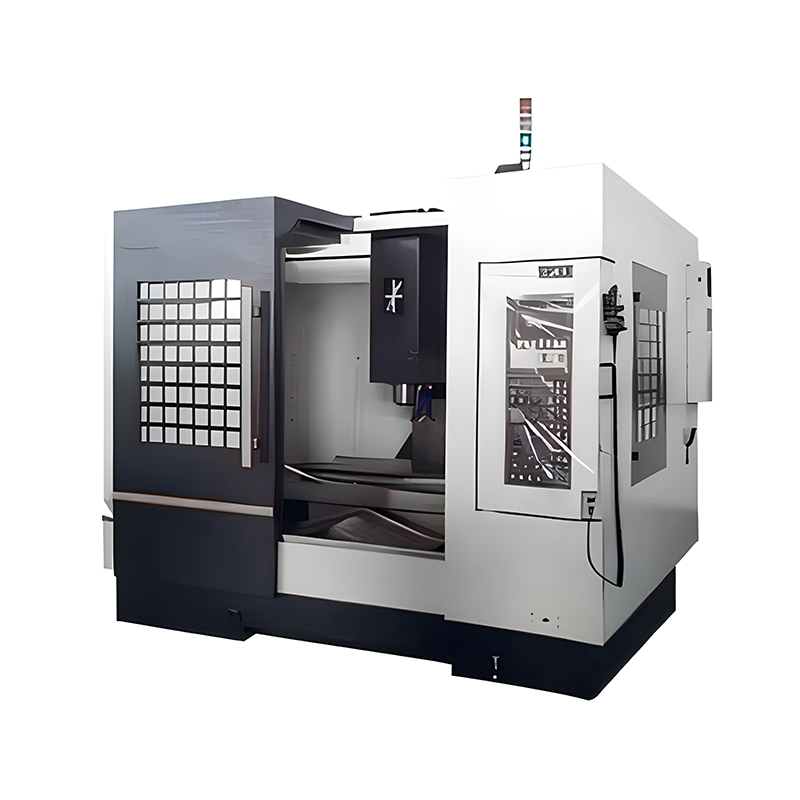
Vertical machining centers are the backbone of most metalworking shops. They use a rotating cutter with multiple flutes to remove material from the top of a workpiece. A 3-axis machine can move the cutter along X, Y, and Z, which is enough for most flat and prismatic parts. A 5-axis machine adds two rotary axes, allowing the cutter to approach the workpiece from almost any angle. This reduces the need for multiple set-ups and improves accuracy when milling curved surfaces.
Modern vertical machining centers can perform face milling, shoulder milling, slotting, drilling, reaming, and tapping in one clamping. They are ideal for aluminium automotive components, steel mould plates, brass and bronze valve bodies, and general-purpose machine parts. The key factor is spindle rigidity. A high-speed spindle is useful for finishing soft metals, but if the machine structure is not rigid enough, heavy roughing operations will produce chatter and poor surface finish.
Turning for Cylindrical Parts
A CNC lathe rotates the workpiece while a stationary cutting tool moves along the length and diameter. This process is called turning. It is the most efficient way to produce cylindrical shapes such as shafts, pins, sleeves, and threaded components. A basic 2-axis lathe controls the radial and axial motion of the tool. A turning center with live tooling can also perform milling and drilling on the workpiece without moving it to another machine.
For example, a stainless steel valve stem can be turned, drilled, and tapped in a single cycle. The material removal rate is high, and the surface finish depends on feed rate, cutting speed, and insert geometry. For long, slender parts, tailstock support and proper toolpath selection become critical to avoid vibration and dimensional drift.
EDM for Hard Materials and Deep Cavities
Electrical discharge machining works by creating a controlled spark between an electrode and the workpiece. The workpiece must be electrically conductive. EDM can machine hardened steel, cemented carbide, titanium alloys, and other materials that are difficult to cut with conventional milling. Because there is no mechanical contact, there is no cutting force, so fragile features can be produced without distortion.
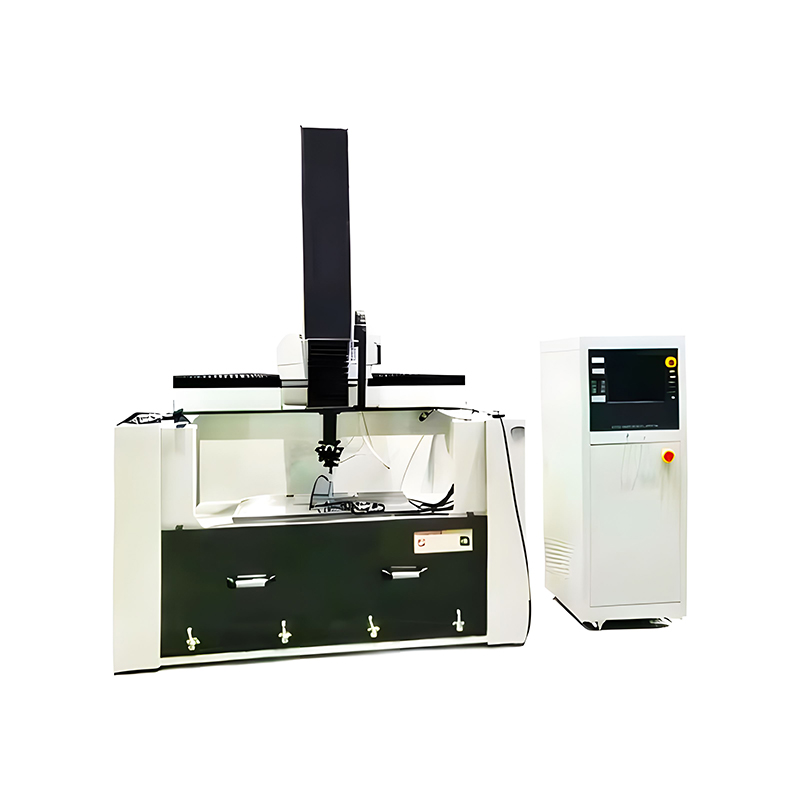
Die-sinking EDM uses a shaped electrode to burn a cavity into the workpiece. Multi-axis EDM machines can move the electrode in three directions, which is useful for complex mould cavities with ribs and side walls. Wire EDM uses a continuously moving wire to cut precise contours through a block of material. Small-hole EDM uses a rotating hollow electrode to drill small, deep holes in hardened steel or superalloys.
Precision Grinding and Engraving
Grinding is typically a finishing process. It uses an abrasive wheel to remove very thin layers of material, which gives a high accuracy and a fine surface finish. CNC grinding machines are used for parts that need roundness better than a few microns, such as hydraulic valve spools or bearing journals. Engraving and engraving-milling machines are lighter and faster. They can carve fine text, decorative patterns, and shallow three-dimensional reliefs. A graphite engraving machine is specifically designed to cut graphite electrodes for EDM mould making.
Materials a CNC Machine Can Process
The functional range of a CNC machine is largely determined by the materials it can handle. A standard milling center with a high-speed spindle and carbide tooling can cut soft materials like aluminium, brass, and most plastics. With a lower-speed, high-torque spindle, the same machine can mill steel, stainless steel, cast iron, and even hardened tool steel. The harder and tougher the material, the more important the machine rigidity becomes.
- Aluminium and aluminium alloys – high-speed milling, engraving, mould making. Example: DX6060 aluminium mould engraving machine.
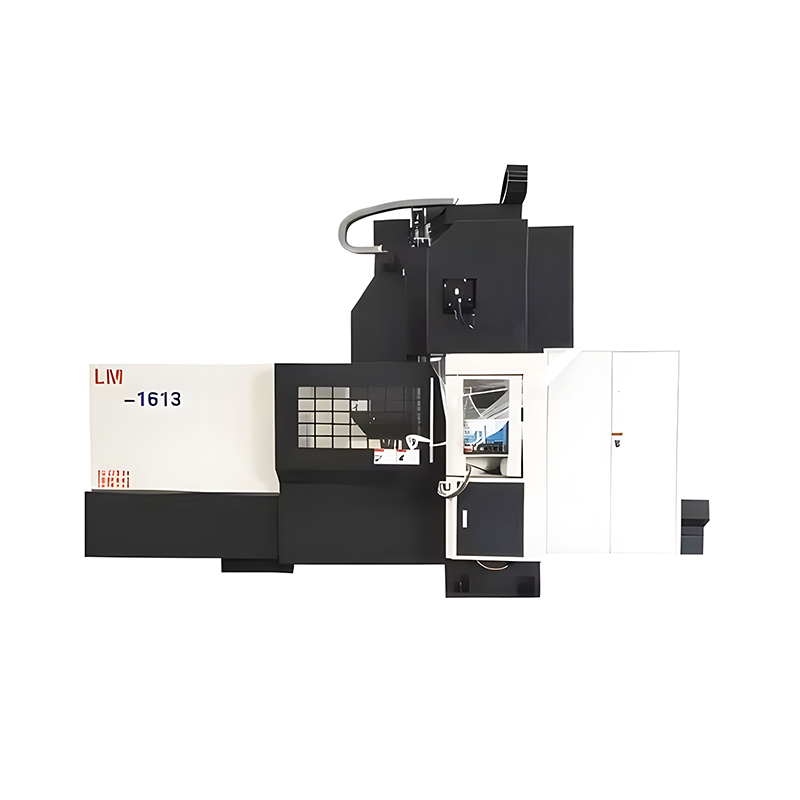
- Steel and stainless steel – heavy milling, drilling, and tapping. Example: DX1080 gantry type CNC for steel and cast iron.
- Copper and brass – conductive materials for electrodes and precision parts. Example: DX7580 copper electrode milling machine.
- Graphite – commonly used for EDM electrodes. Needs dust extraction and a rigid machine. Example: graphite engraving milling machine.
- Titanium and superalloys – aerospace applications. Often processed with EDM or low-speed heavy milling.
- Thermoplastics and composites – machining with sharp cutters and controlled feed rates to prevent melting or delamination.
At the other end of the scale, some materials are extremely difficult to machine with conventional cutters. Thick, hardened tool steel with a hardness above 50 HRC is usually left to EDM or wire EDM. Ceramics and some non-conductive composites may require special grinding tools or laser-based processes, which are outside the standard CNC milling capability.
Industries That Use CNC Machines
CNC machines serve every sector that manufactures metal or durable parts. The most common users are mould and die shops, precision machining subcontractors, automotive component factories, electronics manufacturers, and aerospace suppliers. Within each industry, the specific tasks vary greatly, and the machine choice follows the workpiece size and material.
Mould and die shops rely on die-sinking EDM, wire EDM, and high-speed milling machines. A stamping die for a car body often requires a large die block, gantry milling, and wire-cut contouring of the cutting edge. A plastic injection mould needs a polished cavity with small ribs, which is best achieved with a combination of milling and EDM.
Automotive part makers use vertical machining centers for aluminium housings, cast iron brake components, and steel suspension parts. The cycle time matters. A rigid machine with a fast tool changer can reduce production time significantly. Automotive suppliers also value repeatability, because every part must meet the same tolerance over thousands of cycles.
Electronics manufacturers often machine aluminium heat sinks, graphite electrodes, and thin copper components. Engraving milling machines and high-speed vertical centers are common in this segment. The parts tend to be small, but the demand for fine detail and tight tolerances is high.
Aerospace suppliers work with difficult materials such as titanium, Inconel, and high-strength stainless steel. Five-axis milling machines are used for complex structural parts, while EDM drilling machines process cooling holes in turbine blades and nozzle guide vanes. The workpiece area can be large, which is why a gantry type machine is preferred for long aerospace structures.
Precision and Tolerances to Expect
Modern CNC machining centers are capable of positioning accuracy within the range of ±0.005 mm to ±0.01 mm under stable thermal conditions. This is a typical specification for high-quality machining centers used in tool and die production. The actual achievable tolerance depends on machine geometry, spindle runout, thermal expansion, tool wear, and the workpiece material.
Surface finish is another important parameter. A precise milling operation with a fine feed rate can achieve a Ra value of 0.4 to 0.8 µm, while grinding can reach Ra 0.1 to 0.2 µm. If you need a mirror finish, you will usually need a polishing step after machining. Electrical discharge machining produces a recast layer that may need to be removed if the application requires a very fine surface.
These values are industry-standard expectations for good machine tools. They are not guarantees for every workpiece. A long, slender part will deflect more than a short, rigid block, and an inaccurate clamping fixture can cause a mismatch in tolerance even if the machine is precise.
How to Choose the Right CNC Functional Set
There is no single machine that does everything perfectly. The selection process starts with your workpiece geometry and material. The following table provides a practical starting point.
| Workpiece Requirement | Recommended CNC Machine Type | Key Feature to Check |
|---|---|---|
| Small to medium prismatic parts in aluminium or steel | Vertical machining center | Spindle speed and tool change time |
| Large mould bases, long structural parts | Gantry milling machine | Worktable travel and stiffness |
| Hardened steel cavity with complex internal shape | Die-sinking EDM | Electrode size and connection type |
| Small precision holes in hard metal | CNC EDM drilling machine | Number of axes and hole diameter range |
| Fine contour profiles in conductive material | Wire EDM | Wire spool capacity and taper angle |
| Graphite electrode manufacture | Graphite engraving milling machine | Dust extraction system and rigidity |
Before purchasing, inspect the machine’s structural components and the quality of its guide rails. A machine that uses a heavy cast bed and high-precision linear guides will keep its accuracy longer. Also consider the availability of spare parts, the service level from the supplier, and the warranty policy. The machine with the cheapest purchase price may not be the best investment if it causes frequent downtime.
If you are unsure about the suitable model for your parts, it is better to contact our team with sample drawings. We can recommend the machine configuration that matches your tolerance requirements and production volume. For engraving operations, you can also read our CNC engraving milling machine knowledge guide to understand the differences between engraving and conventional milling.
Frequently Asked Questions About CNC Machine Capabilities
Can a CNC machine do both milling and turning?
Milling and turning require different machine architectures. A vertical machining center holds the workpiece stationary and rotates the tool, while a lathe rotates the workpiece and holds the tool stationary. There are multitasking turning centers and machining centers with rotary tables that can perform both functions, but they are more expensive and complex. For most shops, dedicated machines for milling and turning are simpler and more cost-effective.
What is the difference between 3-axis and 5-axis CNC machining?
A 3-axis machine moves the tool along X, Y, and Z. It can machine most flat and prismatic parts, but it cannot reach undercuts or inclined surfaces without repositioning the workpiece. A 5-axis machine adds two rotary axes, allowing the tool to approach the workpiece from multiple directions. This reduces set-up time and makes it possible to machine complex shapes like impellers and turbine blades.
Can CNC machines work on hardened steel?
Yes. Milling hardened steel above 50 HRC is possible with carbide or ceramic tools, but it is slow and can generate high cutting forces. Die-sinking EDM and wire EDM are often used for hardened steel because they do not produce cutting forces and can achieve sharp internal corners. For large hard blocks, the best approach is to use EDM for the final detail after roughing in the soft state.
How does EDM differ from regular milling?
EDM removes material through electrical discharges, not by cutting with a hard tool. There is no direct mechanical contact, so the workpiece does not receive cutting forces. This makes EDM suitable for fragile features and materials that are too hard for typical milling. However, EDM is slower than milling and leaves a thin recast layer that may need polishing.
What materials cannot be processed by a standard CNC machine?
Non-conductive materials can be milled if they are not too brittle or heat-sensitive, but they cannot be processed by EDM. Ceramics, glass, very hard carbons, and some advanced composites often require diamond grinding or laser processing. Standard CNC milling equipment is not ideal for these materials because cost per removed volume becomes very high.
A CNC machine is a versatile production tool, but its practical range depends on the specific machine and its configuration. Whether you need high-speed aluminium milling, heavy steel removal, wire-cut precision, or deep EDM cavities, there is a CNC machine type that fits the job. Use the operation type, material, workpiece size, and tolerance requirements as your guiding factors when selecting equipment. That approach will save you time, reduce scrap, and give you a machine that remains productive for years.
PREV:No previous article
NEXT:What Is a 5 Axis CNC Machine? Definition, Types, Applications & Buying Guide
NEXT:What Is a 5 Axis CNC Machine? Definition, Types, Applications & Buying Guide
Interested in cooperation or have questions?
News
-
-
What Is a 5 Axis CNC Machine? A Direct Answer for Shop Owners Imagine a turbine blade arriving at your machine shop. It has complex sculpted surfaces, a twisted root form, and the supplier expects it on a two-week deadline. With ...
READ MORE -
The Direct Answer: Which Is Stronger Titanium is stronger than aluminum. That holds true for nearly every commercial grade of the two metals, but the useful answer becomes more nuanced once you compare strength against weight. A ...
READ MORE -
Case hardening is a thermochemical surface-hardening treatment that diffuses carbon, nitrogen, or both into the outer layer of a low-carbon steel workpiece. The result is a shallow, hard, wear-resistant shell that surrounds a sof...
READ MORE
Related Products


-
Factory Address
Zhaxi Township Industrial Park, Nantong City, Jiangsu Province, China (west of Huaneng Power Plant)
-
Phone
+86-13615235768
+86-15950816906
-
Fax
+86-513-85632766
-
Email
pan.director@sunwayer.com
Stay Connected
lf you can't find the answer you're looking for, chat with our friendly team.
Stay Connected
Copyright © Nantong Sunway Science and Technology Development Co., Ltd. All Rights Reserved.
China CNC Equipment Manufacturers
Custom CNC Equipment Factory
