


 русский
 Español
A counterbore is a cylindrical, flat-bottomed recess machined concentrically around a through hole so that a bolt head, cap screw, or nut sits flush with - or slightly below - the surface of a workpiece. The same word also names ...
READ MORE
What Is a 5 Axis CNC Machine? Definition, Types, Applications & Buying Guide
Content
- 1 What Is a 5 Axis CNC Machine? A Direct Answer for Shop Owners
- 2 The Five Axes Explained: X, Y, Z, A, B and C
- 3 Two Main Types of 5 Axis CNC Machines
- 4 Why Shops Switch to 5 Axis Machining
- 5 Where 5 Axis CNC Machines Are Used
- 6 Critical Specifications for a 5 Axis CNC Machine
- 7 5 Axis vs 3 Axis: Cost, ROI, and Practical Boundaries
- 8 Five Common Myths About 5 Axis Machining
- 9 How Nantong Sunway Supports 5 Axis Machining Needs
- 10 Frequently Asked Questions About 5 Axis CNC Machines
- 10.1 What is the definition of a 5 axis CNC machine?
- 10.2 How many axes do I actually need for my parts?
- 10.3 What is the difference between full 5 axis and 3+2 positioning?
- 10.4 Can a 5 axis machine cut advanced materials?
- 10.5 How long does it take to produce a 5 axis program?
- 10.6 What maintenance is needed on the rotary axes?
- 10.7 Is a 5 axis machine a good choice for making graphite electrodes?
- 10.8 Can a 5 axis machine replace a wire EDM?
- 10.9 How much more expensive is a 5 axis machine compared to a 3 axis?
- 10.10 What is the most important thing to check before buying a 5 axis machine?
- 11 Bottom Line: Is 5 Axis Right for Your Shop?
What Is a 5 Axis CNC Machine? A Direct Answer for Shop Owners
Imagine a turbine blade arriving at your machine shop. It has complex sculpted surfaces, a twisted root form, and the supplier expects it on a two-week deadline. With a conventional 3-axis vertical machining center, you would need seven setups, seven custom fixtures, and a lot of fingers crossed for accuracy. With a 5 axis CNC machine, you clamp the raw billet once and machine nearly every feature in a single cycle.
A 5 axis CNC machine is a computer-controlled milling machine that moves a cutting tool or workpiece along three linear axes (X, Y, Z) and two rotary axes (A, B, or C) simultaneously. This simultaneous motion lets the tool approach the workpiece from almost any angle without repositioning it.
The practical impact for a machine shop is enormous. It cuts fixture costs, shortens lead times, improves surface finish, and makes geometrically difficult parts a real, repeatable job. It is not just a marketing feature. It is the difference between a shop that can win contracts for impellers, medical implants, and aerospace structural components, and one that must turn those orders away.
The Five Axes Explained: X, Y, Z, A, B and C
Before comparing machines, it is worth knowing what the axes actually do. The naming convention follows ISO 841, which is the international standard for coordinate axes on numerically controlled machines.
Three linear axes define the position of the tool tip in space. Two rotary axes define its orientation. A 5 axis machine can use any two of the rotary axes, but the most common combinations are A+B (trunnion tables) and A+C (swivel head machines).
Linear Axes
X axis is the horizontal side-to-side movement. Y axis is the horizontal front-to-back movement. Z axis is the vertical up-and-down movement. Their interaction points the tool tip directly at a coordinate position on the workpiece.
Rotary Axes
A axis rotates around the X axis. B axis rotates around the Y axis. C axis rotates around the Z axis. On a 5 axis machine, you typically see A and B, or A and C, or B and C. The machine controller coordinates all five so the tool can cut while the workpiece is tilted and rotated at a constant orientation relative to the cutting edge.
| Axis | Type | Movement | Typical Application |
|---|---|---|---|
| X | Linear | Left / Right | Milling wall pockets |
| Y | Linear | Front / Back | Cutting stepped shoulders |
| Z | Linear | Up / Down | Plunging and slotting |
| A | Rotary | Rotates around X | Tilting a workpiece |
| B | Rotary | Rotates around Y | Angular approach to a rib |
| C | Rotary | Rotates around Z | Rotating a circular part |
Two important terms appear again and again in 5 axis: full 5-axis simultaneous machining and 3+2 positioning. Full 5-axis means all five axes move in one interpolated program, used for sculpted surfaces like blisks. 3+2 means the rotary axes tilt to a fixed orientation, then the three linear axes cut. Most shops use both on the same machine, and the decision depends on the geometry.
Two Main Types of 5 Axis CNC Machines
If you are evaluating a 5 axis machine, the single biggest structural decision is whether the workpiece or the tool carries the rotary axes. Each layout has a different strength, and the best choice depends on the dominant parts you make.
Trunnion Table (Workpiece-Tilting)
A trunnion machine mounts the workpiece on a large rotary table, which rests on a smaller tilting axis. The two rotary axes work like a cradle. This design keeps the workpiece close to the bearings, so it can handle very heavy parts and high cutting forces. On the downside, the table takes up work volume, and very large or very tall parts may not fit.
Swivel Head (Spindle-Tilting)
A swivel head machine keeps the table fixed and tilts the spindle carrier instead. The rotary axes sit in the upper structure. This allows the machine to work on very long or very large workpieces because the table is a simple flat surface. The trade-off is that the tilted spindle head has a longer force path, so you may need to reduce feed rates when machining steep angles on hard materials.
| Feature | Trunnion Table | Swivel Head |
|---|---|---|
| Where the rotary axes are | Under the workpiece | Above the table in the head. |
| Typical part size | Small to medium | Large to very large |
| Heavy cutting capability | High, due to short force path | Moderate, longer force path lowers stiffness |
| Chip evacuation | Good, table tilts chips away | Excellent, chips fall directly |
| Best for | Dies, molds, impellers | Aerospace frames, large housings |
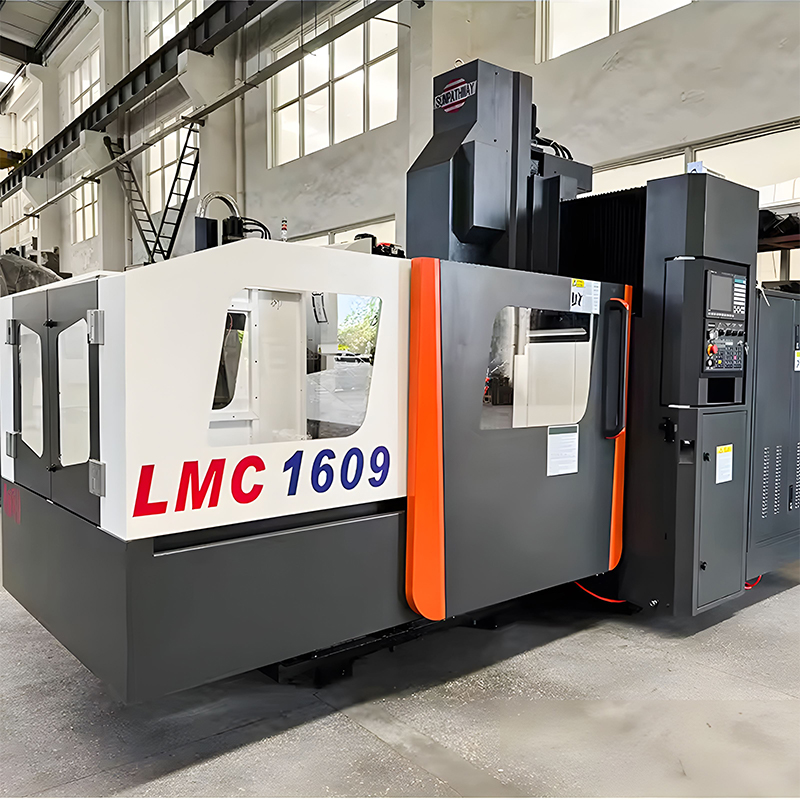 LM-1609 5-Axis CNC Gantry Milling Machine for Large Complex PartsThis gantry milling machine features a rigid structure and 5-axis linkage for simultaneous multi-angle machining. It suits aerospace and automotive industries, handling workpieces up to 1600 kg with high stability.View Product →
Why Shops Switch to 5 Axis Machining
The four measurable results that justify a 5 axis machine are fewer setups, higher accuracy, better finish, and faster delivery. Each one can be tied to a cost number if you track your current production data.
Fewer Setups
A 3-axis machine must approach from one side at a time. An aluminum bracket that requires drilling, slotting, and a side rib may need four separate operations with four fixtures. Every fixture introduces runout error. Every clamping sequence takes minutes to set up and verify. On a 5 axis machine, the same bracket is clamped once. The rotary axes reposition the part, so the tool can reach every feature. You lose the re-clamping time, the fixture cost, and the cumulative error.
Improved Accuracy
In a multi-setup job, the accuracy is limited by the datum shared between setups. If you drill a bore in setup one and mill a face in setup two, you can only guarantee the position to the capability of the fixture and the operator. With one setup, all features share the same machine datum. Typical result: part tolerances of ±0.005 mm are achievable without chasing offsets across three or four work centers.
Better Surface Finish
A 5 axis machine can orient the tool flute so it is always cutting with a sharp edge, not dragging with the side of the shank. This is especially important in finishing passes on hardened steel and nickel alloys. You can use shorter tool overhangs because the tool can approach from straight above, which reduces vibration and chatter. The surface quality becomes more consistent, and polishing time drops.
Shorter Lead Times
One setup means one program, one inspection point, and one completed part flow. On large castings, a 3-axis process can take a week to move between work centers. A 5-axis machine often completes the part in one day and frees up floor space for another job.
Where 5 Axis CNC Machines Are Used
The industries that pay the most for 5-axis capability are aerospace, mold and die, automotive, medical, and energy. Each one has a specific part shape that demands angular cutting or multi-face machining.
Aerospace
Titanium compressor blades, integrally bladed rotors (blisks), and structural frames all have deep pockets and thin walls. A 5 axis machine tilts the tool to keep the cutting edge in contact with the web at the correct angle. This reduces tool bending and prevents the thin flanks from deflection. For superhard alloys, some shops add a 5 axis EDM drilling machine to make deep cooling holes in blade roots.
Mold and Die
Injection molds and die-casting dies are often the easiest reason to buy 5 axis. The cavity has walls that meet at different angles. A 3-axis machine would leave small fillets that a hand polisher must chase. A 5 axis machine can cut the draft and the cavity wall in one pass, so the mold opens correctly with minimal EDM work afterward. Graphite electrodes for EDM are also machined on small 5 axis milling machines to produce complex electrode shapes.
Automotive
Performance parts such as intake manifold cores, gearbox housings, and con rod molds benefit from 5 axis. The ability to machine a complete manifold core in one setup eliminates parting line mismatch and shortens the development cycle.
Medical
Custom hip replacements and spinal implants are small parts with complex anatomical surfaces. 5 axis machining cuts titanium and cobalt-chrome with short tools and minimal heat, which is critical for the fatigue life of an implant.
Energy
Gas turbine blades, pump volutes, and compressor wheels all have curved profiles that change continuously along the surface. They require simultaneous 5-axis interpolation because a simple tilt and cut would leave steps along a twisted surface.
| Industry | Typical Parts |
|---|---|
| Aerospace | Blisks, turbine blades, structural ribs |
| Mold and Die | Injection molds, die-casting dies, graphite electrodes |
| Automotive | Manifold cores, gearbox housings, mold inserts |
| Medical | Hip stems, spinal implants, surgical tools |
| Energy | Gas turbine blades, pump volutes, impellers |
 XK-430 High-Speed 5-Axis EDM Drilling Machine for Precision HolesDesigned for drilling cooling holes in turbine blades and molds, this EDM machine uses 5-axis control and high-speed technology to produce burr-free holes as small as 0.1 mm with tight tolerances.View Product →
 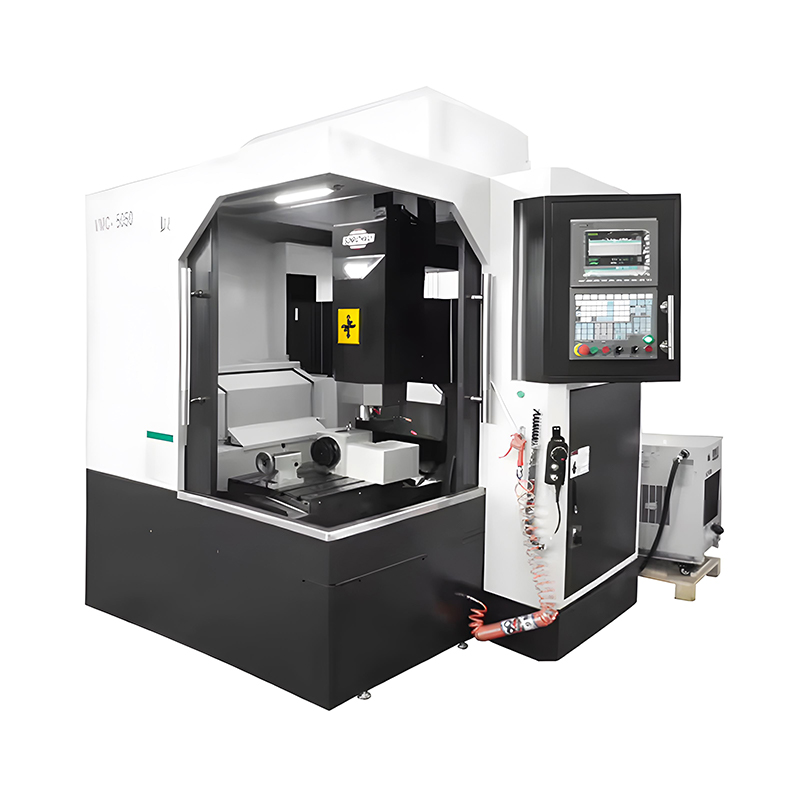 DX-5050 3/4/5-Axis CNC Engraving Milling Machine for Versatile ProductionThis modular machine supports 3, 4, or 5-axis configurations, making it adaptable for small-batch and high-mix production. It delivers precise surface finishes and integrates seamlessly with CAD/CAM software.View Product →
Critical Specifications for a 5 Axis CNC Machine
What separates a good 5 axis machine from a problematic one is not the number of axes on the brochure. It is the combination of working envelope, rotary range, spindle torque, and controller functions.
Working Envelope
The most common error is picking a table that is too small after adding 5-axis tilt. A part that fits a 600 mm table may not fit the same table once the A axis tilts it 30 degrees. Check both X/Y/Z travel and the maximum workpiece diameter and height when tilted.
Rotary Axis Range
Look for at least ±120 degrees on the tilting axis. Some machines offer ±30 degrees or ±105 degrees, which limits your angle, especially when you need to cut a deep undercut. The C axis should be continuous (360 degrees) so you can rotate the part without resetting.
Spindle Power and Speed
For aluminum and plastics, 12,000 to 24,000 rpm with 15 to 30 kW is common. For steel, stainless, and titanium, you need lower speed but higher torque. Check the spindle curve: does it deliver full torque at 1,000 rpm? If the spindle only delivers torque at high speed, heavy roughing of steel will be slow.
Accuracy
A reliable 5 axis machine should hold positioning accuracy of 0.008 mm across the full travel and repeatability of 0.005 mm. For contour cutting, the important spec is the volumetric and circular contour accuracy, which is usually measured on the machine at the factory.
Controller for 5 Axis
The controller must have RTCP (rotational tool center point) compensation, 5-axis simultaneous interpolation, and preferably collision detection. RTCP is what keeps the tool tip on the programmed path while the rotary axes tilt. Without it, the program must be post-processed to account for the machine geometry, which is less practical for programming work.
5 Axis vs 3 Axis: Cost, ROI, and Practical Boundaries
A 3 axis machine is still the correct choice for many simple parts. The 5 axis decision should be based on part geometry, not on the idea that more axes are always better.
| Factor | 3 Axis | 5 Axis |
|---|---|---|
| Machine price | $30,000 to $80,000 | $100,000 to $300,000+ |
| Setups per order | 3 to 6 | 1 |
| Fixture cost | High, many fixtures | Low, almost one |
| Accuracy | 0.01 to 0.02 mm | 0.005 to 0.008 mm |
| Programming difficulty | Low | Medium to high |
The practical boundary is simple. If a part consists of three flat faces, a few drilled holes, and no sharp undercuts, a 3 axis will machine it fast and cheaply. If the part has is a twisted surface, a deep cavity, or a row of pockets arranged around a cylinder, a 5 axis will do it better and more economically.
Five Common Myths About 5 Axis Machining
Most shops do not need to replace every machine. They need to understand the expense and the toolpath planning before buying.
Myth 1: 5 axis machines are only for aerospace factories
Not true. Small job shops make injection molds, bushings, and custom fixtures on 5 axis machines. Prices for compact machines have fallen over time, and the daily operating cost can be similar to a 3 axis machine once fixtures are eliminated.
Myth 2: 5 axis programming is impossible for a traditional shop
Modern CAM software has simplified this. Heuristics for toolpath generation, collision checking, and tool orientation rules are built into packages. The difficult part is learning the post-processor for a specific machine, but this is a capital investment.
Myth 3: 5 axis machines are less rigid
A well-built trunnion machine is often more rigid than a 3 axis machine because the table is supported on both sides. The machine builder balances casting, linear guides, and ball screw stiffness. The problem is usually in the programming, not the construction.
Myth 4: 5 axis always improves accuracy
It improves accuracy only when the part is complex enough that it eliminates setup errors. For simple parts, a 3 axis machine with a simple fixture can compare or beat a 5 axis that is not aligned correctly.
Myth 5: You necessarily need expensive live tooling
Live tooling is for lathes. A 5 axis is a milling machine, and the rotary axes are already in the machine table or head. It is the control system and cam software that require extra investment.
How Nantong Sunway Supports 5 Axis Machining Needs
Nantong Sunway Technology Development Co., Ltd. manufacturers CNC equipment for mold making, precision part machining, and the automotive and aerospace supply chains. Its product line covers 3 axis and 5 axis vertical machining centers, gantry milling machines, engraving and milling machines, EDM die-sinking, EDM drilling, and slow wire-cut EDM.
For shops focused on large or complex workpieces, the LM1609 five-axis gantry milling machine is a strong example. The gantry structure supports heavy dies, long aerospace parts, and structural components that need the 5 axis approach. The company also builds 5 axis EDM drilling machines and 5 axis engraving and milling machines for graphite electrodes and small mold details.
Sunway has a foundry workshop of about 10,000 square meters and a large structural part processing shop. This allows the company to machine castings and bedways, assemble complete machines, and control quality from the base frame to the spindle. You can read more in the comprehensive gantry milling machine knowledge guide.
If you are in the middle of a 5 axis machine purchase and want to verify the machine's shape, table capacity, or controller options, a technical consultation is the best next step.
Frequently Asked Questions About 5 Axis CNC Machines
What is the definition of a 5 axis CNC machine?
A 5 axis CNC machine is a computer-controlled milling center with three linear axes (X, Y, Z) and two rotary axes (A, B, or C) that move simultaneously, enabling the cutting tool to reach almost any angle without repositioning the workpiece.
How many axes do I actually need for my parts?
If your parts are primarily flat plates with drilled holes, a 3 axis machine will produce them faster and at lower cost. If the part has sculptured surfaces, deep undercuts, or irregular orientations, 5 axis will save time and improve accuracy.
What is the difference between full 5 axis and 3+2 positioning?
Full 5 axis machining moves all five axes during the cutting operation. This is used for complex contours like impellers. 3+2 positioning tilts the rotary axes to a fixed angle, then cuts with the linear axes only. Both are used in a typical 5 axis machine.
Can a 5 axis machine cut advanced materials?
Yes. It is especially useful for high-temperature alloys, titanium, and composites because the tool can be oriented to keep the cutting edge near the surface, reducing heat and tool wear.
How long does it take to produce a 5 axis program?
It remains longer than a 3 axis program. A simple turbine blade can take 2 to 5 hours to program with adequate toolpaths and collision checks. The time savings come from eliminating multiple setups and fixtures.
What maintenance is needed on the rotary axes?
Rotary axes need regular lubricant checks, calibration, and occasional backlash measurement. The machine manufacturer should provide a working maintenance schedule.
Is a 5 axis machine a good choice for making graphite electrodes?
Yes. Small 5 axis engraving and milling machines are used to shape graphite electrodes for EDM, and the 5 axis capability helps create complex electrode shapes.
Can a 5 axis machine replace a wire EDM?
No. A 5 axis milling machine removes material mechanically, while wire EDM is an electrical discharge process. They are complementary. Many shops use a 5 axis mill for roughing parts and a wire EDM for finishing deep slots and narrow tools.
How much more expensive is a 5 axis machine compared to a 3 axis?
A general shop can expect to pay 2 to 4 times more for a 5 axis machine than for a comparable 3 axis machine. The difference is justified by fewer fixtures, less rework, and shorter delivery times.
What is the most important thing to check before buying a 5 axis machine?
Your workpiece size, the maximum tilt angle you need, and the required accuracy. Confirm the rotary travel and the flatness and torque of the A/B or A/C axes against your actual drawing.
Bottom Line: Is 5 Axis Right for Your Shop?
5 axis CNC machining is a practical answer for complex parts and multi-side work. It reduces the use of fixtures, improves accuracy, and shortens the flow from raw material to finished part. It also adds programming complexity and requires a higher investment.
Run a simple arithmetic test for one of your recurring parts. Count the current 3-axis setup time, fixture cost, and scrap rate. Then calculate the theoretical 5-axis cycle with one clamp. If the total annual labor and fixture cost exceeds the added payment for the machine, the business case is solid.
Before making a purchase, verify the rotary axis clearance, the controller's RTCP features, and the spindle torque curve. A technical conversation with a manufacturer is the fastest path to a clear recommendation. Contact our engineering team to discuss your specific part dimensions and applications.
PREV:What Can a CNC Machine Do? 10 Core Operations, Materials, and Industries Explained
NEXT:Titanium vs Aluminum: Which Is Stronger and When Should You Choose Each?
NEXT:Titanium vs Aluminum: Which Is Stronger and When Should You Choose Each?
Interested in cooperation or have questions?
News
-
-
A clearance fit is an assembly condition in which the minimum hole diameter is always larger than the maximum shaft diameter. In one sentence: the two mating parts are separated by a guaranteed positive gap, so they can slide, ro...
READ MORE -
Heat treatment is a controlled thermal process that changes the mechanical properties of metal by heating it to a specific temperature, holding it there, and then cooling it at a rate chosen to produce a desired internal structur...
READ MORE -
An EDM machine, also called an electrical discharge machining machine, uses controlled sparks to erode electrically conductive metal without direct contact between the tool and the workpiece. The workpiece is submerged in a diele...
READ MORE
Related Products

-
Factory Address
Zhaxi Township Industrial Park, Nantong City, Jiangsu Province, China (west of Huaneng Power Plant)
-
Phone
+86-13615235768
+86-15950816906
-
Fax
+86-513-85632766
-
Email
pan.director@sunwayer.com
Stay Connected
lf you can't find the answer you're looking for, chat with our friendly team.
Stay Connected
Copyright © Nantong Sunway Science and Technology Development Co., Ltd. All Rights Reserved.
China CNC Equipment Manufacturers
Custom CNC Equipment Factory
