


 русский
 Español

Direct answer first: to deburr means to remove the burr, the thin ridge of deformed metal that clings to an edge after cutting, drilling, milling, punching, or laser cutting. The word is simply "de-burr" - take the burr off. It i...
READ MORE
What Is Deburr? A Complete Guide to Burr Removal Methods in CNC Machining
Content
- 1 Where Burrs Come From and How Big They Really Get
- 2 The Seven Main Deburring Methods and What Each One Suits
- 3 Electrochemical Deburring: No Heat, No Force, No Missed Corners
- 4 Hand Deburring or Automated Deburring: The Cost Argument
- 5 How to Specify Deburring Before the Quote Is Issued
- 6 What to Check After Deburring
- 7 Why Moulds, Aerospace Parts, and Precision Components Suffer Most
- 8 Deburring Mistakes That Keep Coming Back
- 9 Frequently Asked Questions About Deburring
- 9.1 Is deburring the same thing as chamfering?
- 9.2 Can CNC machining produce parts with no burrs at all?
- 9.3 How much does deburring normally cost?
- 9.4 Will deburring affect a critical dimension?
- 9.5 Which deburring method works best on aluminum?
- 9.6 Does EDM leave burrs that still need removal?
- 9.7 How should parts be stored after deburring?
- 9.8 When is it worth moving from hand deburring to an automated process?
Direct answer first: to deburr means to remove the burr, the thin ridge of deformed metal that clings to an edge after cutting, drilling, milling, punching, or laser cutting. The word is simply "de-burr" - take the burr off. It is a finishing operation, not a shaping one.
That definition is the easy half. In a real shop, a burr is not a cosmetic problem. It is attached material that changes fits, scratches mating surfaces, becomes a crack initiation point under load, and turns into loose metal debris inside an assembly line. Deburring is usually the last operation on a routing sheet, the least accurately quoted, and the one that decides whether a batch ships on Friday or sits on the floor.
The rest of this guide works through where burrs come from, what actually removes them, what each method costs, and when one process clearly beats another.
Where Burrs Come From and How Big They Really Get
Any process that makes a chip makes a burr, because the cutting edge pushes material ahead of it as it exits the workpiece surface. At the instant the material passes its yield point, it stops being cut cleanly and starts deforming plastically. Part of that deformed material stays attached to the edge.
The size surprises people. In clean CNC milling, burrs typically run from 0.02 mm to 0.2 mm, and the same tool path can produce a burr three times larger once the cutter has worn. That is the trap: the feature is tiny, invisible without magnification, and still large enough to blow a plus-minus 0.05 mm tolerance.
Material matters just as much. Aluminum forms soft, tall burrs that smear rather than break. Cast iron fractures and sheds brittle burrs that fall off on their own. Stainless steel and titanium produce tough, ductile burrs that resist a hand file and work-harden if you push too hard.
| Process | Burr Form | Typical Size | Usual Removal Method |
|---|---|---|---|
| Drilling | Exit-side lip or roll-over | 0.02 - 0.2 mm | Chamfering, reaming, brushing, ECM |
| Milling | Rolled edge along the top face | 0.02 - 0.3 mm | Hand deburring, power brushing, abrasive flow |
| Turning | Long helical curl on the circumference | 0.05 - 0.5 mm | In-machine chamfering, hand work, brushing |
| Stamping | Torn and bent edge | 0.1 - 1.0 mm | Tumbling, vibratory finishing, abrasive belts |
| Laser cutting | Dross and recast layer | 0.05 - 0.5 mm | Grinding, abrasive blasting, brushing |
| Grinding | Thin hard burr pressed into the surface | 0.01 - 0.1 mm | ECM, abrasive flow, hand stone |
Reading that table, the practical conclusion is that burr size is a process variable you can influence, not a fixed cost you simply absorb. Sharper tooling, smaller feed per tooth, climb milling on the exit edge, and a tool wear limit tied to a measured burr height all shrink the problem before anyone reaches for a file.
The Seven Main Deburring Methods and What Each One Suits
There is no universal deburring process. Every method below trades reach, speed, cost, and edge quality against each other.
- Hand deburring. Files, scrapers, oil stones, and abrasive pads at a bench. It is the most flexible method, reaches awkward geometry that nothing else touches, and needs no tooling investment. It is also the least repeatable, and on a 5,000-piece order the same edge will be finished six different ways by six different operators.
- Power brushing. Nylon abrasive or steel brushes mounted in a spindle, robot cell, or dedicated deburring machine. Fast and consistent, and it works well for edge breaking on the outside of a part. It struggles inside deep cavities because the bristles cannot reach past a certain depth-to-width ratio.
- Chamfering and edge rounding. Instead of removing the burr, the operation cuts the corner off entirely. This gives the most predictable result because the edge geometry is defined by the tool, not by how long someone rubbed it. Remember that chamfering removes base material: a 0.3 mm chamfer next to a nominal dimension can push a part out of tolerance.
- Tumbling and vibratory finishing. Parts and abrasive media move together in a rotating or vibrating bowl. Cost per piece is very low at volume, and it reaches all external surfaces at once. It is a poor fit for delicate features, threads, and tight tolerances, because the media erodes everything equally.
- Abrasive flow machining and abrasive jet. A viscoelastic abrasive medium is forced through or across the part. It is one of the few mechanical methods that deburrs internal cross-drillings reliably, but the tooling fixture has to be built for that specific part family.
- Thermal energy deburring. The part sits in a chamber filled with a hydrogen and oxygen mixture that is ignited. The flame reaches roughly 3,000 degrees Celsius for a few milliseconds, which is long enough to burn off the burrs and too short to heat the part body noticeably. It handles every external and internal edge in one cycle, but it leaves an oxidized surface and is not suitable for every material.
- Electrochemical deburring. The only method on this list that targets edges by principle rather than by access. It is worth its own section.
Electrochemical Deburring: No Heat, No Force, No Missed Corners
Electrochemical deburring is a variant of electrochemical machining. The workpiece is the anode, a shaped cathode tool sits a short distance away, and electrolyte flows through the gap. DC current passes between them, and metal dissolves atom by atom at the workpiece surface.
Why do burrs vanish first? Because current density concentrates at protruding geometry. A burr tip can carry five to ten times the current density of the surrounding flat surface, so it dissolves far faster than the base material. The gap inside a typical tool is held in the 0.1 to 0.5 mm range, and a cycle usually runs from about fifteen seconds to a minute depending on how much material has to come off.
What that buys you in practice:
- No cutting force, so thin walls and fragile features are not distorted.
- No heat-affected zone on the finished edge, which matters on hardened and aerospace alloys.
- Consistent edge geometry across thousands of parts, because the tool sets the result instead of the operator.
- Access to internal cross-drillings that no brush or file will ever reach.
It is not a universal answer. Non-conductive materials are out. One-off prototypes rarely justify the tooling. Parts with enclosed cavities that cannot be flushed need redesign before they need a machine. Electrolyte handling and post-process rinsing have to be planned, not improvised.
 DJ-5000 Advanced Electrochemical Metal Etching MachineApplication scenarios and scope of application Aerospace Defense – Part numbering, serialization, and anti-counterfeit markings. Medical Implants Instruments – Applyin...View Product →
The equipment side of this is more accessible than it used to be. A modern electrochemical platform such as the DJ5000 advanced electrochemical metal etching machine combines the power supply, electrolyte circulation, and electrode fixturing needed to run controlled dissolution on edges and surfaces, which is exactly the setup electrochemical deburring requires.
Hand Deburring or Automated Deburring: The Cost Argument
Run the arithmetic before you run the debate. Suppose a part takes ninety seconds of manual deburring at a bench. At 5,000 pieces per week, that is 125 hours of labor every week, or roughly three full-time positions doing nothing but edge finishing.
If an automated cell drops that to twenty seconds, you recover about ninety-seven labor hours per week. On that volume, the payback period for a deburring cell is usually measured in months, not years. Below a few hundred pieces per batch, the same cell sits idle and hand work wins on every measure that matters.
- Batch size: hand work below a few hundred pieces, automation above a few thousand.
- Geometry: cross-holes, deep pockets, and internal threads are blind spots for hand tools. Either automate or accept that consistency depends on who is holding the file.
- Damage risk: brushing and tumbling round off features you wanted sharp. Electrochemical and hand work do not.
- Cleaning: mechanical methods generate media and debris that must be removed in a separate step.
- Audit trail: an automated cycle time and current setting are recordable process parameters. A file stroke is not.
One caveat that gets ignored: automation moves the labor, it does not delete it. Someone still loads, fixtures, monitors electrolyte or media condition, and inspects. Budget for that staffing honestly.
How to Specify Deburring Before the Quote Is Issued
Writing "deburr all edges" on a drawing is the single most common cause of argument between buyer and supplier. It means something different to every person who reads it. A workable specification answers these questions:
- Define the edge condition, not the verb. State the required result, for instance a 0.2 to 0.5 mm external edge break with no sharp corners remaining.
- Call out functional edges separately. Sealing faces, thread entries, bearing seats, and locating edges each need their own note.
- Name the surfaces that must not be touched. If brushing would scratch a cosmetic surface, say so before the parts are made.
- Check deburring against the tolerance stack. Edge removal consumes material. A deburring allowance that overlaps a tight dimension is a scrapped part, not a deburring problem.
- State the inspection method and the sample rate. Visual under 2x magnification, tactile check, or profilometer reading on a functional edge - the buyer should pick one.
- Specify cleanliness after the operation. Loose burr fragments left inside a cavity are a functional defect that no drawing note will catch at receiving inspection.
A specification that answers all six costs nothing to write and saves whole batches from rework.
What to Check After Deburring
Verification is where a lot of deburring programs quietly fail. The operation was done, nobody can prove how well, and the argument starts at the customer's incoming inspection.
- Tactile check. Draw a gloved finger or a cotton swab along the edge. It is fast, and with a calibrated reference sample it is surprisingly repeatable.
- Magnified visual inspection. Two to four times magnification under directional light reveals the roll-over that the naked eye reads as a clean edge.
- Profilometer or optical measurement. Use it on functional edges where the edge break dimension is a controlled characteristic.
- Borescope inspection of cross-holes. Internal intersections are exactly where loose burrs hide and exactly where they end up in a hydraulic or fuel circuit.
- Inspect after cleaning, not before. Chips, cutting oil, and dried coolant all read as burrs and send good parts back for rework.
- Keep a boundary sample set. One accepted edge and one rejected edge on the bench settle more disputes than any written note.
Why Moulds, Aerospace Parts, and Precision Components Suffer Most
Three industries keep running into the same wall, because their parts combine small features, hard materials, and zero tolerance for loose metal.
In mould making, a burr left on a cavity edge becomes a visible flow line on every plastic part the mould will ever produce. Mould corners and ribs are frequently finished by electrical discharge machining, which leaves its own recast layer that has to be removed separately. A small CNC electrical discharge machine for metal mould making, such as the CNC430, is typical of the equipment used on those restricted corners where a milling cutter cannot fit. It is worth understanding the fundamentals of how that process cuts before planning the deburring step that follows it - the electrical discharge machining overview covers the mechanics clearly.
In aerospace, the stakes change. Cooling holes in turbine blades and fuel passages in injectors are small, deep, and often produced in titanium or nickel superalloys. A burr that stays attached inside a fuel gallery is foreign object debris, and it will find its way downstream. Hand deburring these features is slow and inconsistent, which is why multi-axis EDM drilling and electrochemical methods became standard practice for holes that no file can enter.
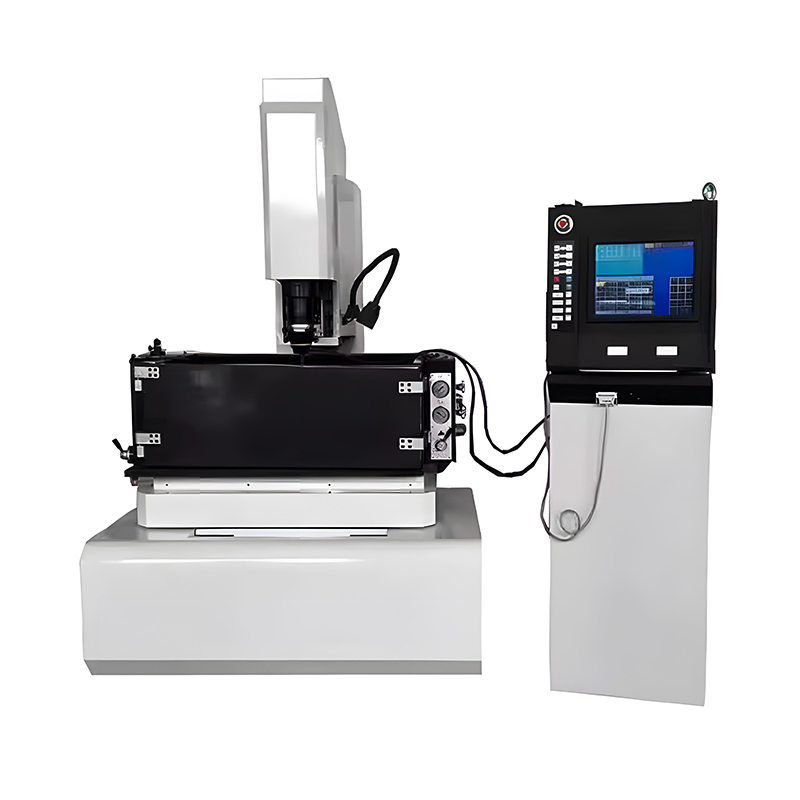 CNC-430 Small CNC Electrical Discharge Machine for Metal Mould MakingApplication scenarios and scope of application Micro-feature engraving in injection mold cavities Blind hole machining for mold cooling channels Detailed finishing on ...View Product → CNC Multi-axis EDM Drilling Machine SuppliersVIEW MORE XK-430 High-Speed CNC 5-Axis EDM Drilling Machine XK-430 High-Speed CNC 5-Axis EDM Drilling Machine is a precision-engineered electrical discharge mac...View Product →
The practical point is that deburring should be designed together with the feature that creates the burr. If the only way to reach an edge is a file, the process is already fragile. If the edge can be reached electrochemically or by a controlled EDM pass, consistency stops depending on the person at the bench.
Deburring Mistakes That Keep Coming Back
- Brushing aluminum with a steel brush. It smears the burr and smears the oxide layer instead of cutting either one off.
- Washing before deburring. Chips trapped under a burr survive the wash and reappear after the edge breaks off in service.
- Setting tolerances after the deburring process is chosen. If the edge break consumes 0.3 mm and the tolerance band is 0.1 mm, the sequence is backwards.
- Assuming the supplier will handle it. "Deburr" on a purchase order without an edge definition is an invitation to rework.
- Skipping internal intersections. Cross-drillings are the highest-risk location on any part and the easiest one to overlook.
- Ignoring post-deburring surface finish. Electrochemical and thermal methods change the edge appearance, and a customer inspecting for appearance may reject a part that is functionally better.
- Treating deburring as unskilled work. Edge finishing decides whether an assembly goes together, and it deserves a trained operator and a defined method.
Frequently Asked Questions About Deburring
Is deburring the same thing as chamfering?
No. Chamfering is one specific technique inside the larger deburring family. Deburring covers hand filing, brushing, tumbling, abrasive flow, thermal energy, and electrochemical dissolution. Chamfering simply cuts the corner away at a defined angle, which happens to remove the burr at the same time.
Can CNC machining produce parts with no burrs at all?
Not absolutely, but the burr can be pushed down to a level where it is functionally irrelevant. Sharp tooling, controlled feed per tooth, correct exit strategies, and a tool wear limit tied to measured burr height all reduce it. Some shops quote a "deburr-free" edge condition on specific features when the residual burr measures below 0.01 mm, but that claim should be verified with a sample, not assumed.
How much does deburring normally cost?
Shop floor estimates commonly put deburring at around 5 to 15 percent of the total part cost, and complex parts with many internal intersections sit at the higher end. On parts that are hand-finished at low volume, the labor share can climb well past that range.
Will deburring affect a critical dimension?
It can, and often does. Removing 0.3 mm of edge material from a feature held to plus or minus 0.1 mm is enough to scrap the part. The edge requirement and the dimensional tolerance have to be reviewed together before the process is selected.
Which deburring method works best on aluminum?
Aluminum burrs are soft and smear easily, so a light hand pass with a fine file followed by a nylon abrasive brush usually gives a clean result. Steel brushes tend to push the burr flat rather than cut it. On high-volume aluminum parts, vibratory finishing with a mild media works well provided threads and fine features are protected.
Does EDM leave burrs that still need removal?
Yes. Electrical discharge machining does not cut with mechanical force, but it does leave a recast layer and small edge irregularities on the exit side of the cut. These are normally removed by a finishing pass or a light deburring step, particularly on mould cavities where the surface transfers directly to the moulded part.
How should parts be stored after deburring?
Clean them first, then protect the edges. Freshly deburred edges are exposed bare metal and will corrode or pick up handling marks faster than the parent surface. A short-term corrosion inhibitor and edge protection in packing avoid turning a good deburring result into a receiving inspection rejection.
When is it worth moving from hand deburring to an automated process?
When the part runs in thousands per batch, when the edge geometry is repeatable enough to fixture, or when a customer requires documented process parameters. If the part changes every week and the batches stay small, hand work plus a good boundary sample set is usually the more sensible choice.
The short version: a burr is a machining by-product you can measure, and deburring is the operation that decides whether that by-product becomes a defect. Control the burr at the cutting edge first, choose a removal method that matches the geometry and the batch size second, and write the edge requirement down third.
If a specific part keeps failing inspection on its edges, the fastest route forward is usually to send the drawing, the material, and the batch quantity and let the process be matched to the feature rather than guessed at. You can start that conversation through our contact page, and the team will work through the edge specification with you.
PREV:No previous article
NEXT:What Is a Datum in Engineering? Understanding Datums, DRFs, and GD&T Basics
NEXT:What Is a Datum in Engineering? Understanding Datums, DRFs, and GD&T Basics
Interested in cooperation or have questions?
News
-
-
A die insert arrives on the inspection bench. The drawing specifies the bottom face as datum A, the rear face as datum B, and the left face as datum C. Every pocket, hole, and contour is located from this three-plane system. The ...
READ MORE -
A counterbore is a cylindrical, flat-bottomed recess machined concentrically around a through hole so that a bolt head, cap screw, or nut sits flush with - or slightly below - the surface of a workpiece. The same word also names ...
READ MORE -
A clearance fit is an assembly condition in which the minimum hole diameter is always larger than the maximum shaft diameter. In one sentence: the two mating parts are separated by a guaranteed positive gap, so they can slide, ro...
READ MORE
Related Products

-
Factory Address
Zhaxi Township Industrial Park, Nantong City, Jiangsu Province, China (west of Huaneng Power Plant)
-
Phone
+86-13615235768
+86-15950816906
-
Fax
+86-513-85632766
-
Email
pan.director@sunwayer.com
Stay Connected
lf you can't find the answer you're looking for, chat with our friendly team.
Stay Connected
Copyright © Nantong Sunway Science and Technology Development Co., Ltd. All Rights Reserved.
China CNC Equipment Manufacturers
Custom CNC Equipment Factory
