


 русский
 Español

What a Tapping Drill Actually Is A tapping drill is the drill bit that opens the hole a tap will later cut into a thread. Its diameter is deliberately smaller than the finished thread's outside diameter, because the tap needs wal...
READ MORE
What Is a Tapping Drill? Sizes, Formulas, and Shop Floor Practice Guide
Content
- 1 What a Tapping Drill Actually Is
- 2 Why Thread Engagement Percentage Decides Everything
- 3 How to Calculate a Tapping Drill Size in Ten Seconds
- 4 Common Tapping Drill Sizes at a Glance
- 5 Cutting Taps and Forming Taps Use Different Drills
- 6 Material Behavior: Aluminum, Stainless, Cast Iron, Titanium
- 7 Tapping on a CNC Machine: The Numbers That Must Match
- 8 When a Tap Breaks: Getting It Out Without Scrapping the Part
- 9 Hard Alloys and Burr-Free Hole Edges
- 10 Tapping Drill Mistakes That Show Up on the Scrap Report
- 11 What to Check Before Buying Tooling or a New Machine
- 12 Frequently Asked Questions About Tapping Drills
- 12.1 Is a tapping drill the same as a tap drill?
- 12.2 What tapping drill size do I need for M8?
- 12.3 Can I use any jobber drill as a tapping drill?
- 12.4 How do I check whether the hole is the right size?
- 12.5 What happens if the tapping hole is too large?
- 12.6 Can I tap hardened steel?
- 12.7 Why does the tap squeal before it breaks?
What a Tapping Drill Actually Is
A tapping drill is the drill bit that opens the hole a tap will later cut into a thread. Its diameter is deliberately smaller than the finished thread's outside diameter, because the tap needs wall material to bite into. On an M10 x 1.5 thread the tapping drill is 8.5 mm, not 10 mm. Drill 10 mm and the tap has nothing to remove; go far below 8.5 mm and the tap must push aside too much metal, torque climbs, and the tool snaps.
The term carries two meanings on the shop floor, and mixing them up causes real scrap. The first meaning, and the one used in tapping drill charts, is the pilot drill that prepares the hole for a tap. The second meaning shows up in tool catalogs and machine specifications, where a "tapping drill" can describe the drill section of a combined drill-tap tool or the drill used inside a tapping attachment. When someone asks what is a tapping drill, the answer is almost always the first: the sizing drill that matches the tap.
A useful mental picture: the thread is a triangle wound around the hole wall. Roughly one quarter of that triangle height is removed by the tap flutes in a standard 75 percent thread, and the remaining shape of the hole is what the tapping drill leaves behind. Change the drill diameter and you change the shape of every thread crest in the part.
Why Thread Engagement Percentage Decides Everything
Thread engagement is the percentage of full thread height that actually forms between the hole wall and the major diameter. Standard tapping drill tables target about 75 percent engagement. That number is not sacred, and understanding the trade-off is where experience pays.
- 75 percent engagement gives strong threads with a comfortable margin on torque.
- Dropping to 50 percent cuts tapping torque noticeably, and tap manufacturers' technical guides commonly report that moving from 75 to 50 percent engagement can multiply tap life several times over.
- Going above 85 percent is where broken taps and galled threads live, particularly in stainless steel and titanium.
Engagement length matters just as much as engagement percentage. A widely used rule of thumb, repeated in general machine shop references, is that a threaded length of about 1.5 times the nominal diameter in steel approaches full bolt strength, while aluminum and softer alloys want closer to 2 to 2.5 times the diameter. In other words, a shallow but correct thread beats a deep thread cut with the wrong drill.
How to Calculate a Tapping Drill Size in Ten Seconds
The classic formulas appear in Machinery's Handbook and in nearly every tap manufacturer's catalog, and they are quick enough to use at the machine without opening a chart.
Metric threads
Tapping drill diameter in millimeters equals nominal diameter minus pitch. M12 x 1.75 gives 12 minus 1.75, or 10.25 mm, which the charts round to 10.2 mm. M6 x 1.0 gives 5.0 mm. M16 x 2.0 gives 14.0 mm. The formula also exposes a common mistake: fine pitch threads need a larger drill than coarse pitch threads of the same nominal size. M12 x 1.25 takes 10.75 mm, not 10.2 mm.
Unified and inch threads
Tapping drill diameter in inches equals major diameter minus one divided by threads per inch. A 3/8-16 thread gives 0.375 minus 0.0625, or 0.3125 inch, which is exactly 5/16 inch. A 1/4-20 thread gives 0.200 inch, and the nearest standard drill is a number 7 at 0.201 inch. A 1/2-13 thread gives 0.423 inch, matched by a 27/64 inch drill at 0.4219 inch.
One practical rule when the theoretical value does not match any drill in the cabinet: round up to the next available size rather than down. A hole a few hundredths of a millimeter large costs a little engagement. A hole that is small costs taps, time, and sometimes the whole part.
Common Tapping Drill Sizes at a Glance
| Thread | Tapping Drill (cutting tap) | Tapping Drill (forming tap) |
|---|---|---|
| M3 x 0.5 | 2.5 mm | 2.8 mm |
| M4 x 0.7 | 3.3 mm | 3.65 mm |
| M5 x 0.8 | 4.2 mm | 4.6 mm |
| M6 x 1.0 | 5.0 mm | 5.5 mm |
| M8 x 1.25 | 6.8 mm | 7.4 mm |
| M10 x 1.5 | 8.5 mm | 9.25 mm |
| M12 x 1.75 | 10.2 mm | 11.1 mm |
| 1/4-20 UNC | No. 7 (0.201 in) | No. 1 (0.228 in) |
| 3/8-16 UNC | 5/16 in (0.3125 in) | Q (0.332 in) |
Cutting Taps and Forming Taps Use Different Drills
A cutting tap removes material. A forming tap, also called a roll tap, pushes material into the thread profile without producing chips. That single difference changes the tapping drill by roughly half the thread pitch, which is why the same M8 hole is 6.8 mm for a cutting tap and about 7.4 mm for a forming tap.
Forming taps bring real advantages: no chip evacuation problem in blind holes, a stronger grain flow in the thread, and excellent results in aluminum and thin-walled parts. They also bring a tighter requirement. The hole must be held within roughly plus or minus 0.05 mm, because an oversize hole leaves the thread crest incomplete and an undersize hole raises torque sharply. If your drilling process wanders more than that, a cutting tap is the safer choice.
Chip direction also drives tool selection. Spiral point taps push chips forward and suit through holes. Spiral flute taps pull chips backward and suit blind holes. Straight flute taps work in brittle materials such as cast iron or bronze where chips break small, and they are also the usual choice for hand tapping.
Material Behavior: Aluminum, Stainless, Cast Iron, Titanium
The same tapping drill chart produces very different results across materials, because the failure modes are different.
- Aluminum galls and welds to the tap. High-lubricity oil, higher surface speed, and a slightly larger hole all help. Many shops run aluminum taps at 50 to 60 percent engagement without any loss of joint strength.
- Stainless steel work hardens the moment the tap rubs instead of cuts. Keep the feed positive, never dwell at the bottom of a blind hole, and use a sulfurized or heavily fortified tapping fluid. Reducing engagement is often the cheapest fix for chronic breakage.
- Cast iron is abrasive but brittle, so chips break cleanly and tapping is often run dry or with a light air blast.
- Titanium and nickel alloys combine high torque with poor heat conduction. Cutting speeds usually drop into the single digits of meters per minute, and thread milling or spark erosion becomes an attractive alternative for holes above roughly M6.
As a starting point for high speed steel taps, general shop references put cutting speeds near 15 to 20 meters per minute in carbon and alloy steel, 8 to 12 in stainless, and 60 to 100 in aluminum. These are starting numbers, not rules; the tap's coating, the hole depth, and the rigidity of the setup move them considerably.
Tapping on a CNC Machine: The Numbers That Must Match
On a machining center, the tapping drill is only half the job. The spindle feed must equal spindle speed multiplied by thread pitch, exactly, or the tap gets dragged or pushed and the thread tears. At 600 rpm on an M8 x 1.25 thread, the commanded feed is 750 mm per minute. A synchronized spindle with rigid tapping holds that relationship without a floating holder; a tension-compression holder tolerates a small mismatch but adds depth error.
Three machine details matter more than the tap itself. First, spindle torque at low rpm, because tapping happens slowly and a spindle that stalls at 300 rpm will break tools. Second, coolant-through capability for deep holes, since chip packing is the leading cause of breakage in holes deeper than one and a half times the diameter. Third, repeatable depth control for blind holes, where two or three pitches of unused thread at the bottom are wasted if the drill is short and the tap is long, or the tap bottoms out if the reverse is true.
Vertical machining centers built for mixed drilling and tapping work, such as the 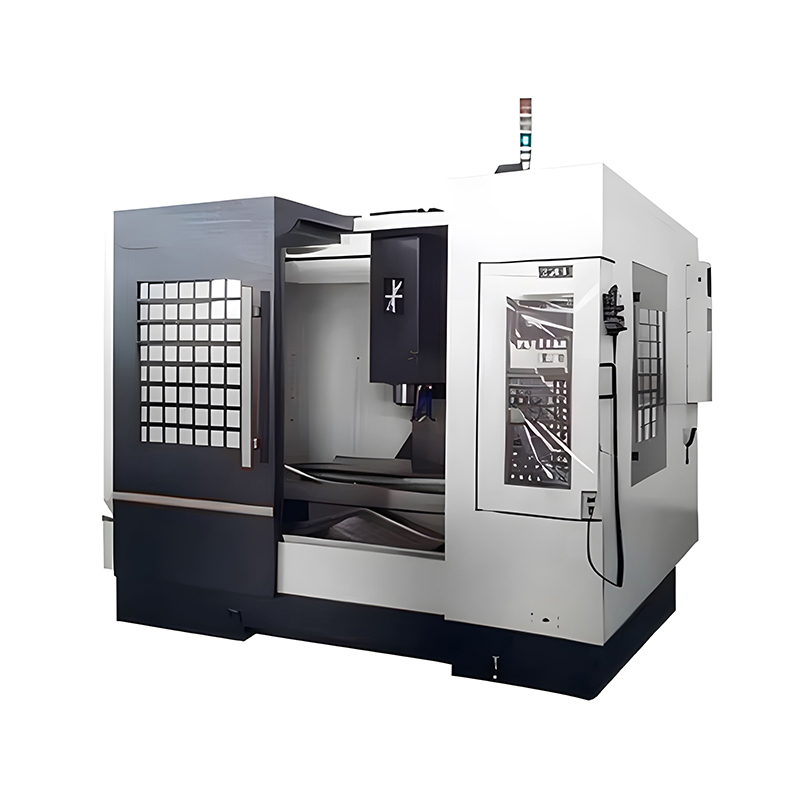 VMC850L High Speed 3 Axis CNC Vertical Machining CenterApplication scenarios and scope of application This machining center is widely used in the production of precision components, including engine parts, hydraulic fittin...View Product →, are usually specified with spindle encoders and synchronized feed for exactly this reason. When a shop moves tapping from a manual drill press to a CNC, the tapping drill size rarely changes, but the tolerance on the drilled hole becomes far more important, because the machine will faithfully reproduce whatever hole the drill produced.
When a Tap Breaks: Getting It Out Without Scrapping the Part
A broken tap in a nearly finished mold or a large weldment is an expensive moment. Most taps are high speed steel or powder metallurgy steel hardened to roughly 60 HRC and above, so drilling them out with a normal bit rarely works and often makes the hole worse by wandering into the parent material.
The reliable route is spark erosion. A small hole popper, or EDM drilling machine, uses a hollow brass or copper tube electrode from about 0.5 mm to 3 mm in diameter to burn away the tap's core. Once the center is gone, the remaining flutes usually collapse inward and can be picked out. There is no cutting force on the workpiece, hardness is irrelevant, and the surrounding thread is normally untouched if the electrode is aligned to the tap center. If you want the background on why this process handles hardened metal so well, our overview of how electrical discharge machining removes hardened metal explains the mechanism in plain terms.
The equipment for this job is compact and does not need a large tank, which is why hole poppers are often the first EDM a mold shop buys. A multi-axis EDM drilling machine such as the  XK-430 High-Speed CNC 5-Axis EDM Drilling MachineApplication scenarios and scope of application Aerospace Turbine Components – Drilling cooling holes in turbine blades and combustion chambers. Mold Die Manufacturing ...View Product → covers exactly this work: broken tap removal, start holes for wire EDM, and small deep holes in hardened steel.
Prevention beats removal. In three cases out of four, the cause is traceable: a tapping drill one size too small, a worn tap that has already cut hundreds of holes, or chips packed at the bottom of a blind hole. Checking the drill diameter with a gauge pin before a run costs seconds.
Hard Alloys and Burr-Free Hole Edges
Above roughly 45 HRC, tapping becomes impractical with conventional tools. Shops either thread mill, which lets a single tool cut several thread sizes and produces clean flanks, or they drill and finish the hole by spark erosion. In aerospace work with titanium and nickel-based superalloys, the same logic applies to the hole itself: small diameter holes at high depth-to-diameter ratios are frequently produced by EDM rather than twist drilling.
Burrs are the other hidden cost. A burr left on a tapped hole edge can break loose later and contaminate a hydraulic circuit or a gearbox. Electrochemical machining removes material atomically at the edge without heat affected zones, which makes it effective for deburring cross-drilled intersections and for finishing edges on parts that cannot tolerate thermal damage. A machine such as the DJ-5000 Advanced Electrochemical Metal Etching MachineApplication scenarios and scope of application Aerospace Defense – Part numbering, serialization, and anti-counterfeit markings. Medical Implants Instruments – Applyin...View Product → is typically applied to that class of work in tool rooms handling difficult alloys.
Tapping Drill Mistakes That Show Up on the Scrap Report
- Using the nearest drill in the cabinet instead of the charted size. A 0.3 mm difference in the wrong direction can double tapping torque.
- Forgetting that fine pitch threads need a larger hole. M10 x 1.25 takes 8.75 mm, not the 8.5 mm used for M10 x 1.5.
- Running a forming tap hole with a cutting tap drill. The hole is too small, torque spikes, and the tap shears.
- Drilling deep holes without pecking, then discovering the hole is tapered and the tap's first threads are cutting a different diameter than its last.
- Skipping lubrication in stainless because the previous job ran dry in cast iron.
- Assuming a drill produces its nominal size. A worn 8.5 mm drill can cut 8.62 mm, which quietly drops engagement to about 60 percent.
The last point deserves emphasis. Drill diameter tolerance and point geometry both affect the hole, and a drill with an off-center point will cut oversize. Measuring a sample hole with a gauge pin or a bore gauge at the start of a batch is far cheaper than finding out after the tap breaks on hole number forty.
What to Check Before Buying Tooling or a New Machine
Purchasing decisions around tapping usually come down to five practical questions, whether you are buying a drill set or a machining center.
- What hole tolerance can the process hold? Compare this against the requirement of your chosen tap type, especially with forming taps.
- Does the machine support synchronized tapping, and what is spindle torque at the rpm you actually intend to run?
- Can chips escape? Through-spindle coolant, peck cycles, and correct tap geometry solve more breakage than any other single change.
- What is the plan when a tap breaks? A shop without any EDM capability ends up scrapping parts that a hole popper would save.
- How rigid is the setup? Tapping is a form of single-point cutting with high radial load, and a fixture that flexes will produce bell-mouthed holes.
Where hardened materials, deep small holes, or highly finished edges are involved, the machine tool technology matters as much as the drill size. A supplier with in-house casting and structural machining capability can usually discuss how the frame and spindle of a machine behave under tapping load, which is exactly the kind of question that decides whether a thread is cut cleanly at 500 rpm or turns into a service call.
Frequently Asked Questions About Tapping Drills
Is a tapping drill the same as a tap drill?
Yes, in everyday use the two terms mean the same thing: the drill that opens the pilot hole for a tap. Some catalogs use "tapping drill" to describe a drill integrated into a tapping attachment, so check the context on the specification sheet before ordering.
What tapping drill size do I need for M8?
For a standard M8 x 1.25 cutting tap, use 6.8 mm. For M8 x 1.0 fine pitch, use 7.0 mm. For a forming tap in M8 x 1.25, use about 7.4 mm.
Can I use any jobber drill as a tapping drill?
Only if the diameter matches the charted value closely enough. Jobber drills are available in fractional, letter, number, and metric sizes, which is precisely why tapping drill charts exist. A drill that is 0.1 mm small can raise tapping torque enough to break a small tap.
How do I check whether the hole is the right size?
Use a gauge pin or a bore gauge on the first few holes of a batch. For a 6.8 mm tapping drill, the hole should accept a 6.8 mm pin with light drag and reject a 6.9 mm pin if tolerance is tight.
What happens if the tapping hole is too large?
Thread engagement drops. At around 50 percent, most joints still hold for general fastening, but the thread strips sooner under load and the crests look flat and incomplete. In safety-critical joints, an oversize hole means rejecting the part.
Can I tap hardened steel?
Not with standard high speed steel taps once hardness goes much above the mid forties on the Rockwell C scale. Thread milling with carbide, or producing the hole by spark erosion and finishing it appropriately, are the usual alternatives.
Why does the tap squeal before it breaks?
Squealing usually signals that the tap is rubbing rather than cutting, often because the hole is undersize, the tap is dull, or lubrication is inadequate. Stop the cycle, inspect the hole diameter, and replace or recondition the tap before continuing.
A tapping drill is a small item with an outsized influence on cost. Get the diameter right, match it to the tap type, hold the hole tolerance, and control the chips, and tapping stops being the operation that ruins parts. Get it wrong and the savings from skipping a gauge pin disappear in one broken tool and one scrapped workpiece.
If your work involves hardened dies, deep small holes, or superalloy parts where conventional tapping runs into a wall, it is worth discussing the process with people who build the machines. You can talk with our engineers about your drilling, tapping, and EDM requirements and get a straight answer on which route fits your parts.
PREV:No previous article
NEXT:What Is an Endmill? Definition, Types, Coatings and CNC Milling Basics
NEXT:What Is an Endmill? Definition, Types, Coatings and CNC Milling Basics
Interested in cooperation or have questions?
News
-
-
An endmill is a rotating cutting tool that removes material with cutting edges on both its cylindrical side and its tip. It is gripped in the spindle through a collet, a hydraulic holder or a shrink-fit holder, spins on its own a...
READ MORE -
Direct answer first: to deburr means to remove the burr, the thin ridge of deformed metal that clings to an edge after cutting, drilling, milling, punching, or laser cutting. The word is simply "de-burr" - take the burr off. It i...
READ MORE -
A die insert arrives on the inspection bench. The drawing specifies the bottom face as datum A, the rear face as datum B, and the left face as datum C. Every pocket, hole, and contour is located from this three-plane system. The ...
READ MORE
Related Products


-
Factory Address
Zhaxi Township Industrial Park, Nantong City, Jiangsu Province, China (west of Huaneng Power Plant)
-
Phone
+86-13615235768
+86-15950816906
-
Fax
+86-513-85632766
-
Email
pan.director@sunwayer.com
Stay Connected
lf you can't find the answer you're looking for, chat with our friendly team.
Stay Connected
Copyright © Nantong Sunway Science and Technology Development Co., Ltd. All Rights Reserved.
China CNC Equipment Manufacturers
Custom CNC Equipment Factory
