


 русский
 Español
Heat treatment is a controlled thermal process that changes the mechanical properties of metal by heating it to a specific temperature, holding it there, and then cooling it at a rate chosen to produce a desired internal structur...
READ MORE
Which CNC machine is best for a beginner? A beginner's guide.
Content
For beginners, the ideal CNC machine isn't necessarily the most powerful one, but rather the one that makes you "confident enough to get started" and has a "high tolerance for errors."
Here are a few types of machines suitable for beginners, along with the reasons why:
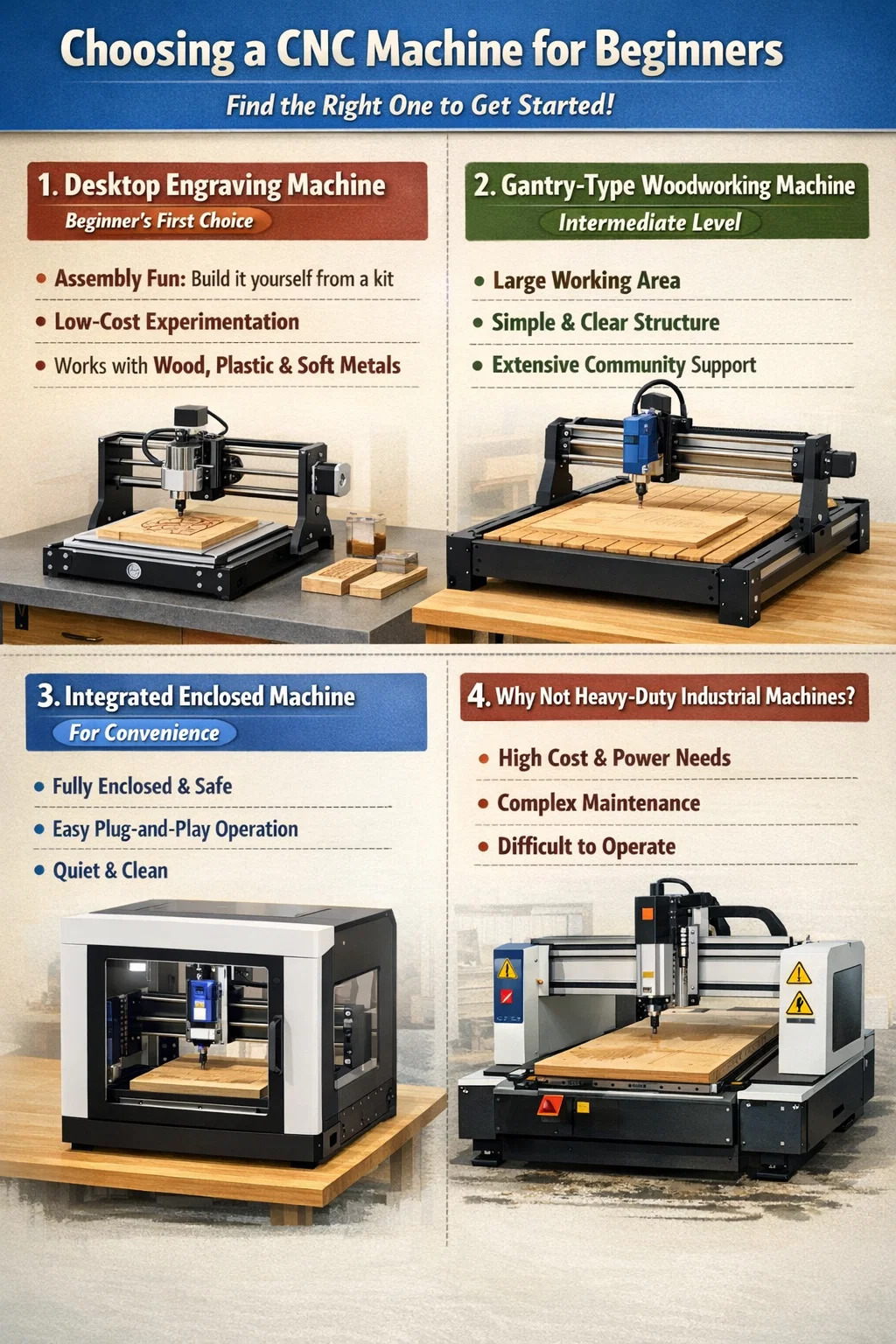
1. Desktop Engraving Machine (Beginner's First Choice)
If you have absolutely no experience and want to try it out at home on your desk or in your garage, this type of machine is the best starting point.
Assembly Fun: Many of these CNC machines are shipped as kits. Assembling it yourself allows you to understand how the guide rails, lead screws, and motors work together from the ground up.
Low-Cost Experimentation: Their unit price is usually low, so if you make a mistake, break a tool, or damage a part, the repair and replacement costs are low, reducing psychological pressure.
Suitable Materials: They are very suitable for processing wood, plastic, acrylic, and can even be used for soft metals (such as aluminum).
2. Gantry-Type Woodworking Engraving Machine (Intermediate Level)
If you've already decided to make furniture, signs, or large-scale crafts, choosing this type of machine will be more practical.
Large Working Area: Its bed is usually quite spacious, allowing you to place a whole piece of wood.
Simple and Clear Structure: Its movements are very intuitive; the movements in the X/Y/Z directions are easy to understand at a glance.
Extensive Community Support: This type of CNC machine has a very large user base, with a wealth of free tutorials and ready-made processing drawings available online. You can easily find answers to your questions with a quick search.
3. Integrated Enclosed Machine (For Convenience)
If you don't want chips flying everywhere during processing, and you don't want to deal with complex wiring, this type of machine is a typical "plug-and-play" option.
Safety Protection: The fully enclosed casing blocks flying chips and coolant, and also reduces noise during operation, making it ideal for indoor or educational environments.
Good Software Support: This type of machine usually comes with a very user-friendly control software, eliminating the need to delve into complex code; it's more like operating a printer.
4. Why is it not recommended for beginners to buy heavy-duty industrial machines directly?
Power and Space Requirements: Industrial-grade CNC machines typically require specialized industrial power supplies and reinforced foundations, which are difficult to accommodate in a typical residential setting.
Maintenance Costs: Every component of an industrial machine is expensive, and a single operational error can result in repair costs that exceed the price of a new entry-level machine.
Operational Complexity: Industrial systems have extremely complex buttons and commands, making independent operation difficult without professional training.
PREV:What are the 5 common types of CNC machines?
NEXT:Why you need a checklist for cnc machine operation (boost precision & safety)?
NEXT:Why you need a checklist for cnc machine operation (boost precision & safety)?
Interested in cooperation or have questions?
News
-
-
An EDM machine, also called an electrical discharge machining machine, uses controlled sparks to erode electrically conductive metal without direct contact between the tool and the workpiece. The workpiece is submerged in a diele...
READ MORE -
Cutting Tools Are Used to Convert Raw Material into Functional Parts Cutting tools are the hardened, wear-resistant elements that shear away unwanted material from a workpiece to create a finished component. They are applied in e...
READ MORE -
A CNC machine can cut, drill, mill, turn, burn, and shape almost any conductive or composite material with an accuracy that manual machines rarely match. The real question is not what a CNC machine can do in theory, but what a sp...
READ MORE
Related Products

-
Factory Address
Zhaxi Township Industrial Park, Nantong City, Jiangsu Province, China (west of Huaneng Power Plant)
-
Phone
+86-13615235768
+86-15950816906
-
Fax
+86-513-85632766
-
Email
pan.director@sunwayer.com
Stay Connected
lf you can't find the answer you're looking for, chat with our friendly team.
Stay Connected
Copyright © Nantong Sunway Science and Technology Development Co., Ltd. All Rights Reserved.
China CNC Equipment Manufacturers
Custom CNC Equipment Factory
