


 русский
 Español
Heat treatment is a controlled thermal process that changes the mechanical properties of metal by heating it to a specific temperature, holding it there, and then cooling it at a rate chosen to produce a desired internal structur...
READ MORE
How much is a 5 axis vertical machining center?
Content
- 1 How Much Does a 5 Axis Vertical Machining Center Cost in 2026?
- 2 What Is a 5 Axis Vertical Machining Center and Why Does Configuration Drive Price?
- 3 Key Factors That Drive the Price of a 5 Axis Vertical Machining Center
- 4 Current 5 Axis Vertical Machining Center Models and 2026 Price Estimates
- 5 2026 Market Trends Affecting 5 Axis Vertical Machining Center Prices
- 5.1 Tariffs Are Adding Real Cost to Imported Machines
- 5.2 IoT Integration, Digital Twins, and Smart Machine Features Are Becoming Standard
- 5.3 Hybrid Additive-Subtractive Machines Are Emerging at Premium Prices
- 5.4 Chinese Manufacturers Gaining Ground in Mid-Range Specifications
- 5.5 EV and Aerospace Demand Is Sustaining Premium Machine Investment
- 6 True Cost of Ownership: What to Budget Beyond the Machine Price
- 7 Industry-Specific Price Expectations in 2026
- 8 New vs Used 5 Axis Vertical Machining Center: 2026 Market Reality
- 9 How to Get the Best Price on a 5 Axis Vertical Machining Center in 2026
- 10 Financing a 5 Axis Vertical Machining Center in 2026
How Much Does a 5 Axis Vertical Machining Center Cost in 2026?
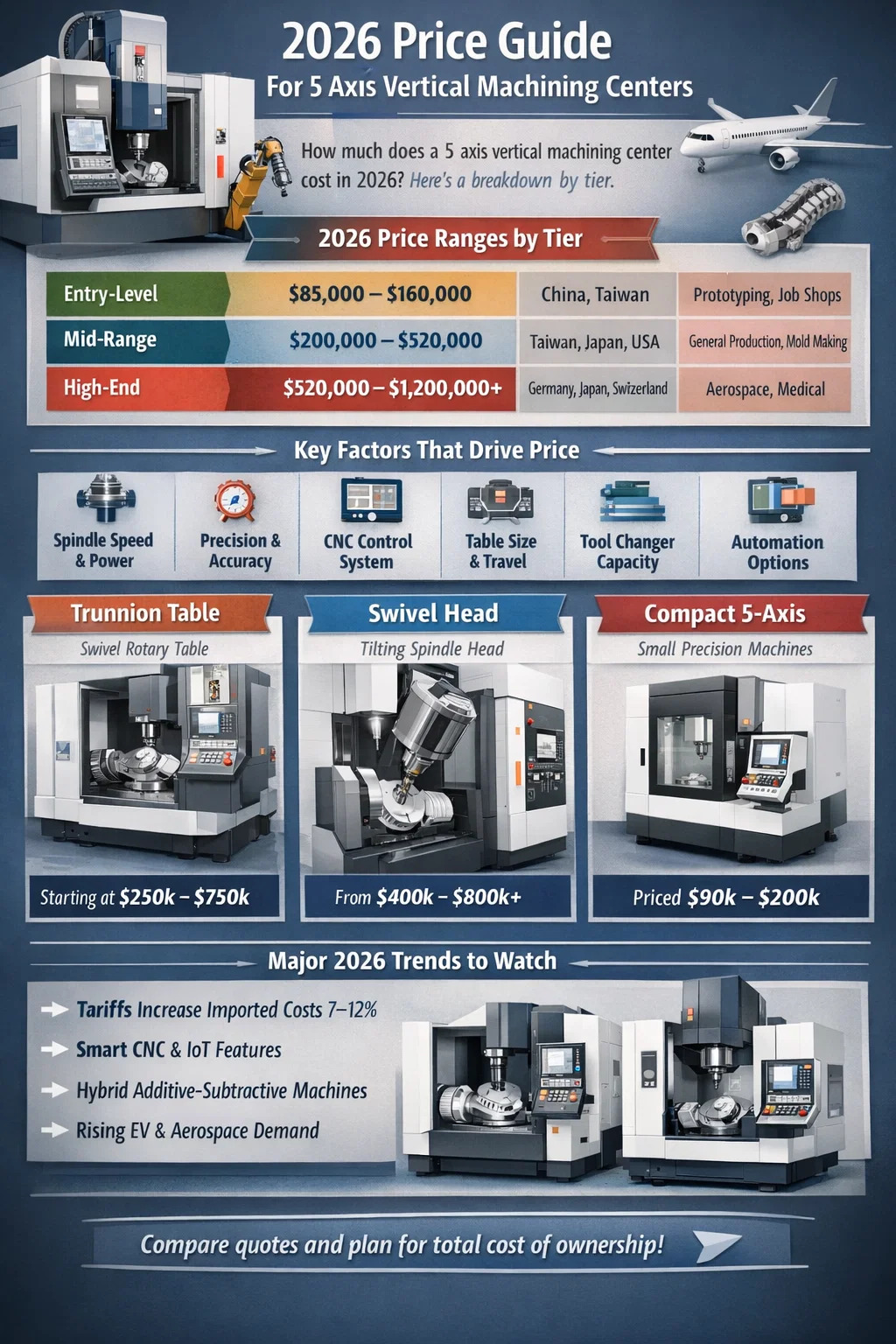
In 2026, a 5 axis vertical machining center typically costs between $85,000 and over $1,200,000, depending on the brand, configuration, table size, spindle performance, and included automation. Entry-level machines from Asian manufacturers start around $85,000–$160,000. Mid-range models from established Taiwanese and Japanese brands fall between $200,000 and $500,000. High-precision machines from European and top-tier Japanese brands — DMG Mori, Makino, Hermle — regularly exceed $600,000 to $1,200,000 when fully configured.
It is worth noting that 2025 U.S. tariff measures introduced upward pressure on imported machine tool components. Tariffs on imported machine tools have increased system costs by 7–12% in key markets, a trend that has carried into 2026 pricing. Buyers sourcing machines from Japan, Germany, or Taiwan should factor this into budget planning and compare landed cost carefully across brands. Some manufacturers have responded by strengthening regional assembly and local service networks to partially offset this exposure.
The global 5-axis CNC machine tool market reached $11.25 billion in 2026, up from $10.16 billion in 2025, reflecting a 10.7% growth rate driven by aerospace, medical, and automotive demand. This market growth, combined with tariff pressure, means list prices on new machines are generally 5–10% higher in 2026 than they were in 2023–2024. Buyers who act before additional trade policy changes should consider locking in quotes now rather than waiting.
| Tier | 2026 Price Range (USD) | Typical Origin | Best For |
|---|---|---|---|
| Entry-Level | $85,000 – $160,000 | China, Taiwan | Prototyping, job shop entry, training |
| Mid-Range | $200,000 – $520,000 | Taiwan, Japan, USA | General production, mold making, automotive |
| High-End | $520,000 – $1,200,000+ | Germany, Japan, Switzerland | Aerospace, medical implants, high-precision parts |
What Is a 5 Axis Vertical Machining Center and Why Does Configuration Drive Price?
A vertical machining center is a CNC machine where the spindle axis runs vertically — perpendicular to the worktable. Adding 5 axis capability means the machine can move the cutting tool or rotate the workpiece along two additional rotary axes (typically labeled A and B, or B and C) alongside the standard X, Y, and Z linear travel. This simultaneous 5 axis motion allows machining of complex curved surfaces, undercuts, and compound angles in a single setup, eliminating the repeated repositioning required on 3-axis machines. The result is fewer fixtures, tighter feature-to-feature tolerances, and dramatically faster throughput on complex parts.
The structural configuration of a 5 axis vertical machining center directly and significantly impacts price. There are three main designs:
Trunnion Table (Swivel Rotary Table)
The workpiece tilts and rotates on the table while the spindle moves in X, Y, and Z. This is the most common configuration for mid-size vertical machining centers handling parts up to approximately 500–630mm in diameter and 200–400kg in weight. Trunnion-style machines offer excellent rigidity for cutting and are widely used in aerospace and automotive component manufacturing. In 2026, quality trunnion-style 5 axis vertical machining centers typically start around $250,000 and reach $750,000 for precision-grade versions with thermal compensation. The Haas UMC series, DMG Mori DMU 50, and Mazak Variaxis all use trunnion configurations at different price points. Haas notes that new UMC-500SS pricing with a 10-pallet pool and 70-station ATC carries a replacement cost exceeding $337,000 — a useful baseline for understanding what a well-equipped mid-range trunnion machine costs in today's market.
Swivel Head (A/B Axis on the Spindle Head)
The rotary axes are located at the spindle head rather than the table, allowing the table to remain stationary while the head tilts and rotates. This design handles large, heavy workpieces that cannot be easily tilted. The Mazak VTC-800/30 series uses a ±110° B-axis swiveling head with a 137.8" × 32.28" long table — ideal for aerospace structural components and large die parts. Swivel-head configurations for mid-to-large vertical machining centers typically start at $400,000 and scale well above $800,000 for long-table gantry variants used in airframe manufacturing. The tradeoff is added mass and mechanical complexity at the spindle head, which requires more rigorous maintenance to preserve accuracy over time.
Compact and Specialized Designs
Compact 5 axis vertical machining centers built for small precision parts — dental components, medical implants, watchmaking, and micro-mold inserts — occupy the lower end of the price spectrum. Machines like the Kitamura MedCenter5AX (featuring a 30,000 RPM HSK-E40 spindle with ±0.001mm positioning accuracy in a 4' × 7' footprint) and the Campro NU-170C (with a 170mm table diameter for high-speed precision work) are examples of purpose-built compact machines. These typically price from $90,000 to $200,000. Their limited axis travel — commonly 170–300mm — makes them unsuitable for structural aerospace or large mold work, but for the right application they deliver exceptional value per dollar.
Key Factors That Drive the Price of a 5 Axis Vertical Machining Center
Understanding what drives price variation helps you evaluate whether a quote represents real value or whether you are paying for capabilities your work will never use. These are the factors that account for the majority of price differences between machines in 2026.
Spindle Speed, Power, and Design
Spindle specifications are among the largest single cost drivers. Standard vertical machining centers operate at 8,000–12,000 RPM — adequate for steel and cast iron. High-speed spindles for aluminum and titanium aerospace parts run 20,000–30,000 RPM, with direct-drive motor spindle assemblies adding $30,000–$80,000 to machine cost. The Kitamura MedCenter5AX runs a 30,000 RPM HSK-E40 integral drive spindle; the Makino D800Z offers a 12,000 or 18,000 RPM HSK-A100 spindle for large die/mold work. Spindle power also matters: a 15 kW (20 hp) spindle is standard, while heavy-duty versions pushing 37–50 kW add significant cost. Matching spindle spec to your material — not simply buying the fastest spindle available — is how experienced buyers avoid overpaying.
Positioning Accuracy and Thermal Compensation
Standard vertical machining centers offer positioning accuracy of ±0.005mm and repeatability of ±0.003mm — sufficient for most general machining. Precision-grade 5 axis machines specify ±0.002mm or better, achieved through linear scales on all axes, high-resolution encoders, and active thermal compensation. The Kitamura MedCenter5AX, for example, specifies positioning accuracy of ±0.001mm with repeatability of ±0.0005mm using 67-million-pulse encoder technology and fine-pitch 16mm ballscrews. Achieving this level of accuracy requires substantially higher component quality throughout the entire machine structure and typically adds 25–50% to base price compared to standard-accuracy alternatives.
CNC Control System
The control system is the brain of any vertical machining center and significantly impacts both usability and price. Haas machines use their proprietary Haas control with Dynamic Work Offsets and Tool Center Point Control for 5-axis work — included as standard and a major reason for their competitive pricing. Fanuc-based controls dominate Japanese and Taiwanese machines and offer reliable RTCP function at mid-range cost. Siemens 840D controls (used on DMG Mori, Chiron, and others) add $15,000–$40,000 over comparable Fanuc setups. Heidenhain TNC controls — favored for high-precision 5 axis simultaneous machining — command the highest premium, adding $20,000–$55,000 over baseline. For shops running 3+2 positional work on simpler geometries, a mid-level Fanuc controller is fully adequate; the Heidenhain premium only pays back for complex simultaneous contouring applications where superior kinematic accuracy and collision avoidance matter.
Table Size and Axis Travel
Larger tables and longer axis travel require larger castings, more powerful drive systems, and more complex structural engineering. A compact 5 axis vertical machining center with 500mm × 400mm × 400mm travel costs significantly less than a machine with 1,000mm × 800mm × 600mm travel even from the same manufacturer. The Campro NU-550 (550mm table, up to 600mm Y-travel with roller-type linear guideways) sits considerably above the compact NU-170C in price for exactly this reason. For context, a mid-range trunnion machine with 630mm × 500mm × 500mm travel from a Japanese manufacturer today costs $350,000–$480,000, while a comparable architecture with 900mm × 700mm × 600mm travel from the same manufacturer prices at $560,000–$720,000.
Automatic Tool Changer Capacity
Standard machines include a 24–32 tool ATC. Expanded magazines — 60, 120, or 240+ tools — enable longer unattended machining cycles and are essential for lights-out manufacturing. Haas offers a 120-pocket side-mount tool changer for the UMC-750 paired with a dual-rack robotic pallet loader, supporting fully unattended production runs. Expanding from 30 to 120 tools typically adds $15,000–$45,000 in 2026. The Campro NU-400C and NU-550 offer up to 40-tool chain-type ATC as an upgrade from the standard 24-tool unit. For shops with high part variety and automation goals, investing in larger ATC capacity at time of purchase almost always costs less than a retrofit.
Automation Readiness and Integrated Pallet Systems
In 2026, automation integration has become a primary purchasing criterion rather than an afterthought. Machines designed from the ground up for automation — with pallet pool interfaces, robot-loading-ready access doors, and integrated part inspection probing — command meaningful premiums but generate rapid payback in high-volume environments. The Haas UMC-500 and UMC-750 are designed with side-window access specifically to accommodate pallet pools and robotic loading systems. The Mazak Variaxis series supports full automated cells. Adding a 10-pallet pool system to a mid-range vertical machining center adds $40,000–$90,000, while a robot-loaded cell integration can add $80,000–$200,000 depending on complexity. Nearly 64% of manufacturers in 2026 are driving purchasing decisions based on automation capability, up sharply from prior years.
Brand Origin and After-Sales Infrastructure
Brand origin still plays a substantial role in 2026 pricing and total cost of ownership. German manufacturers (DMG Mori, Hermle, Chiron) and Japanese manufacturers (Makino, Mazak, Okuma, Kitamura) command premiums reflecting engineering quality, long service life, and global after-sales support. Haas Automation (USA) occupies a unique middle ground — domestically manufactured in Oxnard, California, with extensive Factory Outlet dealer networks and pricing that undercuts comparable Japanese or European specifications by 20–35%. Taiwanese manufacturers (Hartford, Quaser, Awea) deliver strong mid-range value. Chinese manufacturers (SMTCL, KEDE, Haitian Precision) are making increasing inroads in standard-accuracy mid-range machines and remain a force in EV die-casting and domestic Asian markets. Asia-Pacific now accounts for over 45% of global 5-axis simultaneous machining center volume consumption, a share that continues to grow.
Current 5 Axis Vertical Machining Center Models and 2026 Price Estimates
The following table reflects representative 2026 pricing based on current market data. Actual quotes will vary depending on selected options, tooling packages, installation requirements, dealer location, and promotional financing programs. Prices shown are approximate base configurations before options.
| Model | Manufacturer | Config | Spindle RPM | Est. 2026 Price (USD) |
|---|---|---|---|---|
| UMC-500 | Haas (USA) | Trunnion, 400mm platter | 8,100 | $145,000 – $220,000 |
| UMC-750SS | Haas (USA) | Trunnion, 500mm platter | 12,000 | $230,000 – $340,000 |
| DMU 50 (3rd Gen) | DMG Mori | Trunnion, 500mm travel | 14,000–18,000 | $310,000 – $480,000 |
| Variaxis i-500 | Mazak | Trunnion, 500mm table | 12,000–15,000 | $370,000 – $540,000 |
| D500 iA 5AX | Makino | Trunnion, 500mm table | 20,000 | $430,000 – $640,000 |
| D500/5AX | Hermle | Trunnion, high-precision | 18,000–30,000 | $540,000 – $800,000 |
| MedCenter5AX | Kitamura | Compact trunnion, medical | 30,000 | $280,000 – $420,000 |
| VTC-800/30 | Mazak | Swivel head, large table | 18,000 | $500,000 – $780,000 |
Haas machines represent the most transparent pricing in the industry — their build-and-price configurator is publicly accessible, and their policy states that the listed price includes all specified delivery costs with no hidden mandatory charges. Adding a Renishaw probing system, mist collector, chip conveyor, pallet pool, or extended tool magazine can add $20,000–$130,000 to any of these machine orders depending on the options selected. Mazak is also currently offering 0% financing on select machines, making 2026 a favorable time to evaluate financing alongside purchase price.
2026 Market Trends Affecting 5 Axis Vertical Machining Center Prices
Several converging trends are reshaping how 5 axis vertical machining centers are specified, priced, and purchased in 2026. Understanding these trends is critical for anyone making a capital investment decision this year.
Tariffs Are Adding Real Cost to Imported Machines
The 2025 U.S. tariff measures have increased machine tool import costs meaningfully. Tariffs on components and finished machines from Japan, Germany, and Taiwan have driven effective landed costs up by 7–12% compared to pre-tariff baselines. Manufacturers have responded by investing in regional assembly and strengthening local service networks to reduce tariff exposure. Haas Automation, manufacturing entirely in Oxnard, California, is insulated from this pressure, which explains in part why Haas has gained share in the U.S. market during this period. Buyers sourcing from European or Asian manufacturers should request tariff-inclusive landed cost quotes and compare them directly to U.S.-manufactured alternatives.
IoT Integration, Digital Twins, and Smart Machine Features Are Becoming Standard
In 2026, IoT-enabled monitoring, predictive maintenance scheduling via AI algorithms, and digital twin simulation for toolpath verification are no longer premium extras — they are becoming baseline expectations in mid-to-high-range vertical machining centers. DMG Mori's CELOS control platform, Mazak's SmartBox IoT system, and Okuma's OSP control with Machining Navi demonstrate how controls have evolved from pure CNC function to connected manufacturing platforms. Nearly 65% of manufacturers are now prioritizing smart CNC integration when specifying new machines. This software content adds $10,000–$30,000 to machine price but delivers measurable value through reduced unplanned downtime and faster root-cause diagnostics.
Hybrid Additive-Subtractive Machines Are Emerging at Premium Prices
The emergence of hybrid machines combining 5 axis subtractive machining with directed energy deposition (DED) additive manufacturing represents the next frontier in vertical machining center technology. These machines — offered by DMG Mori (LASERTEC series) and Mazak (INTEGREX with hybrid capability) — can build up material with a laser head and then machine it to final specification in a single setup. Prices for hybrid 5 axis machining platforms start above $800,000 and can exceed $2,000,000 for fully configured systems. While the market is still developing, aerospace repair and complex part manufacturing are driving early adoption, and the addressable opportunity is substantial given that the hybrid additive-CNC segment represents a projected $2.1 billion market opportunity by the mid-2020s.
Chinese Manufacturers Gaining Ground in Mid-Range Specifications
A significant trend in 2026 is the rise of capable regional players from China in the mid-range 5 axis vertical machining center market. Companies like KEDE CNC, Haitian Precision, and SMTCL are competing through cost-effective mid-range solutions with Fanuc or Siemens controls and positioning accuracy that would have been considered competitive with Taiwanese machines just five years ago. China's "Smart Manufacturing 2026" government initiative is accelerating both domestic adoption and export competitiveness of Chinese machine tools. For buyers in non-U.S. markets or for applications where tolerances of ±0.005mm are sufficient, Chinese mid-range 5 axis vertical machining centers priced at $120,000–$250,000 deserve serious evaluation. For U.S. buyers, the tariff impact on Chinese-origin machines significantly narrows the landed cost advantage.
EV and Aerospace Demand Is Sustaining Premium Machine Investment
Electric vehicle die-casting — particularly the production of large, complex battery enclosures, motor housings, and structural castings — is generating strong demand for high-rigidity 5 axis vertical machining centers capable of machining aluminum and magnesium alloys with tight tolerances. Simultaneously, commercial aerospace recovery has sustained strong demand for titanium and aluminum structural components requiring high-speed simultaneous 5 axis machining. Nearly 68% of U.S. aerospace and defense manufacturers rely on 5 axis CNC systems for precision components, a figure that has driven capital equipment investment even against the backdrop of tariff pressure and tighter credit conditions.
True Cost of Ownership: What to Budget Beyond the Machine Price
The purchase price of a 5 axis vertical machining center is the most visible cost, but experienced manufacturers evaluate total cost of ownership (TCO) over a 10–15 year machine life. These downstream costs are real, substantial, and frequently underestimated by first-time 5 axis buyers.
Installation and Site Preparation
A 5 axis vertical machining center requires a level concrete foundation to achieve specified positioning accuracy. Standard shop floor installation costs $5,000–$18,000. A dedicated isolation pad with thermal control and vibration damping in a climate-controlled environment can cost $30,000–$85,000. Electrical supply upgrades (3-phase 200–480V, 50–100A service), compressed air supply, and coolant drainage must also be budgeted. High-precision machines like the Hermle D500 or Kitamura MedCenter5AX may require temperature-controlled environments (±1°C) to achieve their specified accuracy, adding both installation and ongoing HVAC operating cost.
Tooling and Workholding
Initial tooling packages for a new 5 axis vertical machining center commonly run $18,000–$65,000, covering HSK or BT tool holders, cutting tools for roughing and finishing, and workholding fixtures. Five axis machining demands shorter, stiffer tool assemblies to minimize vibration during tilted-axis cuts. Zero-point clamping systems (Schunk, Jergens, 5th Axis Workholding) for efficient 5 axis workholding add $6,000–$25,000 per setup. For shops running diverse part families, building a complete tooling and workholding inventory can represent 15–20% of the machine purchase price as a one-time setup investment.
CAM Software and Post-Processor Development
Simultaneous 5 axis toolpaths require capable CAM software. Leading options in 2026 include Mastercam, Hypermill, Siemens NX CAM, and Catia. Annual license costs range from $5,000 to $28,000 per seat. Vericut simulation software for collision avoidance and program verification adds another $5,000–$15,000 per year. Post-processor development for a new 5 axis vertical machining center — converting CAM output into machine-specific G-code — costs $2,500–$9,000 as a one-time fee. Without proper CAM and simulation, even the most capable 5 axis vertical machining center cannot realize its potential. This is a non-negotiable investment that must be in the budget from day one.
Operator Training
5 axis machining is considerably more complex than 3 axis work. Operators and programmers need training in RTCP (Rotational Tool Center Point) function, kinematic calibration, workpiece coordinate system management, and fixture offset programming for tilted planes. Most manufacturers offer 3–5 day formal training programs at $2,200–$5,500 per person. Developing full in-house 5 axis programming proficiency — where operators can confidently program complex simultaneous toolpaths independently — typically takes 9–18 months of hands-on production experience. Haas's well-documented control interface and extensive online training resources (including their "Don't Fear 5-Axis" video series) are specifically noted by customers as helping shorten this learning curve.
Maintenance, Service Contracts, and Spindle Life
Annual preventive maintenance for a 5 axis vertical machining center from a major manufacturer costs $5,500–$16,000 per year, covering spindle inspection, axis calibration, lubrication, and control diagnostics. Full-coverage service contracts run $16,000–$38,000 per year. Over a 10-year machine life, maintenance costs add $80,000–$220,000 to total investment. Spindle rebuilds — the most expensive unplanned maintenance item — cost $15,000–$65,000 when required. Buying a cheaper machine from a manufacturer with limited local service infrastructure can result in 2–4 week response times for critical repairs, costing far more in lost production than the initial savings on machine price.
| Cost Category | Estimated Range (USD) |
|---|---|
| Machine Purchase Price | $350,000 |
| Installation and Site Prep | $10,000 – $40,000 |
| Initial Tooling and Workholding | $25,000 – $65,000 |
| CAM Software (10 yr) | $60,000 – $120,000 |
| Operator Training | $8,000 – $20,000 |
| Maintenance and Service (10 yr) | $80,000 – $180,000 |
| Total 10-Year Ownership Cost | $533,000 – $775,000 |
Industry-Specific Price Expectations in 2026
Different industries drive very different purchasing decisions, reflecting the specific performance requirements of each application.
Aerospace
Aerospace manufacturers working with aluminum structural components, titanium brackets, and nickel alloy turbine parts invest in 5 axis vertical machining centers in the $420,000–$950,000 range in 2026. These machines need AS9100-traceable calibration, high-speed spindles (20,000+ RPM for aluminum), high-torque capability for titanium, large tool magazines for complex multi-feature parts, and thermal compensation for long cutting cycles. The Mazak VTC-800/30SDR with dual synchronized rotary tables is specifically designed for aerospace components requiring high-accuracy simultaneous 5 axis machining and high material removal rates. Makino's SGI.5 technology delivers 20–60% faster cycle times on complex aerospace contouring — a tangible production advantage that justifies premium machine pricing for high-volume aerospace shops.
Medical Device Manufacturing
Medical device manufacturers machining orthopedic implants, surgical instruments, and dental components need surface finish capability of Ra 0.2–0.4 µm on titanium and micron-level positioning accuracy. The Kitamura MedCenter5AX — with its 30,000 RPM spindle, ±0.001mm positioning accuracy, and ultra-compact footprint suitable for ISO-certified cleanroom-adjacent environments — is specifically designed for this application. Machines in the $280,000–$700,000 range dominate medical implant production, with top-end machines from Röders and Hermle serving the highest-precision requirements. The ability to machine titanium alloy (Ti-6Al-4V) with consistent surface finish over thousands of parts drives investment in machines with high dynamic stiffness and active vibration control.
Automotive and EV Manufacturing
Automotive shops machining engine components, suspension parts, and — increasingly in 2026 — EV battery enclosures and motor housings typically invest in 5 axis vertical machining centers in the $260,000–$620,000 range, with emphasis on cycle time, automation integration, and high material removal rates for aluminum. EV die-casting is one of the strongest current demand drivers for 5 axis vertical machining center investment, requiring precise finishing of large, thin-walled aluminum castings with tolerances of ±0.02mm. Mazak, Okuma, and Doosan are popular in this tier, and the trend toward pallet automation and robot-loaded cells is particularly strong in automotive production environments.
Mold and Die Making
Mold makers require high-speed spindle capability (20,000–42,000 RPM for micro-milling hardened steel), excellent surface finish on tool steel at 50–62 HRC, and high-accuracy contouring for complex cavity surfaces. Machines in the $320,000–$850,000 range from Makino, Röders, and Hermle dominate this application. The D800Z from Makino, with its 12,000 or 18,000 RPM HSK-A100 spindle and large machining envelope, is described as ideal for high-performance die/mold shops handling large part 5 axis machining. Surface finish requirements in mold making — achieving Ra 0.05–0.2 µm directly off the machine — demand machines with high structural damping and precise axis control that lower-price alternatives cannot consistently deliver.
General Job Shops and Contract Manufacturers
Job shops adding 5 axis capability for the first time in 2026 most commonly invest in the $175,000–$420,000 range, seeking versatile machines capable of handling aluminum, steel, and stainless steel across a wide variety of part types. The Haas UMC-500 and UMC-750 series dominate this segment in the U.S. due to their competitive pricing, familiar control interface (shared with Haas 3-axis VF series), and extensive dealer network. Haas customers repeatedly cite the ability to complete jobs in 1–2 setups that previously required 4–10 setups on 3-axis machines as the primary payback driver — a finding consistent with the broader industry data showing 58% of industrial users reporting higher productivity gains through simultaneous machining.
New vs Used 5 Axis Vertical Machining Center: 2026 Market Reality
The used 5 axis vertical machining center market in 2026 shows machines from 2013–2020 available at prices that look attractive on the surface. A 2016–2018 DMG Mori DMU 50 or Mazak Variaxis, originally purchased at $350,000–$450,000, currently appears on the secondary market at $80,000–$180,000 depending on spindle hours and condition. A 2017 DMG Mori CMX 50 U 5-axis VMC is currently listed at $99,500. Used Brother Speedio M140X2 (4+1 axis) units with Renishaw probing and mist collectors are appearing at $75,500. These prices attract buyers, but the risks require careful management.
- Spindle wear is the most expensive hidden risk. A worn spindle on a 5 axis vertical machining center costs $15,000–$65,000 to rebuild or replace. Machines that ran continuous production shifts may have 20,000–40,000+ spindle hours — at or near end-of-life without disclosure. Insist on documented spindle hour history.
- Rotary axis backlash in A/B/C axes is especially damaging to 5 axis accuracy. Worn worm gear drives or cycloidal rotary mechanisms with measurable backlash can render a machine unsuitable for true simultaneous 5 axis work, even if the X/Y/Z linear axes test acceptably. A ballbar test on the rotary axes is non-negotiable before purchase.
- Ball screw and linear guide wear affects positioning accuracy in ways that are not visible during casual inspection. Even a machine that appears to run smoothly may have 0.02–0.05mm of backlash in worn ball screws — far outside tolerance for precision 5 axis work on aerospace or medical parts.
- Obsolete controls on machines from 2005–2012 may no longer be supported by the manufacturer, making repairs, new post-processor development, and CAM compatibility problematic or impossible.
- Tariff considerations on re-imported machines can apply in some circumstances — verify duty treatment with your customs broker before finalizing a cross-border used machine purchase.
Always hire a certified machine tool appraiser to perform a full ballbar test, spindle analysis, and axis accuracy verification before committing to a used 5 axis vertical machining center purchase. Budget $10,000–$35,000 as a reserve for pre-purchase inspection and immediate refurbishment items. A used machine with verified accuracy and documented low spindle hours represents excellent value; an uninspected used machine is frequently far more expensive than a new one once repair costs are tallied.
How to Get the Best Price on a 5 Axis Vertical Machining Center in 2026
Purchasing a 5 axis vertical machining center is a capital investment negotiation, not a commodity transaction. The following approaches consistently help buyers achieve better outcomes in the current market.
- Compare tariff-inclusive landed cost, not list price. In 2026, the effective price of an imported 5 axis vertical machining center is 7–12% higher than list price after tariff and compliance costs are factored in. Evaluate total delivered and installed cost — not the number on the manufacturer's spec sheet — when comparing Japanese, German, or Taiwanese machines against domestically manufactured alternatives like Haas.
- Get competitive quotes from at least three manufacturers. Dealers know that losing a $300,000–$500,000 deal has real consequences. Documented competing quotes give you negotiating leverage. Discounts of 5–15% from list price are common when buyers demonstrate they are seriously evaluating alternatives.
- Consider 0% manufacturer financing programs. Mazak is currently offering 0% financing on select machines meeting applicable terms — a meaningful benefit when competing against standard bank financing at 6–9%. Always compare manufacturer financing programs against bank equipment loans before signing. The effective cost advantage of 0% financing on a $400,000 machine over 36–48 months is substantial.
- Time your purchase for trade show and year-end cycles. IMTS 2026 (September 14–19, Chicago) will feature Kitamura, Mazak, Makino, DMG Mori, and most major manufacturers with demo machines, promotional pricing, and show-special financing. Demo and showroom machines from IMTS typically carry 15–25% price reductions from list with full warranty and less than 200 hours of use. Year-end Q4 purchases also frequently unlock dealer discount authority as salespeople work to close annual targets.
- Bundle all options at initial purchase rather than retrofitting later. ATC upgrades, probing systems, coolant-through-spindle, chip conveyors, and pallet changers added at the time of original purchase almost always cost less than post-sale retrofits. Manufacturers are more willing to bundle options into an initial sale than to sell them separately after the machine is delivered.
- Negotiate service and training into the deal rather than taking a straight cash discount. Extended warranty (from 1 year to 2–3 years), free operator training, post-processor development, and discounted preventive maintenance for years 1–2 have real dollar value that is often easier for manufacturers to offer than straight price reductions. A 2-year warranty extension on a $400,000 machine that would otherwise cost $12,000/year to service is worth $12,000 — equivalent to a 3% additional discount.
- Evaluate the One Big Beautiful Bill Act tax provisions. Mazak specifically references the current U.S. legislative environment (the "One Big Beautiful Bill Act") as potentially enhancing the financial case for capital equipment investment through favorable depreciation treatment. Consult your accountant about current Section 179 expensing limits and bonus depreciation provisions before finalizing machine purchase timing for the 2026 tax year.
Financing a 5 Axis Vertical Machining Center in 2026
Most purchasers of 5 axis vertical machining centers use financing rather than outright cash purchase, and 2026 offers several structures worth understanding before you commit to a deal.
Equipment Financing Loan
Banks, credit unions, and specialty equipment lenders offer 5–7 year loans for machine tool purchases. For well-qualified manufacturing businesses in 2026, rates commonly range from 6.5–9.5% for 5–7 year terms depending on credit profile and loan size. On a $400,000 machine financed at 7.5% over 60 months, monthly payments run approximately $8,000–$8,200. The machine is owned outright at end of term, and Section 179 depreciation may allow full-year expense deduction in the purchase year — consult your accountant for current limits and eligibility conditions.
Manufacturer Promotional Financing
Mazak is currently advertising rates as low as 0% on select machines for qualified buyers meeting applicable terms. DMG Mori, Makino, and Haas periodically offer similar promotional programs, particularly at trade show events like IMTS. These programs can be substantially better than bank financing — 0% financing on a $400,000 machine over 36 months saves approximately $40,000–$60,000 in interest compared to a 7.5% bank loan. Always read the fine print: promotional financing often requires specific machine models, delivery within a defined window, and minimum down payment.
Operating Lease
An operating lease allows use of a 5 axis vertical machining center for 3–5 years with the option to return, upgrade, or purchase at residual value. Monthly payments are lower than loan payments since no equity is being built. Operating leases appeal particularly to shops that want to refresh technology every 5 years — given how rapidly 5 axis vertical machining center technology is advancing in areas like IoT integration, control capability, and spindle performance, a 5-year refresh cycle keeps shops current without the depreciation risk of owning aging equipment. Lease payments are typically fully deductible as operating expenses, providing a favorable cash flow and tax treatment compared to loan amortization.
PREV:Cutters Used on Vertical Milling Machines: Complete Guide
NEXT:How does a vertical machine work?
NEXT:How does a vertical machine work?
Interested in cooperation or have questions?
News
-
-
An EDM machine, also called an electrical discharge machining machine, uses controlled sparks to erode electrically conductive metal without direct contact between the tool and the workpiece. The workpiece is submerged in a diele...
READ MORE -
Cutting Tools Are Used to Convert Raw Material into Functional Parts Cutting tools are the hardened, wear-resistant elements that shear away unwanted material from a workpiece to create a finished component. They are applied in e...
READ MORE -
A CNC machine can cut, drill, mill, turn, burn, and shape almost any conductive or composite material with an accuracy that manual machines rarely match. The real question is not what a CNC machine can do in theory, but what a sp...
READ MORE
Related Products

-
Factory Address
Zhaxi Township Industrial Park, Nantong City, Jiangsu Province, China (west of Huaneng Power Plant)
-
Phone
+86-13615235768
+86-15950816906
-
Fax
+86-513-85632766
-
Email
pan.director@sunwayer.com
Stay Connected
lf you can't find the answer you're looking for, chat with our friendly team.
Stay Connected
Copyright © Nantong Sunway Science and Technology Development Co., Ltd. All Rights Reserved.
China CNC Equipment Manufacturers
Custom CNC Equipment Factory
