


 русский
 Español
Heat treatment is a controlled thermal process that changes the mechanical properties of metal by heating it to a specific temperature, holding it there, and then cooling it at a rate chosen to produce a desired internal structur...
READ MORE
How much does a good cnc machine cost?
Content
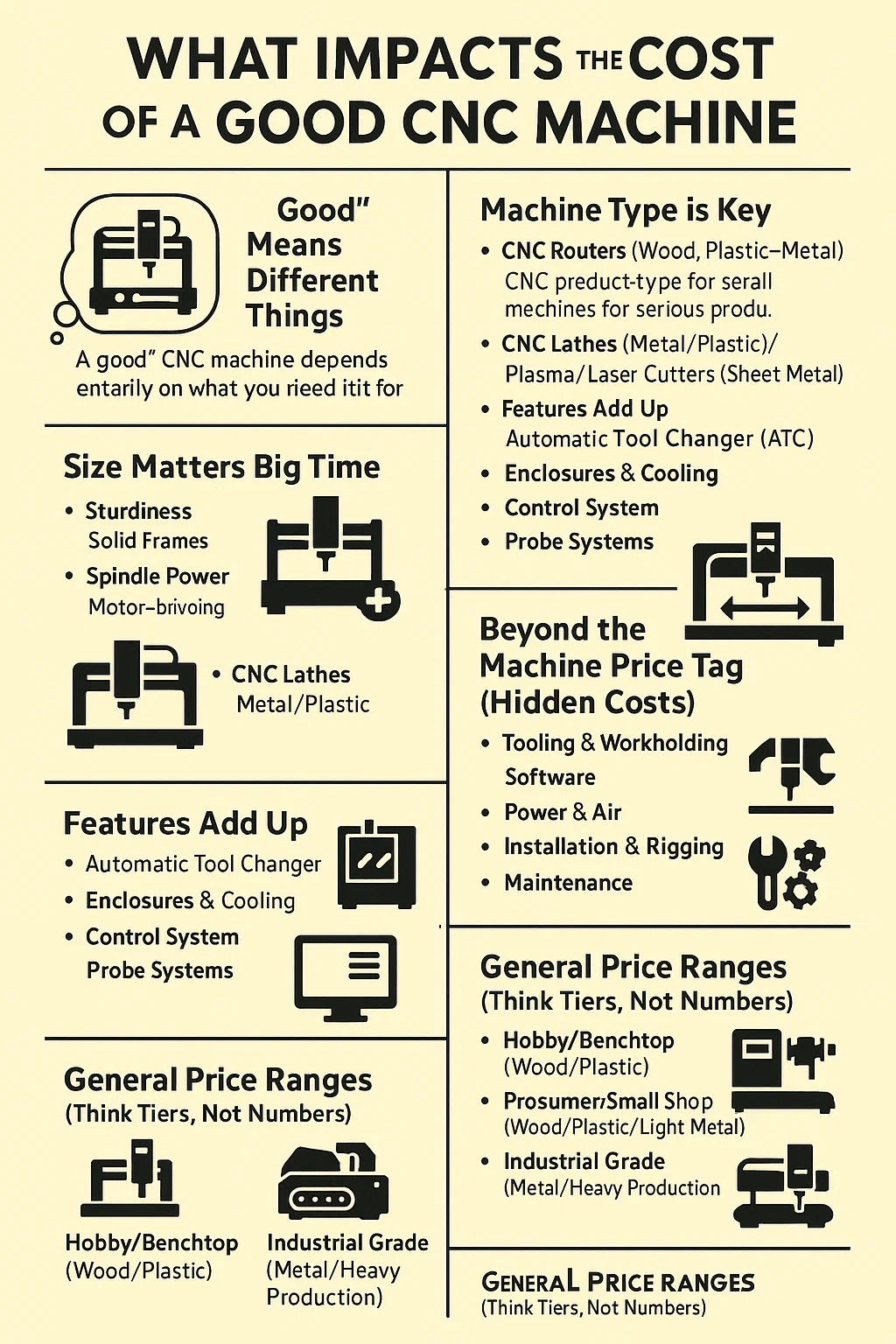
Here's a breakdown of what impacts the cost of a good CNC machine:
●"Good" Means Different Things:
•A "good" CNC machine depends entirely on what you need it for. A machine perfect for detailed woodworking in a home shop wouldn't be "good" for cutting thick steel plates in a factory, and vice versa.
●Machine Type is Key:
•CNC Routers (Wood, Plastic, Light Metal): Good quality hobby/small shop tabletop models cost less than industrial ones. Larger, sturdier machines for serious production work or tougher materials cost significantly more. Benchtop CNC routers are the most common entry point.
•CNC Mills (Machining Centers - Metal): These are generally more expensive than routers. Good quality small shop CNC mills (sometimes called "bench mills" or "toolroom mills") cost more than a router of similar size. Full-sized industrial CNC machining centers represent a major investment.
•CNC Lathes (Metal/Plastic): Similar to mills, small CNC lathes exist at a higher starting point than routers, with industrial turning centers being very costly. Good small CNC lathes are often sought after for precision parts.
•Plasma/Laser Cutters (Sheet Metal): Good CNC plasma tables for steel start higher than hobby routers. Industrial plasma or laser cutting CNC machines jump up substantially in price.
●Size Matters Big Time:
•The physical work area (how big a part it can handle) is a huge cost factor. A small benchtop CNC machine costs much less than a large-format model capable of handling sheet goods or big metal blocks. •Expect price to rise sharply as the cutting area increases.
●Build Quality & Power:
•Sturdiness: Machines built from heavy cast iron or welded steel frames cost more than lighter aluminum or bolt-together kits. A rigid CNC machine is essential for accuracy, especially cutting metal.
•Spindle Power: The motor driving the cutting tool. More horsepower (especially for metal CNC mills or tough materials) means a higher price tag. Spindle quality impacts precision and lifespan.
•Drive Systems: Precision ballscrews and strong motors (servo or stepper) cost more than basic leadscrews and weaker motors. This affects speed, accuracy, and ability to handle tough cuts.
●Features Add Up:
•Automatic Tool Changer (ATC): Lets the CNC machine swap tools by itself. This is a major convenience and productivity booster, adding significantly to the cost.
•Enclosures & Cooling: Full metal enclosures with coolant systems (essential for many metalworking CNC machines) increase cost but improve safety and part quality.
•Control System: Advanced touchscreen controls with more features cost more than basic interfaces. The "brain" of the CNC machine matters.
•Probe Systems: For automated tool setting or part measurement, adding cost but improving precision and setup speed.
●Beyond the Machine Price Tag (Hidden Costs):
•Tooling & Workholding: Cutting bits (end mills, drills), tool holders, vises, clamps, fixtures – essential accessories add hundreds to thousands to your total CNC machine investment.
•Software: You'll likely need CAD (drawing) software and CAM (toolpath programming) software. Good CAM software can be a major expense.
•Power & Air: Industrial CNC machines may need special electrical hookups (like 3-phase power) or compressed air lines.
•Installation & Rigging: Getting a large machine into your shop and set up might require professionals.
•Maintenance: Budget for regular upkeep and eventual repairs to keep your CNC machine running well.
●General Price Ranges (Think Tiers, Not Numbers):
•Hobby/Benchtop (Wood/Plastic): Least expensive tier, but still a significant purchase for an individual. Often smaller benchtop CNC routers.
•Prosumer/Small Shop (Wood/Plastic/Light Metal): A big step up in quality, size, and capability (and cost). Includes robust benchtop CNC mills/routers and small industrial units.
•Industrial Grade (Metal/Heavy Production): Represents a very serious business investment. Expect high costs for full-sized CNC machining centers, turning centers, or large industrial routers/plasma tables.
Interested in cooperation or have questions?
News
-
-
An EDM machine, also called an electrical discharge machining machine, uses controlled sparks to erode electrically conductive metal without direct contact between the tool and the workpiece. The workpiece is submerged in a diele...
READ MORE -
Cutting Tools Are Used to Convert Raw Material into Functional Parts Cutting tools are the hardened, wear-resistant elements that shear away unwanted material from a workpiece to create a finished component. They are applied in e...
READ MORE -
A CNC machine can cut, drill, mill, turn, burn, and shape almost any conductive or composite material with an accuracy that manual machines rarely match. The real question is not what a CNC machine can do in theory, but what a sp...
READ MORE
Related Products

-
Factory Address
Zhaxi Township Industrial Park, Nantong City, Jiangsu Province, China (west of Huaneng Power Plant)
-
Phone
+86-13615235768
+86-15950816906
-
Fax
+86-513-85632766
-
Email
pan.director@sunwayer.com
Stay Connected
lf you can't find the answer you're looking for, chat with our friendly team.
Stay Connected
Copyright © Nantong Sunway Science and Technology Development Co., Ltd. All Rights Reserved.
China CNC Equipment Manufacturers
Custom CNC Equipment Factory
