


 русский
 Español
Heat treatment is a controlled thermal process that changes the mechanical properties of metal by heating it to a specific temperature, holding it there, and then cooling it at a rate chosen to produce a desired internal structur...
READ MORE
What Is Custom Manufacturing? Processes, Benefits & CNC Equipment
Content
- 1 What Is Custom Manufacturing: A Direct Answer
- 2 How Custom Manufacturing Differs from Mass Production
- 3 The Core Processes Used in Custom Manufacturing
- 4 Industries That Rely on Custom Manufacturing
- 5 The Custom Manufacturing Process: From Inquiry to Delivery
- 6 The Role of CNC Equipment in Modern Custom Manufacturing
- 7 Advantages of Custom Manufacturing
- 8 Challenges and Trade-offs in Custom Manufacturing
- 9 How to Choose the Right Custom Manufacturer
- 10 When Custom Manufacturing Is the Right Choice
What Is Custom Manufacturing: A Direct Answer
Custom manufacturing is the process of designing, engineering, and producing components or complete products to meet a specific customer's exact requirements — including materials, dimensions, tolerances, quantities, and performance standards. Unlike mass production, which churns out identical items at high volumes for general markets, custom manufacturing starts with the customer's unique need and works backward to create a solution that fits precisely.
This is not a niche concept. Across industries ranging from aerospace and medical devices to consumer electronics and industrial machinery, custom manufacturing has become the default approach whenever off-the-shelf products fall short. When a startup needs a one-of-a-kind circuit board, when a defense contractor requires components built to military specifications, or when a manufacturer needs parts that integrate seamlessly with existing legacy systems — custom manufacturing is the answer.
The defining characteristic is that each production run begins with a client order, not with a forecast. There are no warehouses full of pre-built stock. Every item produced has a named customer behind it, with specific drawings, tolerances, and acceptance criteria attached.
How Custom Manufacturing Differs from Mass Production
Understanding custom manufacturing requires a clear picture of what it is not. Mass production prioritizes volume and cost-per-unit. Factories running mass production lines often operate 24 hours a day with minimal human intervention, producing tens of thousands of identical parts per shift. The economics favor high quantities — the more units produced, the lower the cost per piece.
Custom manufacturing operates on a fundamentally different logic. Production volumes tend to range from single prototypes to batches of a few hundred or a few thousand pieces. Human involvement is significantly higher at every stage — from design consultation and material selection through machining, inspection, and finishing. That higher involvement directly translates to more frequent quality checks and the ability to catch and correct issues before they multiply across thousands of units.
| Factor | Custom Manufacturing | Mass Production |
|---|---|---|
| Production volume | 1 to a few thousand | Tens of thousands to millions |
| Cost per unit | Higher | Lower at scale |
| Design flexibility | Very high | Very low |
| Quality oversight | Frequent, human-led | Automated, statistical |
| Lead time | Longer for initial setup | Faster once tooled |
| Minimum order quantity | None or very low | Often in the thousands |
| Design change cost | Low to moderate | Very high |
One practical example: if you are producing a specialized bracket for an industrial robot arm with a tolerance of ±0.005 inches, mass production tooling would be overkill for a run of 200 units. Custom manufacturing — specifically CNC machining — would handle that run efficiently, with operators verifying dimensional accuracy at multiple checkpoints rather than relying solely on end-of-line statistical sampling.
The Core Processes Used in Custom Manufacturing
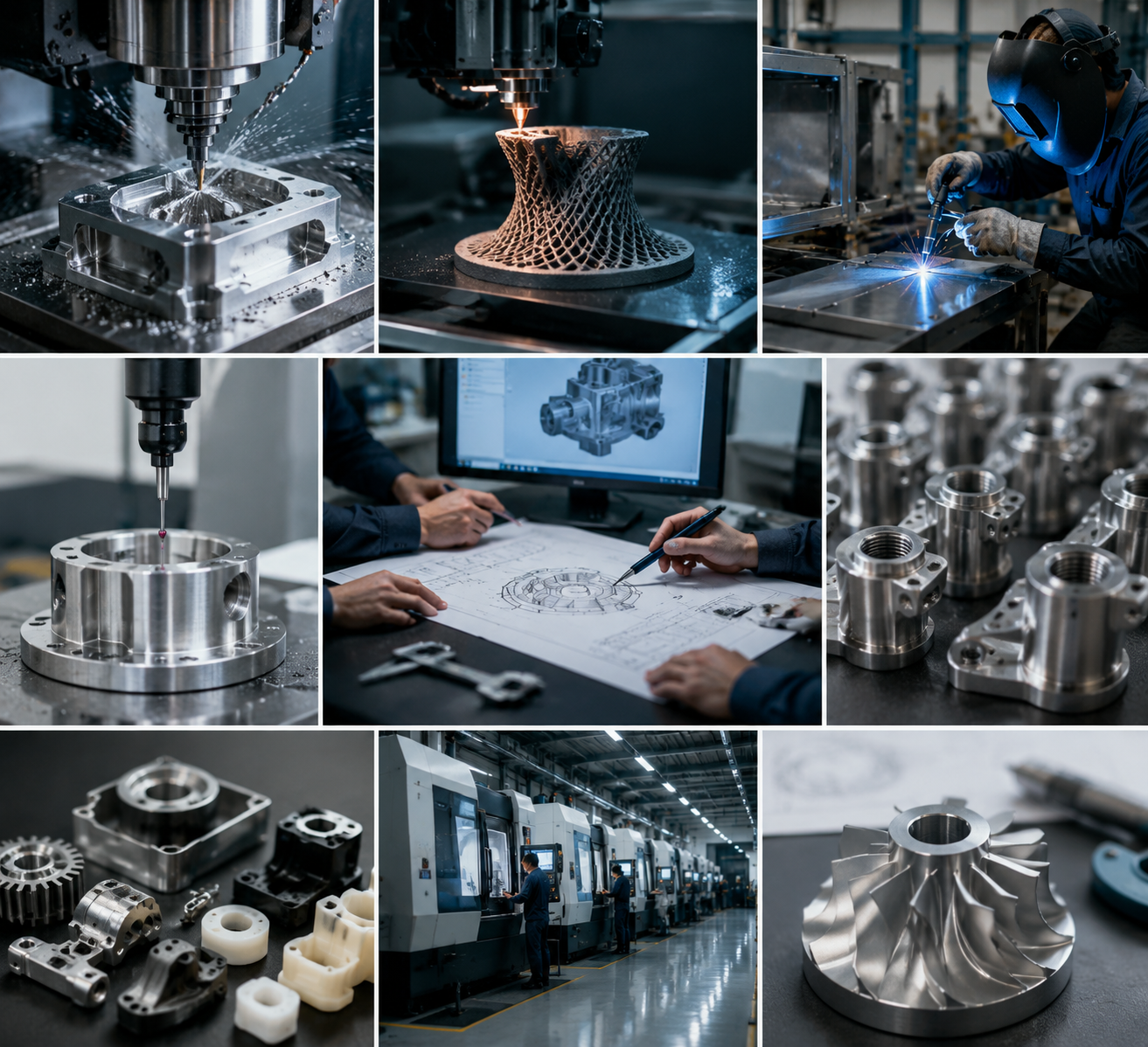
Custom manufacturing is not a single process — it is an umbrella term covering multiple fabrication techniques, each suited to different materials, geometries, and precision requirements. The most commonly used processes include the following.
CNC Machining
Computer Numerical Control (CNC) machining is one of the most widely used processes in custom manufacturing. CNC Equipment operates by following digitally programmed instructions to cut, drill, mill, or turn raw material — typically metal, plastic, or composite — into finished parts with extremely tight tolerances. Modern CNC Equipment can hold tolerances as tight as ±0.001 inches on a consistent basis, making it the go-to method for precision components in aerospace, medical, and defense applications.
CNC Equipment is particularly valuable in custom manufacturing because programs can be modified quickly between runs. If a customer needs a design change between batch one and batch two, the operator updates the digital file rather than retooling an entire production line. This flexibility makes CNC machining ideal for low-to-medium volume custom parts where design iteration is expected. Industries relying heavily on CNC Equipment for custom work include automotive, semiconductor manufacturing, and surgical instrument production.
3D Printing and Additive Manufacturing
Additive manufacturing builds parts layer by layer from digital files, making it exceptionally useful for complex geometries that would be difficult or impossible to machine. For custom prototyping, 3D printing can produce a functional test part in hours rather than days. While material properties in 3D-printed parts have historically lagged behind machined or forged components, advances in industrial-grade filaments and metal sintering processes have brought additive manufacturing into legitimate production use for low-volume custom runs.
Sheet Metal Fabrication
Sheet metal fabrication involves cutting, bending, and welding flat sheet metal into enclosures, brackets, chassis, and structural parts. This process is highly customizable — laser cutters and press brakes can be programmed to produce virtually any shape from customer drawings. Sheet metal custom fabrication is common in electronics enclosures, HVAC equipment, and transportation components.
Custom Injection Molding
While injection molding is often associated with mass production, it is also used in custom manufacturing contexts when a client needs a specific plastic component that does not exist on the market. The mold itself is designed to the customer's geometry, and material selection — from standard ABS to engineering-grade polymers like PEEK — is tailored to the application's temperature, chemical, and mechanical requirements.
Custom Surface Finishing
Many custom manufacturing projects include finishing steps such as anodizing, powder coating, electroplating, or heat treatment. These processes are not cosmetic afterthoughts — they directly affect corrosion resistance, hardness, electrical conductivity, and other performance-critical properties. A custom-manufactured titanium medical implant, for instance, may require a specific surface treatment to promote bone integration.
Industries That Rely on Custom Manufacturing
Custom manufacturing is not limited to high-tech sectors, though it is certainly prominent there. Below are the industries that most consistently depend on it and the reasons why.
Aerospace and Defense
Aircraft and defense systems contain thousands of components with no commercial equivalent. Every part must meet stringent material certifications (such as AMS or MIL-SPEC standards), precise dimensional tolerances, and full traceability documentation. Custom manufacturers working in this sector typically hold AS9100 certification, which governs quality management systems specifically for aerospace. The use of advanced CNC Equipment and rigorous inspection protocols — including coordinate measuring machines (CMMs) — is standard practice.
Medical Devices and Implants
Medical device manufacturing operates under FDA oversight (21 CFR Part 820 in the US) and ISO 13485 quality standards. Implants such as orthopedic screws, spinal cages, and cardiovascular components are machined to patient-specific geometries in some cases, or produced in very small validated batches. The materials — typically titanium alloy, surgical stainless steel, or PEEK — must meet biocompatibility standards. There is no room for deviation in this sector, which is why manufacturers invest heavily in CNC Equipment capable of maintaining tight tolerances over long production cycles.
Electronics and Semiconductors
Custom printed circuit boards, precision heat sinks, RF shielding enclosures, and semiconductor test fixtures are all examples of custom manufactured electronics components. As chip architectures evolve rapidly, the tooling and fixtures required to test and handle them must evolve just as fast — and that requires custom manufacturing partners who can respond quickly to new design requirements.
Industrial Machinery and Automation
Factories building automated production lines often need custom-engineered components — motor mounts, conveyor brackets, robotic end-effectors — that integrate with their specific equipment layout and load requirements. Off-the-shelf catalog parts rarely meet the exact dimensional or material requirements of a custom automation cell. Custom manufacturing fills that gap, often combining CNC-machined metal parts with custom weldments and fabricated assemblies.
Energy and Oil & Gas
Valves, flanges, pressure vessel components, and subsea equipment used in oil and gas operations are typically custom manufactured to meet specific pressure ratings, temperature ranges, and material compatibility requirements. In the renewable energy sector, wind turbine nacelle components and custom solar mounting hardware are also frequently produced through custom manufacturing processes.
The Custom Manufacturing Process: From Inquiry to Delivery
Understanding what custom manufacturing involves at a practical level helps set realistic expectations. The process typically follows these stages, though timelines and specifics vary by project complexity and manufacturer capability.
- Requirements definition: The customer provides drawings, CAD files, material specifications, quantity requirements, and any relevant standards the part must meet. If drawings do not yet exist, some custom manufacturers offer engineering consultation to help develop them.
- Design for manufacturability (DFM) review: The manufacturer reviews the customer's design to identify features that may be difficult or expensive to produce. This step can save significant cost — for example, eliminating an unnecessarily tight tolerance on a non-critical surface can reduce machining time substantially.
- Quoting and material sourcing: Based on the DFM-reviewed drawings, the manufacturer prepares a cost estimate. Material lead times are factored in — certain alloys or specialty plastics may require several weeks to procure.
- Prototyping or first article: For new parts, a first article or prototype is produced and inspected against the drawing. The customer reviews and approves the sample before production quantities are released.
- Production run: With first article approval, production begins. CNC Equipment programs are locked in, operators follow work instructions, and in-process inspection keeps dimensional compliance on track.
- Final inspection and documentation: Finished parts are inspected against acceptance criteria. Certificates of conformance, material certifications, and inspection reports accompany the shipment.
- Delivery: Parts are packaged to prevent damage in transit and shipped to the customer, often with tracking documentation tied to a purchase order and quality records.
Total lead times vary significantly. A simple machined aluminum part might be turned around in 5 to 10 business days. A complex multi-step assembly involving machined components, custom surface treatments, and precision assembly could require 8 to 12 weeks.
The Role of CNC Equipment in Modern Custom Manufacturing
Among all the technologies that enable custom manufacturing, CNC Equipment holds a central position. The term covers a broad family of machine tools — mills, lathes, routers, grinders, EDM machines, and multi-axis machining centers — all of which operate under computer control using G-code programs derived from 3D CAD files.
The impact of modern CNC Equipment on custom manufacturing capabilities is substantial. A 5-axis CNC machining center can produce a complex part in a single setup that previously would have required four or five separate operations and multiple fixtures. That reduction in setups directly translates to better dimensional accuracy (no accumulated re-fixturing error), shorter lead times, and lower labor cost per part.
CNC Equipment enables repeatability that was previously unachievable in custom manufacturing. Once a program is proven on a first article, every subsequent part in the run follows identical toolpaths with the same cutting parameters. For mission-critical industries like aerospace or medical devices, that repeatability is not optional — it is a regulatory requirement.
Investment in CNC Equipment is also a strong indicator of a custom manufacturer's capability. A shop running 3-axis CNC mills and manual lathes is capable of many tasks, but a facility equipped with multi-axis turning-milling centers, high-speed graphite milling machines for EDM electrode production, and automated pallet-changers for lights-out machining can handle far more complex geometries and tighter schedules. When evaluating a custom manufacturing partner, the depth and quality of their CNC Equipment is one of the most reliable proxies for their overall technical capability.
Advantages of Custom Manufacturing
The reasons companies choose custom manufacturing over sourcing mass-produced alternatives are practical and measurable, not abstract. Here are the core advantages with real-world context.
Exact Fit to Application Requirements
Standard catalog parts are designed to satisfy the widest possible range of customers. Custom manufactured parts are designed for one customer's exact application. That difference matters when operating conditions are severe — high temperature, high pressure, chemical exposure, extreme vibration — and standard parts simply cannot deliver the required service life. A pump manufacturer whose impeller operates in a corrosive chemical environment will not find a suitable off-the-shelf part. Custom manufacturing of an impeller in a specific duplex stainless steel alloy, machined to the precise hydraulic geometry required, solves the problem.
Competitive Differentiation
If a company is selling a product that contains only standard, cataloged components, its competitors can source the same components and build functionally identical products. Custom manufactured components — especially when they are the result of proprietary design work — create a barrier to easy imitation. The custom part becomes a product differentiator that competitors cannot easily replicate without their own investment in design and tooling.
Lower Total Cost in the Right Context
Custom manufacturing is often perceived as inherently expensive. That perception is incomplete. A 2012 case documented in the felt manufacturing industry illustrates the point: a customer was paying for an off-the-shelf product and spending additional labor hours modifying it to fit their process. A custom-manufactured replacement cost 17% more per unit, but the elimination of post-purchase modification labor more than offset the price difference. Total cost of ownership — not unit price — is the correct metric.
Design Iteration Without Excessive Penalties
In mass production, changing a design after tooling is completed can cost hundreds of thousands of dollars and weeks of downtime. In custom manufacturing, design changes between production runs typically require only a CAD file update and a revised CNC program — both of which can often be implemented within days. This makes custom manufacturing the right environment for products that are still evolving, or for companies that want to iterate quickly in response to field feedback.
Scalability from Prototype to Production
A custom manufacturer can produce a single prototype part, then scale to 50, then 500, adjusting tooling and process accordingly. The customer does not need to commit to large minimum order quantities to get started, which is particularly valuable for startups and companies launching new product lines where demand forecasting is uncertain.
Challenges and Trade-offs in Custom Manufacturing
Custom manufacturing has real limitations that buyers should understand before engaging a manufacturer. Ignoring these trade-offs leads to unrealistic expectations and project friction.
- Higher unit cost at low volumes: Because each setup, programming effort, and quality inspection is absorbed by a small number of parts, per-unit cost is higher than mass production. For a buyer needing 10 units of a precision housing, this is acceptable. For a buyer needing 100,000 units of a simple bracket, custom CNC machining would be significantly more expensive than an automated stamping line.
- Longer initial lead times: Design consultation, DFM review, first article production, and approval add time before production quantities begin. Projects with urgent timelines may be better served by sourcing near-standard parts where possible.
- Dependence on the manufacturer's expertise: Custom manufacturing quality is tightly linked to the manufacturer's knowledge of materials, processes, and metrology. A manufacturer unfamiliar with the specific alloy or process required for an application may deliver parts that meet dimensional specs but fail in service due to improper heat treatment, surface finish, or material handling. Vetting the manufacturer's track record in the relevant material and industry is essential.
- Tooling investment decisions: For plastic parts, choosing between aluminum tooling (faster, lower upfront cost, limited lifespan) and hardened steel tooling (higher upfront cost, over 1 million cycle lifespan) requires accurate volume forecasting. Choosing the wrong tooling strategy for a given volume can significantly increase total project cost.
- Quality consistency across operators: Because custom manufacturing involves higher levels of human involvement than automated mass production, operator skill variability can affect part-to-part consistency. Reputable custom manufacturers address this through detailed work instructions, calibrated measurement equipment, and documented training records.
How to Choose the Right Custom Manufacturer
Selecting the wrong manufacturing partner is one of the most common and costly mistakes in product development. The following criteria provide a structured framework for evaluation.
Certifications and Quality Systems
ISO 9001 is the baseline quality management certification applicable across industries. AS9100 indicates aerospace-grade quality systems. ISO 13485 is required for medical device manufacturing. These certifications are not guarantees of quality, but they indicate that the manufacturer has documented processes, conducts internal audits, and tracks nonconformances systematically. For regulated industries, working with a non-certified manufacturer is often not an option.
Process Capabilities and CNC Equipment Inventory
Ask prospective manufacturers for a list of their CNC Equipment, including axis counts, work envelope sizes, and spindle specifications. A manufacturer equipped with 5-axis CNC Equipment and in-house CMM inspection is capable of very different work than one running 3-axis mills with only manual gauging. Match the manufacturer's stated capabilities to the actual requirements of your parts — not to their marketing materials.
Industry Experience and Reference Parts
Request examples of similar parts the manufacturer has produced for clients in your industry. A manufacturer with years of experience making components for subsea oil and gas applications will handle corrosion-resistant alloys, documentation requirements, and inspection protocols very differently than a general job shop. Industry-specific experience is particularly critical in aerospace, defense, and medical, where regulatory knowledge directly affects whether parts will be accepted by end customers.
Communication and Engineering Support
The best custom manufacturing relationships are collaborative. A manufacturer who reviews your drawings and proactively identifies design features that will drive cost or quality risk — before quoting — is a far more valuable partner than one who simply quotes whatever is in front of them. Ask how they handle DFM feedback, how quickly they respond to questions, and who your primary point of contact will be during production.
Supply Chain Transparency
Some custom manufacturers are vertically integrated — meaning they perform all major process steps in-house. Others outsource specific operations such as heat treatment, plating, or specialized NDT (non-destructive testing). Neither model is inherently superior, but transparency about what is done in-house versus subcontracted is important for managing quality risk and lead time predictability.
When Custom Manufacturing Is the Right Choice
Not every project benefits from custom manufacturing. Here are the specific scenarios where it is clearly the right path forward.
- You need a component that does not exist in any standard catalog — unique geometry, non-standard material, or application-specific performance requirements make off-the-shelf sourcing impossible.
- You have found catalog parts that partially meet your needs, but combining their best features into a single custom-designed part would reduce assembly complexity, weight, or cost.
- You are in the prototype or early production phase and need the flexibility to make design changes without incurring large tooling penalties.
- Your product operates in a regulated industry (aerospace, medical, defense, nuclear) where traceability, certification, and documentation requirements cannot be met by standard commercial parts.
- Your production volumes are too low to justify mass production tooling investment but too high to make manual fabrication cost-effective — a classic fit for CNC Equipment-based custom manufacturing.
- Your product is a proprietary design that you do not want competitors to easily replicate by sourcing the same standard components.
The decision ultimately comes down to whether the benefits of a precisely matched solution outweigh the higher unit cost and longer initial lead time. For most engineering-intensive products, especially those in critical or specialized applications, the answer is yes.
PREV:What Does CNC Mean? A Complete Guide to CNC Equipment
NEXT:What Software for CNC Router: Best CNC Equipment Programs Guide
NEXT:What Software for CNC Router: Best CNC Equipment Programs Guide
Interested in cooperation or have questions?
News
-
-
An EDM machine, also called an electrical discharge machining machine, uses controlled sparks to erode electrically conductive metal without direct contact between the tool and the workpiece. The workpiece is submerged in a diele...
READ MORE -
Cutting Tools Are Used to Convert Raw Material into Functional Parts Cutting tools are the hardened, wear-resistant elements that shear away unwanted material from a workpiece to create a finished component. They are applied in e...
READ MORE -
A CNC machine can cut, drill, mill, turn, burn, and shape almost any conductive or composite material with an accuracy that manual machines rarely match. The real question is not what a CNC machine can do in theory, but what a sp...
READ MORE
Related Products

-
Factory Address
Zhaxi Township Industrial Park, Nantong City, Jiangsu Province, China (west of Huaneng Power Plant)
-
Phone
+86-13615235768
+86-15950816906
-
Fax
+86-513-85632766
-
Email
pan.director@sunwayer.com
Stay Connected
lf you can't find the answer you're looking for, chat with our friendly team.
Stay Connected
Copyright © Nantong Sunway Science and Technology Development Co., Ltd. All Rights Reserved.
China CNC Equipment Manufacturers
Custom CNC Equipment Factory
