


 русский
 Español
Heat treatment is a controlled thermal process that changes the mechanical properties of metal by heating it to a specific temperature, holding it there, and then cooling it at a rate chosen to produce a desired internal structur...
READ MORE
What Is a CNC Wire Cut Machine? Working Principle & Uses
Content
- 1 What Is a CNC Wire Cut Machine
- 2 How a CNC Wire Cut Machine Actually Works
- 3 Key Components of CNC Wire Cut Equipment
- 4 Types of CNC Wire Cut Machines
- 5 Materials a CNC Wire Cut Machine Can Process
- 6 Industries and Applications
- 7 Advantages and Limitations of CNC Wire Cut Machining
- 8 CNC Wire Cut Machine vs Traditional CNC Machining
- 9 Choosing the Right CNC Wire Cut Equipment
- 10 Operating and Maintenance Best Practices
- 11 Frequently Asked Questions
- 11.1 Is CNC wire cutting the same as laser cutting
- 11.2 What tolerance can a CNC wire cut machine achieve
- 11.3 Can CNC wire cut machines cut thick material
- 11.4 Why does wire EDM use deionized water instead of oil
- 11.5 Does the wire ever touch the workpiece during cutting
- 11.6 How often does the wire need to be replaced
What Is a CNC Wire Cut Machine
A CNC wire cut machine is a piece of CNC Equipment that removes metal by generating controlled electrical sparks between a thin, continuously moving wire electrode and a conductive workpiece, rather than by physical cutting force. The technical name for this process is wire electrical discharge machining, usually shortened to wire EDM. A computer numerical control system drives the wire along a programmed path in deionized water, so the machine can cut extremely hard, brittle, or geometrically complex parts without ever touching them with a blade or bit.
In plain terms: instead of a drill or a mill physically shaving off metal, a CNC wire cut machine uses thousands of tiny electrical sparks per second to vaporize a narrow path through the material. The wire itself never contacts the workpiece directly during cutting, which is why the process can hold tolerances as tight as 0.002 to 0.005 millimeters on well-maintained equipment.
This type of CNC equipment is standard in tool rooms, mold shops, and precision parts manufacturers because it can cut hardened steel, tungsten carbide, and other difficult alloys that would quickly destroy a conventional cutting tool.
How a CNC Wire Cut Machine Actually Works
The working principle behind every CNC wire cut machine follows the same core sequence, regardless of brand or model size. Understanding each stage explains why the process is so precise and why it behaves so differently from milling or turning.
01
Wire Electrode Feed
A thin metal wire, typically brass, zinc-coated brass, or molybdenum, unwinds continuously from a spool and travels through upper and lower guides. Wire diameters commonly range from 0.1 mm to 0.3 mm, and the wire is discarded after a single pass since repeated sparking wears it down.
02
Pulse Power Discharge
A pulse generator applies voltage, often in the range of 100 to 300 volts, between the wire and the workpiece. When the gap becomes small enough, the dielectric fluid breaks down and a spark jumps across, reaching localized temperatures high enough to melt or vaporize the metal instantly.
03
Dielectric Flushing
Deionized water surrounds the cutting zone. It insulates the gap so sparking stays controlled, cools both the wire and the part, and flushes away the microscopic metal particles produced by each discharge so they do not interfere with the next spark.
04
CNC Path Control
The CNC controller reads a programmed toolpath, usually derived from G-code, and drives the worktable or wire head along the X and Y axes, with some machines adding U and V axes for tapered or angled cuts. This is what allows the same CNC equipment to cut a simple slot or an intricate mold cavity with equal accuracy.
Key Components of CNC Wire Cut Equipment
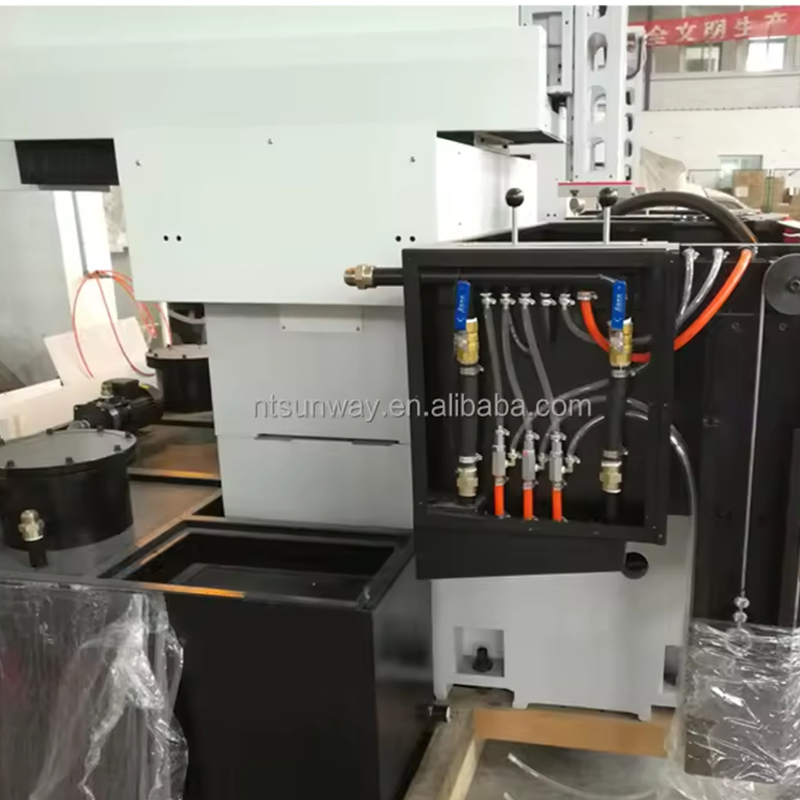
Every CNC wire cut machine, from a small jobbing-shop unit to a large industrial system, is built from the same core subsystems. Knowing what each one does helps when comparing machines or troubleshooting cutting quality.
Worktable
Holds the fixture and workpiece, moving on ball screws driven by stepper or servo motors for precise longitudinal and transverse positioning.
Wire Feed System
Consists of the wire spool, feed motor, tension control, and guide pulleys that keep the wire straight and correctly tensioned during cutting.
Pulse Power Supply
Generates and controls the electrical discharges, adjusting frequency, current, and pulse width to balance cutting speed against surface finish.
Dielectric System
Circulates and filters deionized water, maintaining resistivity within a target range so spark energy stays consistent throughout the job.
CNC Controller
Reads the machining program, coordinates axis motion, monitors gap voltage, and automatically adjusts feed rate to avoid wire breakage.
Frame and Guides
A rigid cast base and precision-ground guide rails minimize vibration, which directly affects the achievable surface finish and roundness.
Types of CNC Wire Cut Machines
CNC wire cut equipment is generally grouped by how many axes it controls and by the type of dielectric fluid it uses. The table below summarizes the main categories found in current production shops.
| Type | Axis Configuration | Typical Use Case |
|---|---|---|
| 2-axis wire EDM | X, Y | Straight-wall cutting, simple profiles, stamping dies |
| 4-axis wire EDM | X, Y, U, V | Tapered walls, upper/lower contour differences, punch and die sets |
| Submerged tank type | Varies | Full dielectric immersion for stable flushing on thick or tall parts |
| Flush-type (non-submerged) | Varies | Faster part loading, common on compact shop-floor machines |
Materials a CNC Wire Cut Machine Can Process
Because the process relies on electrical conductivity rather than mechanical hardness, wire EDM can cut materials that are difficult or impossible to machine with cutting tools. The requirement is simple: the material must conduct electricity.
- Hardened tool steel and die steel, including material already heat-treated to full hardness
- Tungsten carbide, used in stamping punches and wear-resistant tooling
- Titanium and titanium alloys for aerospace and medical components
- Stainless steel in surgical instruments and food-grade parts
- Conductive graphite used for EDM electrodes themselves
- Copper, brass, and other conductive non-ferrous metals
Non-conductive materials such as plastic, ceramic, wood, and glass cannot be cut on this type of CNC equipment, since there is no electrical path for the spark to form.
Industries and Applications
CNC wire cut machines are chosen whenever a part needs sharp internal corners, tight tolerances, or a hardness level that rules out conventional milling. Common application areas include:
Tool and Die Making
Punches, blanking dies, and stamping tools with precise internal profiles and matched clearances.
Aerospace Components
Turbine blade fixtures, fuel system parts, and other components requiring tight dimensional control.
Medical Devices
Surgical instruments, orthodontic hardware, and small implant components with fine geometric detail.
Electronics and Connectors
Micro-cavities, precision connector housings, and small stamped contact parts.
Mold Manufacturing
Injection mold cores and cavities that require sharp corners and hardened steel.
Prototype and Low-Volume Parts
Fast turnaround on one-off or small-batch precision parts without dedicated tooling.
Advantages and Limitations of CNC Wire Cut Machining
Like any CNC equipment, wire cut machining is a strong fit for certain jobs and a poor fit for others. Weighing both sides helps when deciding whether wire EDM is the right process for a part.
Advantages
- Cuts hardened metal after heat treatment, avoiding distortion from post-machining hardening
- No cutting force on the workpiece, so thin or fragile parts stay stable during machining
- Achieves sharp internal corners that a rotating end mill physically cannot produce
- Holds tolerances suitable for precision tooling and mold work
Limitations
- Slower material removal rate than milling for large, open-volume roughing work
- Only works on electrically conductive materials
- Ongoing consumable costs for wire and deionized water treatment
- Requires a through-cut or pre-drilled start hole for internal features
CNC Wire Cut Machine vs Traditional CNC Machining
A common question from buyers evaluating CNC equipment is how wire EDM stacks up against conventional CNC milling or turning. The two processes solve different problems and are frequently used together in the same shop.
| Factor | CNC Wire Cut (EDM) | CNC Milling |
|---|---|---|
| Cutting method | Electrical spark erosion | Physical rotating cutting tool |
| Material hardness limit | None, as long as conductive | Limited by tool material and coating |
| Internal corner sharpness | True sharp corners possible | Limited by cutter radius |
| Removal rate on large volumes | Slower | Faster |
| Best fit | Hardened tooling, dies, precision profiles | Bulk material removal, general shaping |
Choosing the Right CNC Wire Cut Equipment
Selecting the correct machine among available CNC equipment options depends on part size, required tolerance, and expected production volume. A few practical checkpoints:
- Confirm the maximum workpiece thickness and taper angle the machine supports if angled cuts are needed.
- Check whether the control system supports the file formats used by your CAD or CAM software.
- Verify available wire diameter range against the finest detail your parts require.
- Review the automatic wire threading feature, since unattended running depends on reliable re-threading after breaks.
- Compare dielectric filtration and resistivity control, which directly affects repeatable surface finish.
Operating and Maintenance Best Practices
Consistent cutting quality on any CNC wire cut machine depends on routine upkeep rather than one-time setup. Shops that maintain tight tolerances typically follow a short but strict maintenance routine.
Daily: Check dielectric fluid resistivity, inspect wire tension, and clear debris from the filtration system.
Weekly: Inspect wire guides and contact points for wear, since worn guides are a leading cause of positioning drift.
Monthly: Replace dielectric filters on schedule and verify axis calibration against a reference block.
Skipping filtration maintenance is the most frequent cause of inconsistent cut quality, since contaminated dielectric fluid changes spark behavior and can leave visible banding on the finished surface.
Frequently Asked Questions
Is CNC wire cutting the same as laser cutting
No. Wire cutting removes material through electrical spark erosion in a dielectric fluid, while laser cutting uses a focused beam of light to melt or burn through material. Wire EDM also requires the workpiece to be electrically conductive, while laser cutting does not.
What tolerance can a CNC wire cut machine achieve
Well-maintained industrial machines commonly hold tolerances between 0.002 and 0.005 millimeters, though this depends on wire diameter, dielectric condition, and part thickness.
Can CNC wire cut machines cut thick material
Yes. Depending on the machine, thicknesses ranging from a fraction of a millimeter up to several hundred millimeters can be cut, though cutting speed decreases as thickness increases.
Why does wire EDM use deionized water instead of oil
Deionized water offers stable resistivity, effective cooling, and safe operation without the fire risk associated with oil-based dielectric fluids used in some sinker EDM processes.
Does the wire ever touch the workpiece during cutting
No. A small gap is always maintained between the wire and the part. Cutting happens through spark discharge across that gap, not through physical contact.
How often does the wire need to be replaced
The wire is consumed continuously during cutting and is not reused. It feeds from a fresh spool and is collected as scrap after passing through the cutting zone once.
PREV:What Is CNC Programming? Complete Guide + Gantry Milling
NEXT:What Is a CNC Machine? Complete Guide to CNC Equipment
NEXT:What Is a CNC Machine? Complete Guide to CNC Equipment
Interested in cooperation or have questions?
News
-
-
An EDM machine, also called an electrical discharge machining machine, uses controlled sparks to erode electrically conductive metal without direct contact between the tool and the workpiece. The workpiece is submerged in a diele...
READ MORE -
Cutting Tools Are Used to Convert Raw Material into Functional Parts Cutting tools are the hardened, wear-resistant elements that shear away unwanted material from a workpiece to create a finished component. They are applied in e...
READ MORE -
A CNC machine can cut, drill, mill, turn, burn, and shape almost any conductive or composite material with an accuracy that manual machines rarely match. The real question is not what a CNC machine can do in theory, but what a sp...
READ MORE
Related Products

-
Factory Address
Zhaxi Township Industrial Park, Nantong City, Jiangsu Province, China (west of Huaneng Power Plant)
-
Phone
+86-13615235768
+86-15950816906
-
Fax
+86-513-85632766
-
Email
pan.director@sunwayer.com
Stay Connected
lf you can't find the answer you're looking for, chat with our friendly team.
Stay Connected
Copyright © Nantong Sunway Science and Technology Development Co., Ltd. All Rights Reserved.
China CNC Equipment Manufacturers
Custom CNC Equipment Factory
